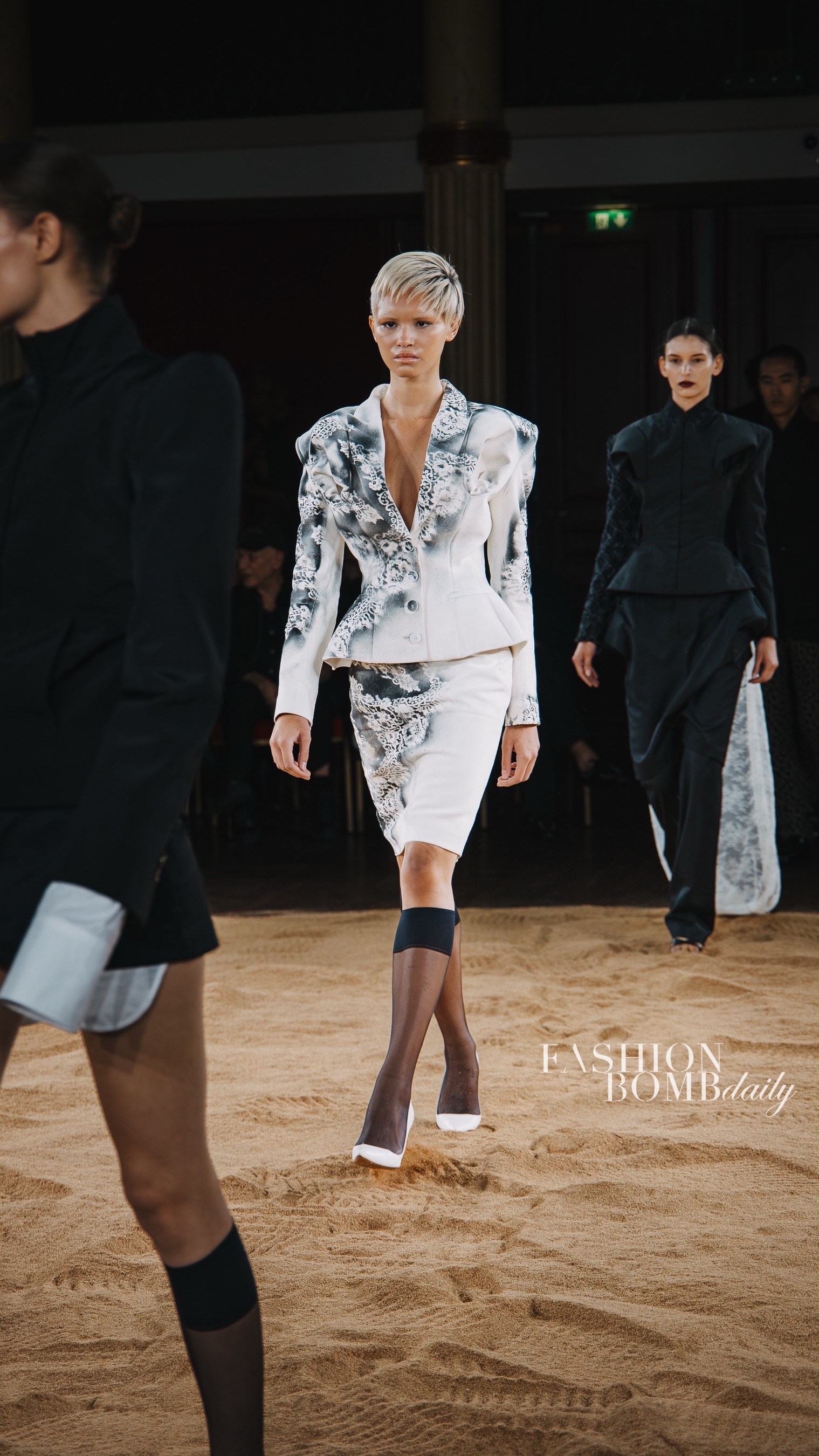
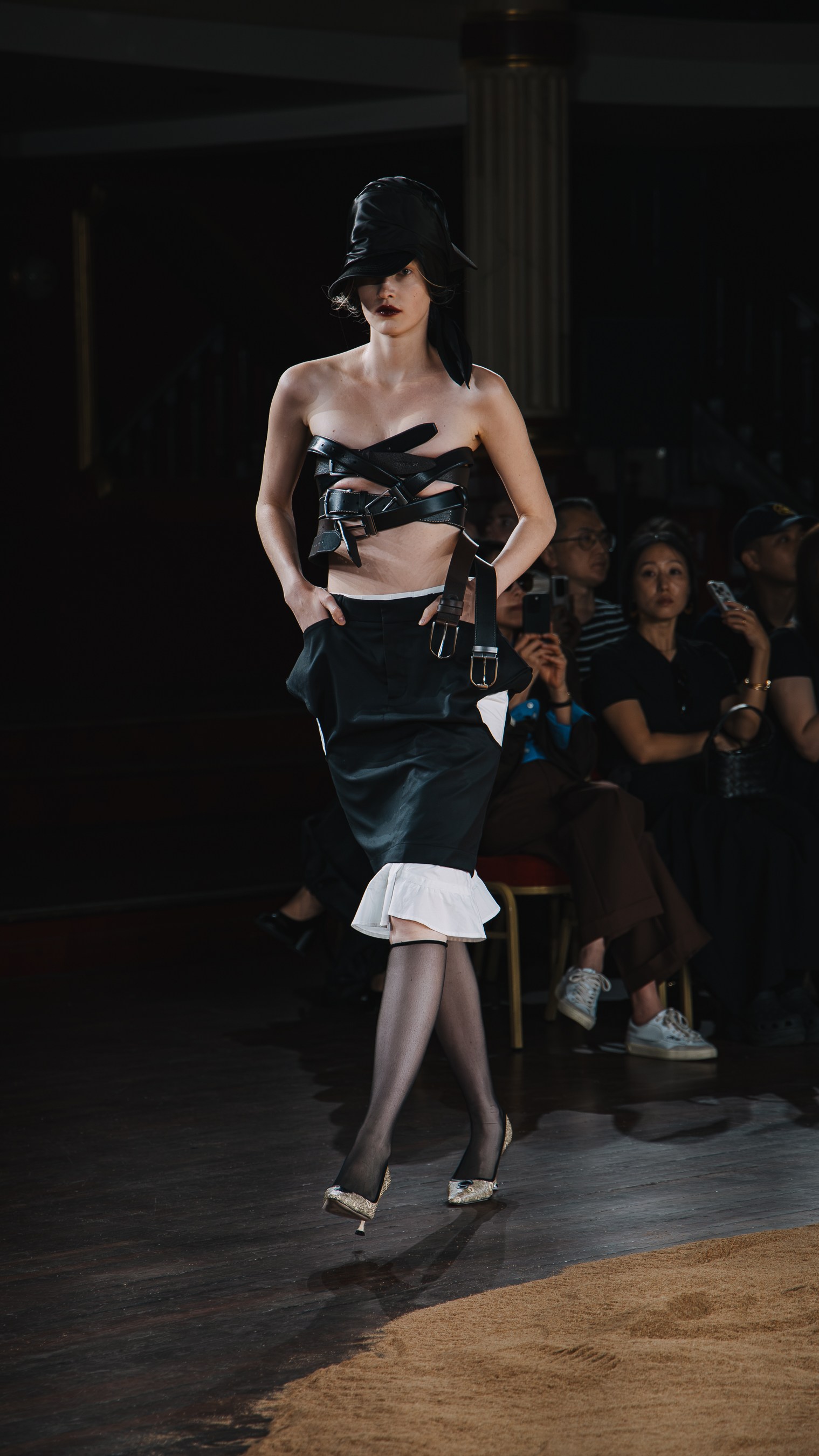
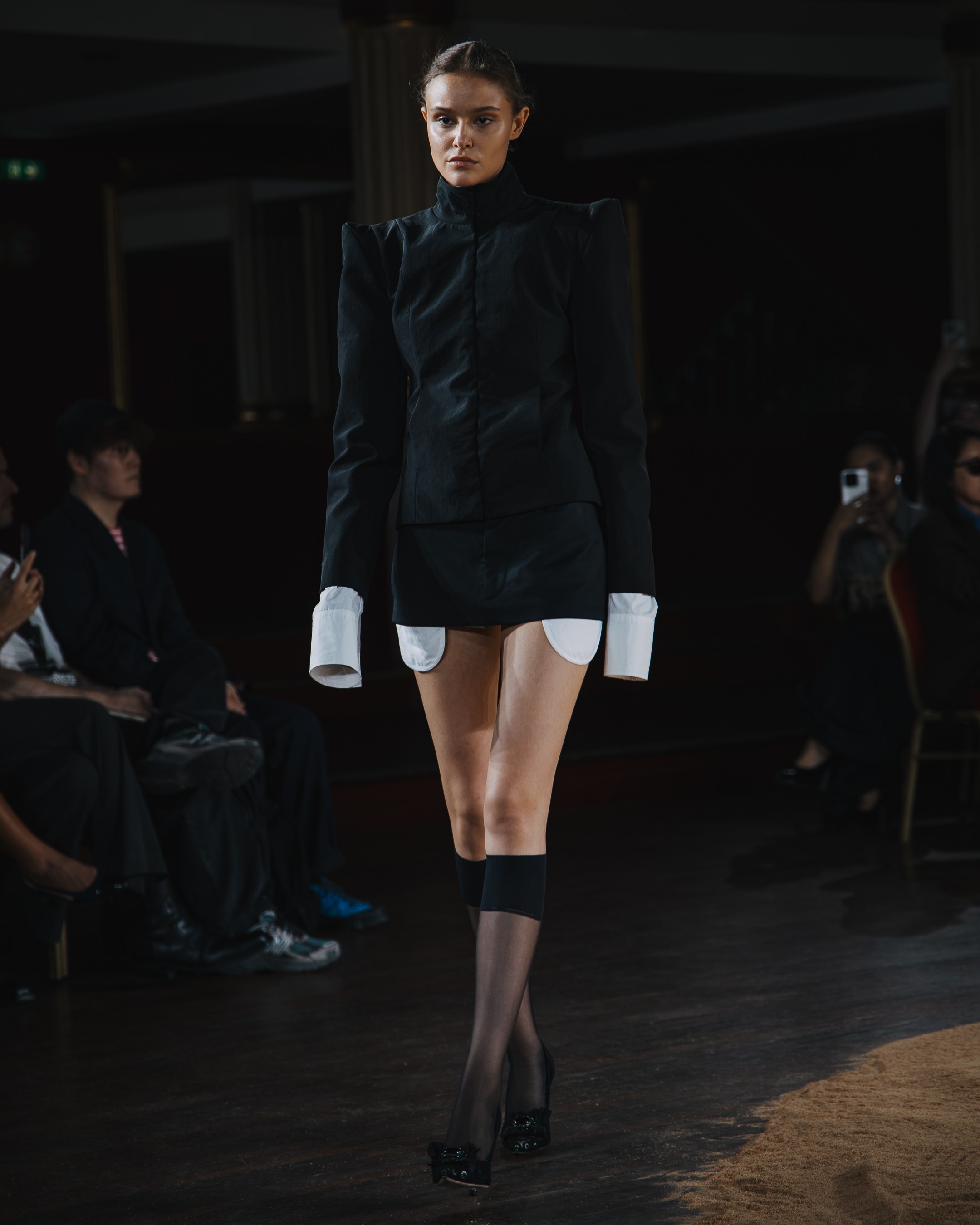
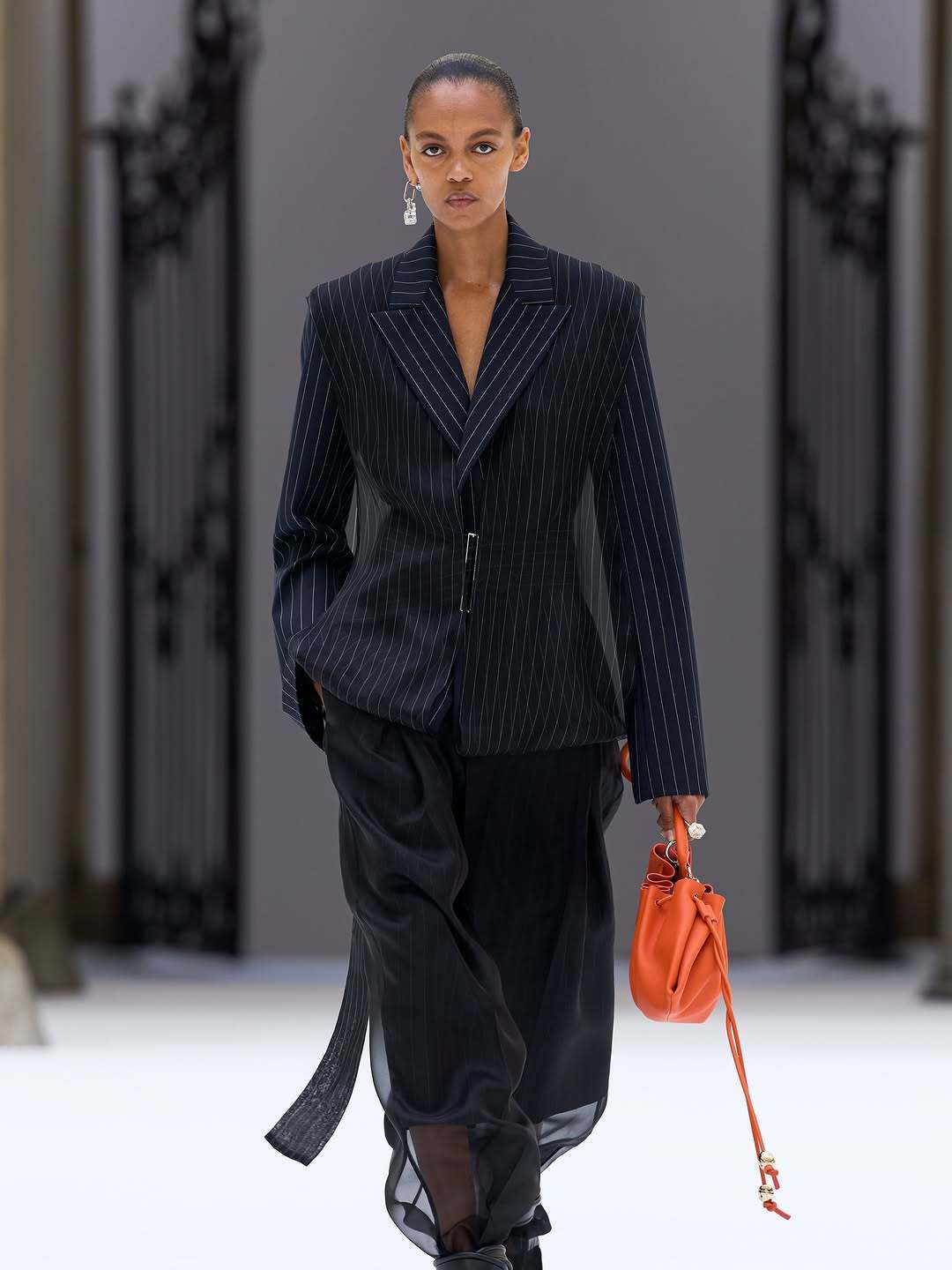
At Torishéju, the room felt like an opera awaiting its first note. Chandeliers flickered above red velvet and gold-trimmed chairs, while a circle of sand cut through the grandeur. Classical music played beneath whispered conversations in French and English.
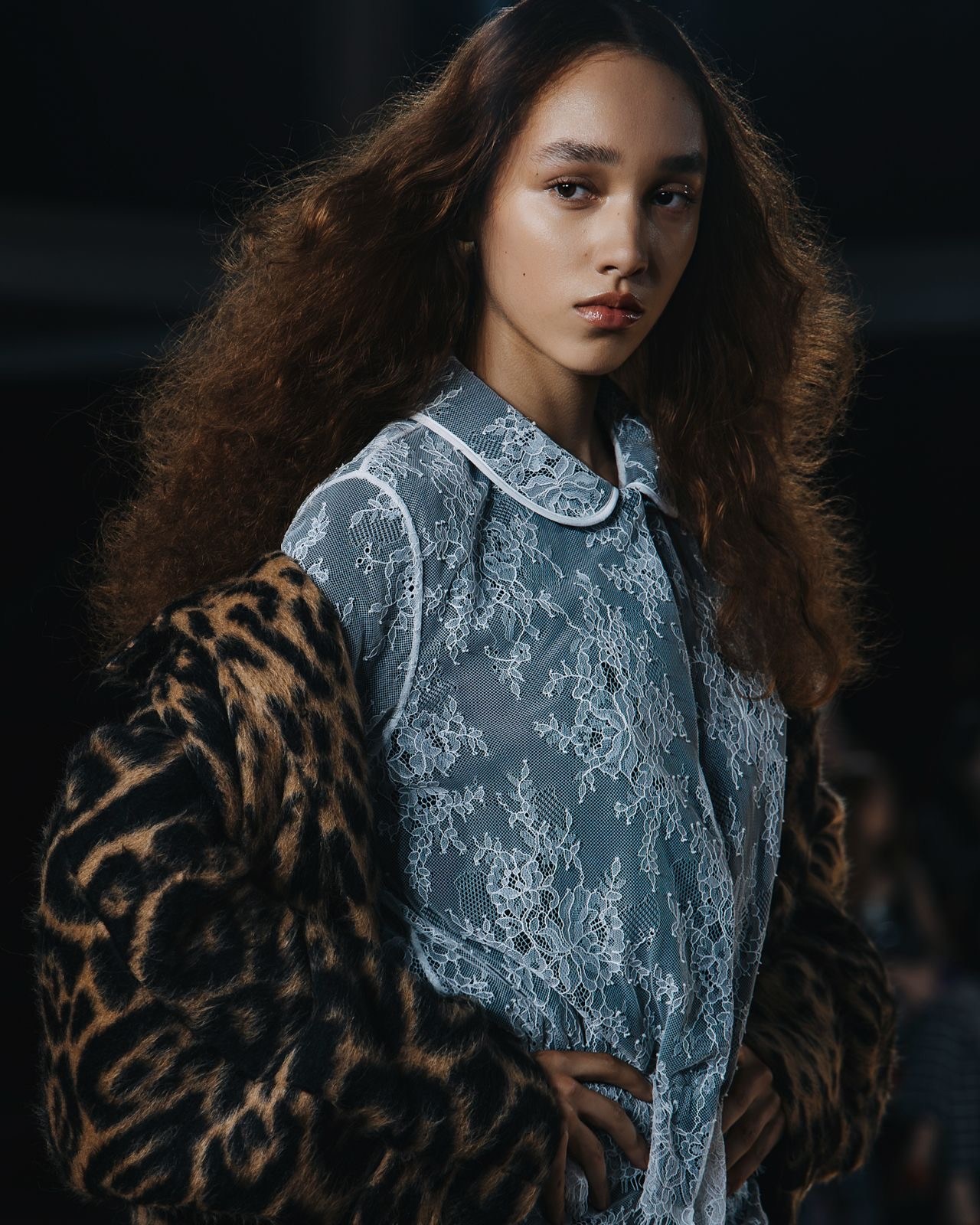
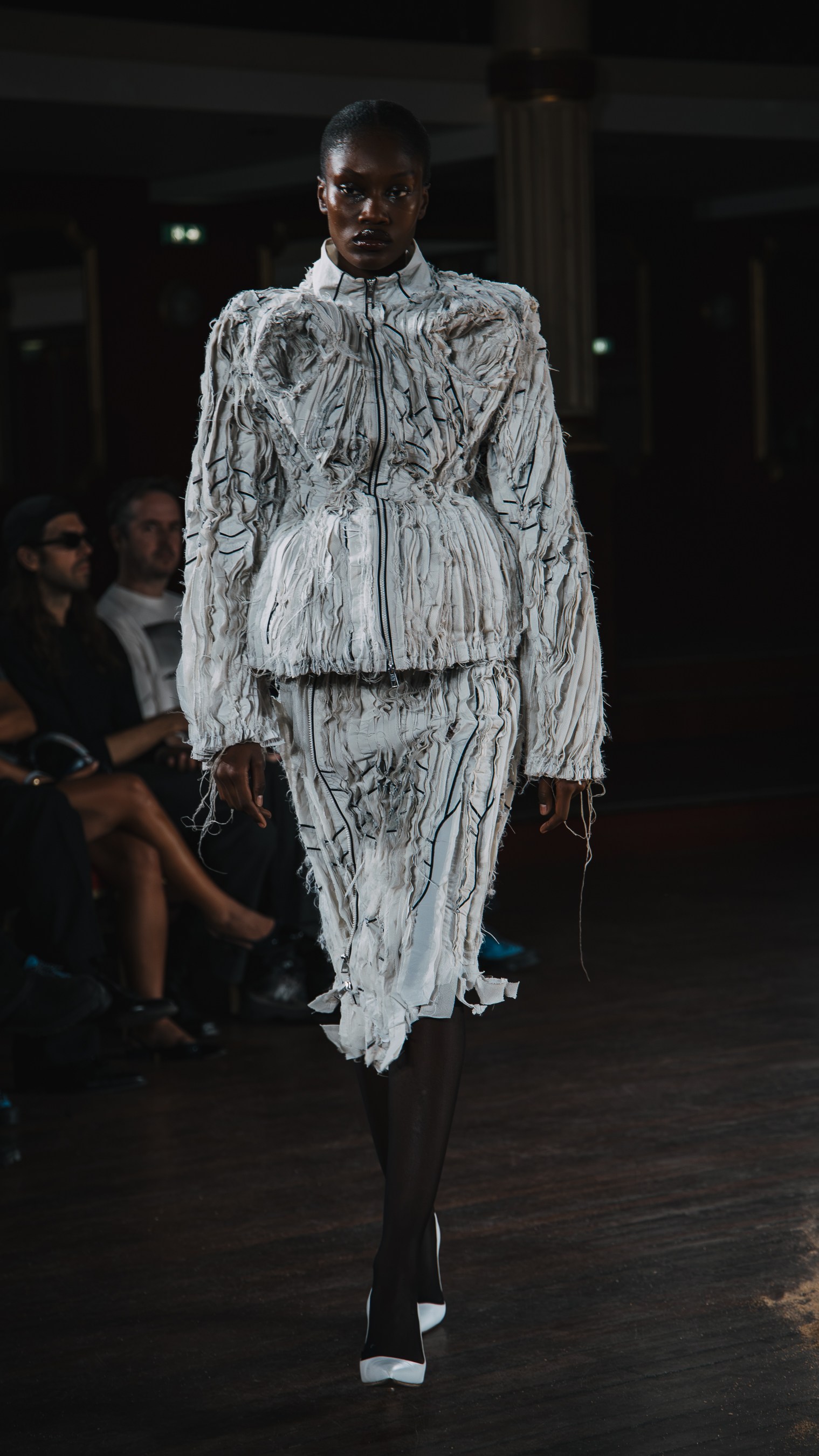
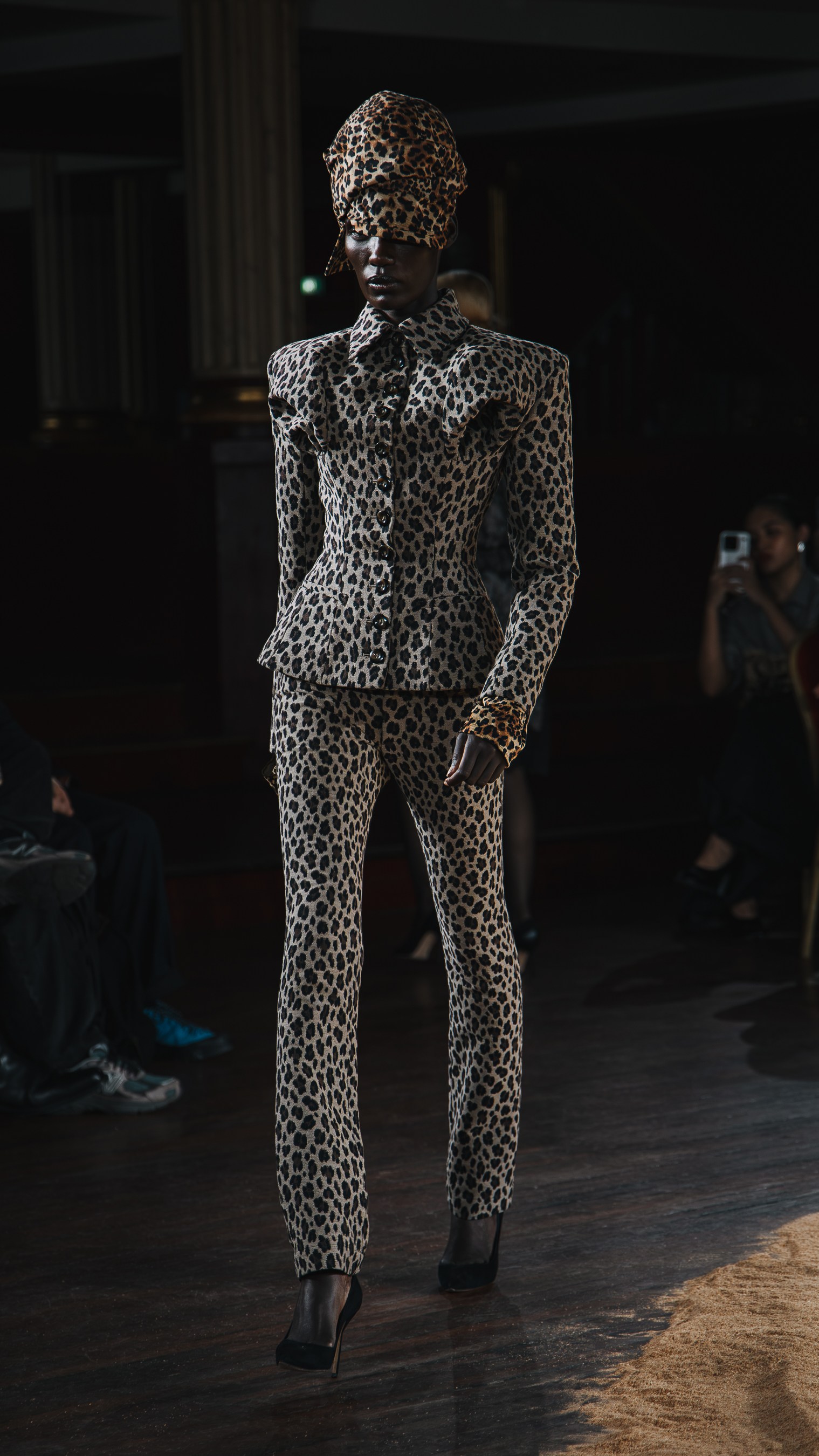
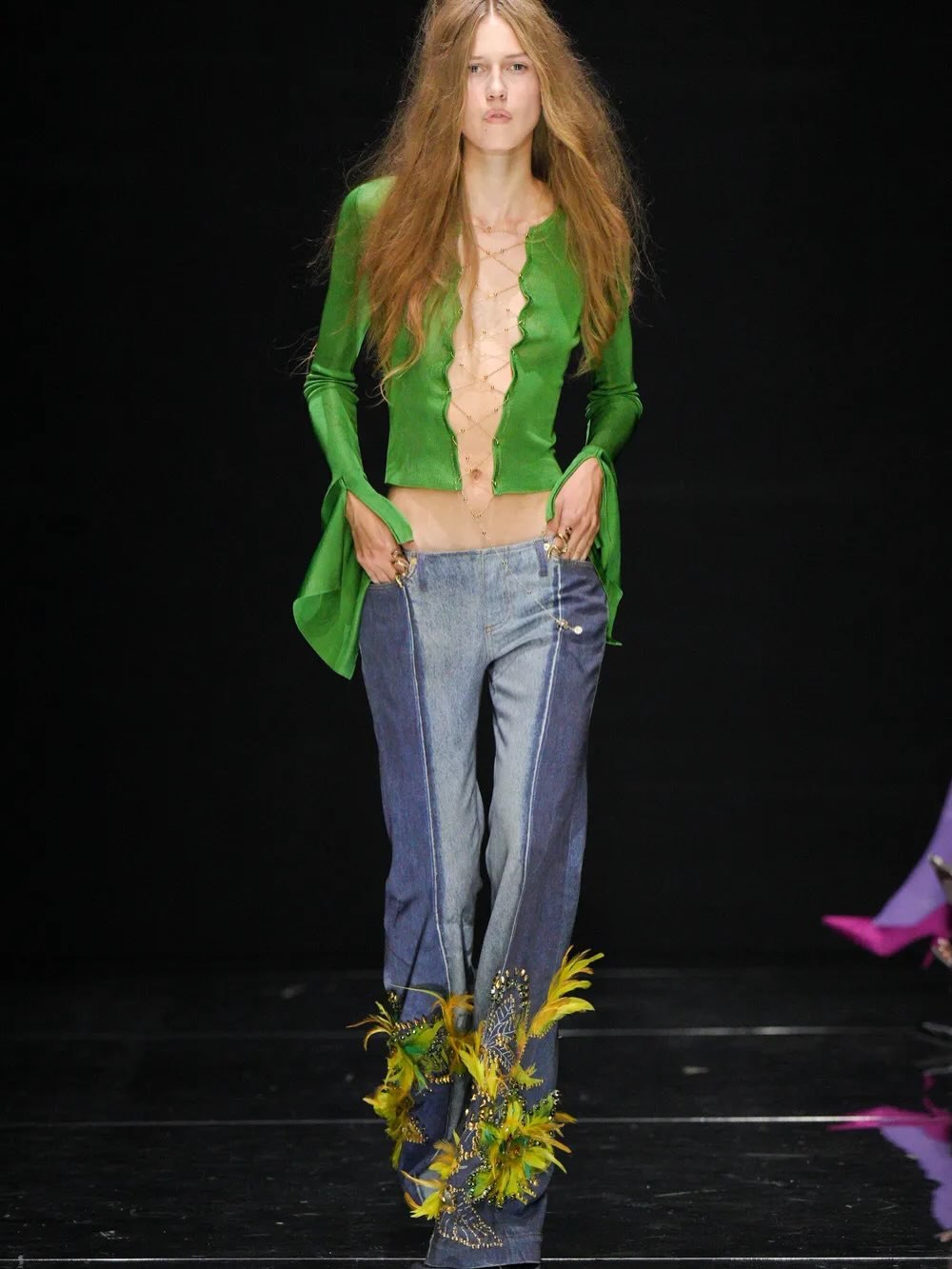
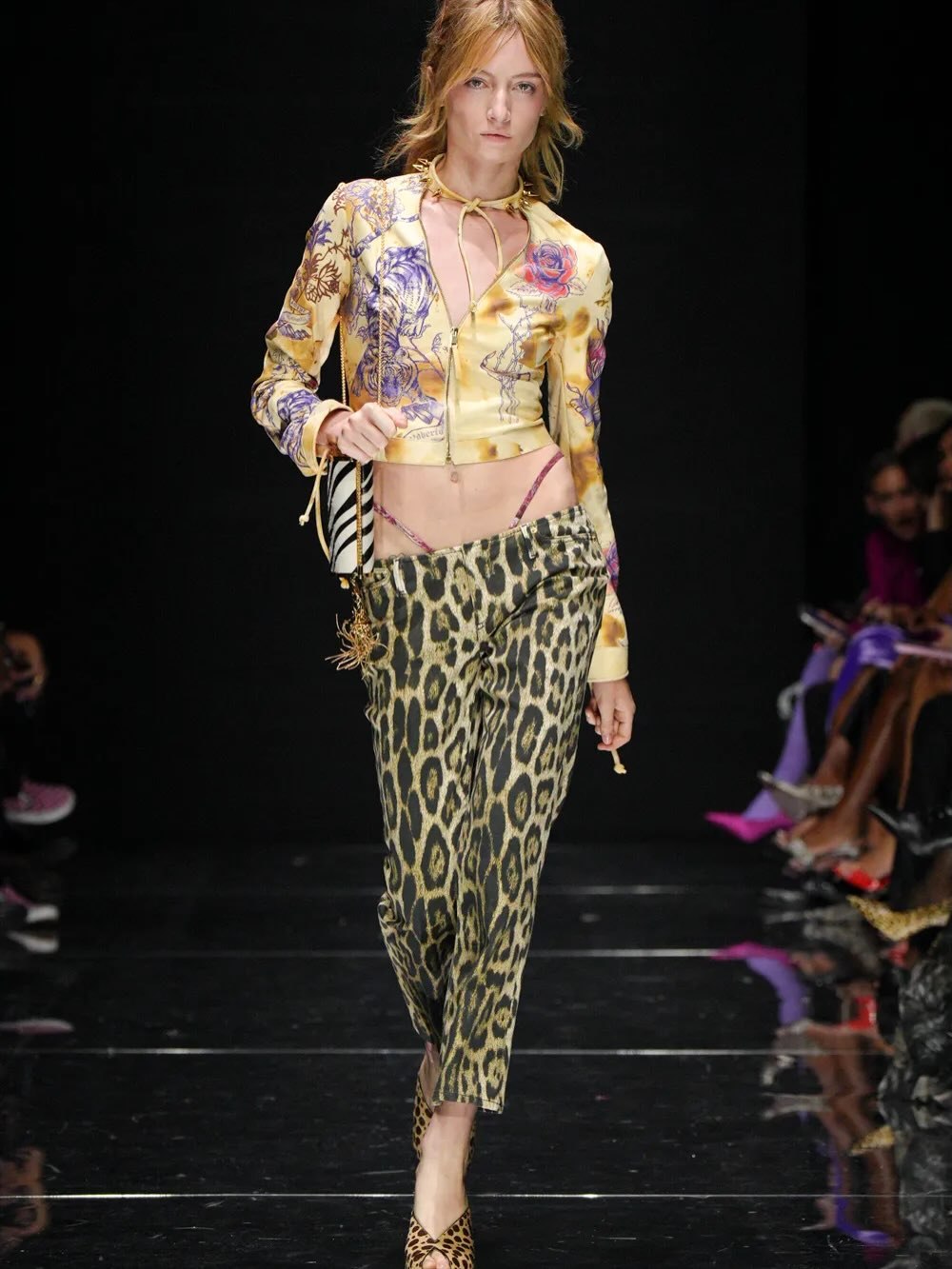
Torishéju Dumi met that ghostly setting with clothes that were anything but shy. Miniskirts showed their pockets; dresses bared the back. Leopard print paired with pinstripes, jackets bristled with nail-like embellishments, and a strapless dress revealed the unmistakable shape of unbuttoned trousers from behind. A red-and-white striped dress finished with an oversized bow brought a flash of playfulness.
Lace, tulle, checks and sharp tailoring moved between hourglass minis and sweeping lengths. Double-brimmed hats, scarf-draped headwear and sheer knee socks added to the collection’s delicious unease. The towering heels proved precarious when one model fell, but the clothes left a clear impression: seductive, strange and entirely Torishéju.
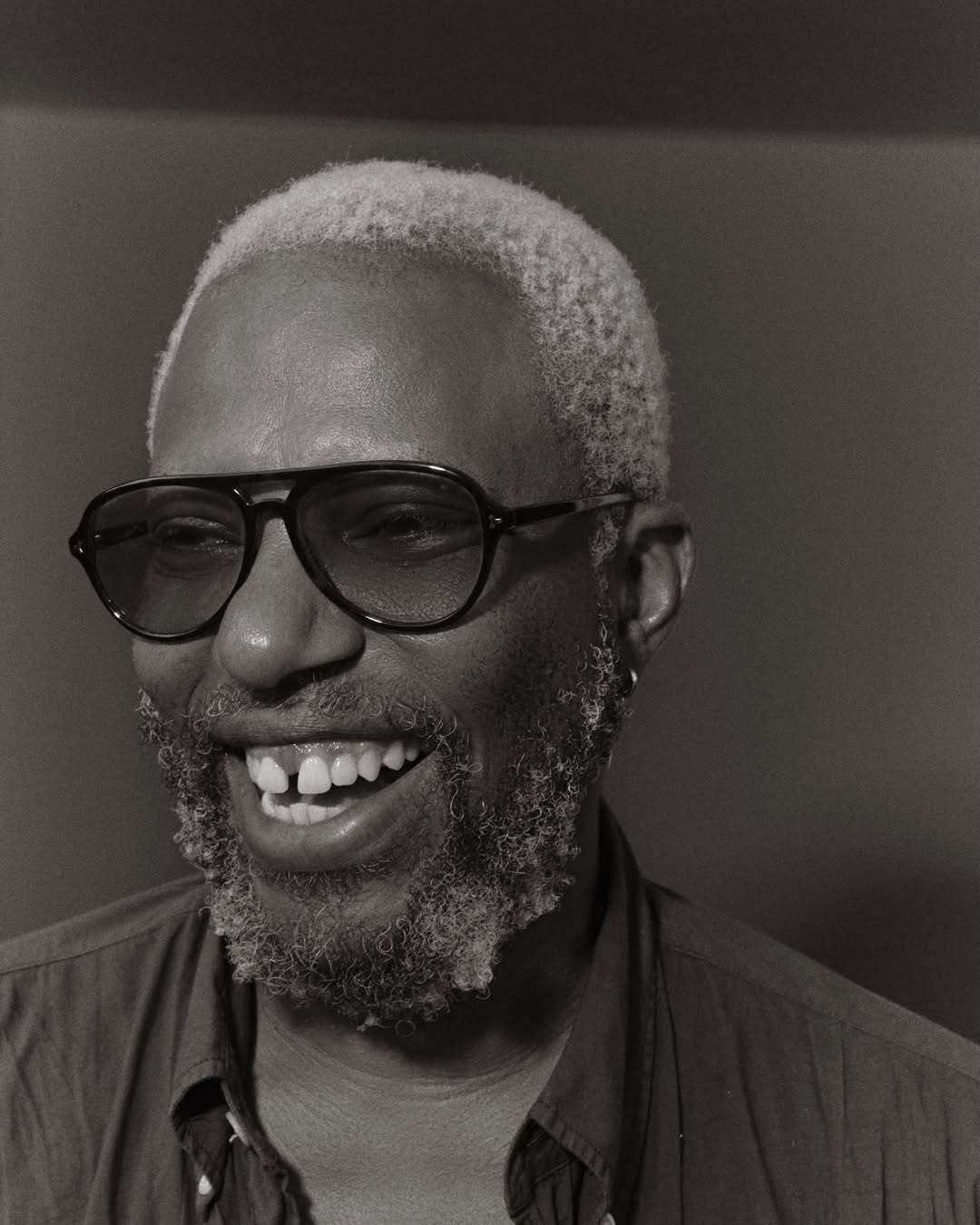
Following the show, Fashion Bomb Daily caught up with Edward Buchanan, who in 1995 became Bottega Veneta’s first design director at just 26 years old, straight out of Parsons School of Design. Buchanan built the foundation for the house’s ready-to-wear line and led its first-ever runway show, work that went largely uncredited for decades until Bottega Veneta honored him in its 50th anniversary campaign. Today he runs the knitwear label Sansovino 6, serves as Fashion Director at Perfect Magazine Milan, and is preparing to launch The Situation, a creative space in Milan supporting emerging design talent.
Buchanan shared his thoughts on Torishéju Dumi’s collection and gave us a first look at what’s coming next with The Situation.
https://youtube.com/shorts/nf5-d4yVWl8?is=4uptdq00xyqj1pRpWhat do you think?Photo credit: It’s Bruno Again
The 2026 MTV Video Music Awards red carpet delivered a night of sculptural couture, sheer lace, and high-shine metallics.
Here are the stars who dressed best.
Olandria takes the top spot in an Man Made Skins Spring/Summer 2026 gown, styled by the Resimans. Fresh from Milan Fashion Week, she arrived in a lace-up corseted mermaid silhouette in rich brown, finished with red beaded trim and ruffle detailing. It was a precise, fashion-forward look and the standout of the carpet.
Chloe Bailey shimmered in a nude Idan Cohen gown covered in mirror and crystal embellishment, styled by Jason Rembert. The long-sleeved, sheer silhouette featured a dramatic keyhole cutout at the bust and a sculpted beaded bra. Geometric mirrored panels traced the waist and skirt. She wore her locs in a sculpted updo with blonde face-framing pieces and completed the look with a diamond cross pendant.
Aniya Harvey sparkled in a silver embellished halter mini dress from Maria Harper Designs. Crystal fringe swung from the hem, and another strand draped from a sculpted shoulder appliqué. Silver ankle-strap sandals and a high updo kept the focus on the beadwork.
Teyana Taylor went full drama in Zuhair Murad Fall/Winter 2026 Couture. The black sheer lace gown was beaded throughout and cut with a plunging neckline and a velvet belt. Ostrich feather trim lined the cuffs and the hem.
Normani wore Robert Wun Fall/Winter 2025 Couture. The gown paired a metallic gold-bronze bodice and matching gloves with a sculptural leaf appliqué at the shoulder. A black pleated mermaid skirt fanned out into a dramatic train.
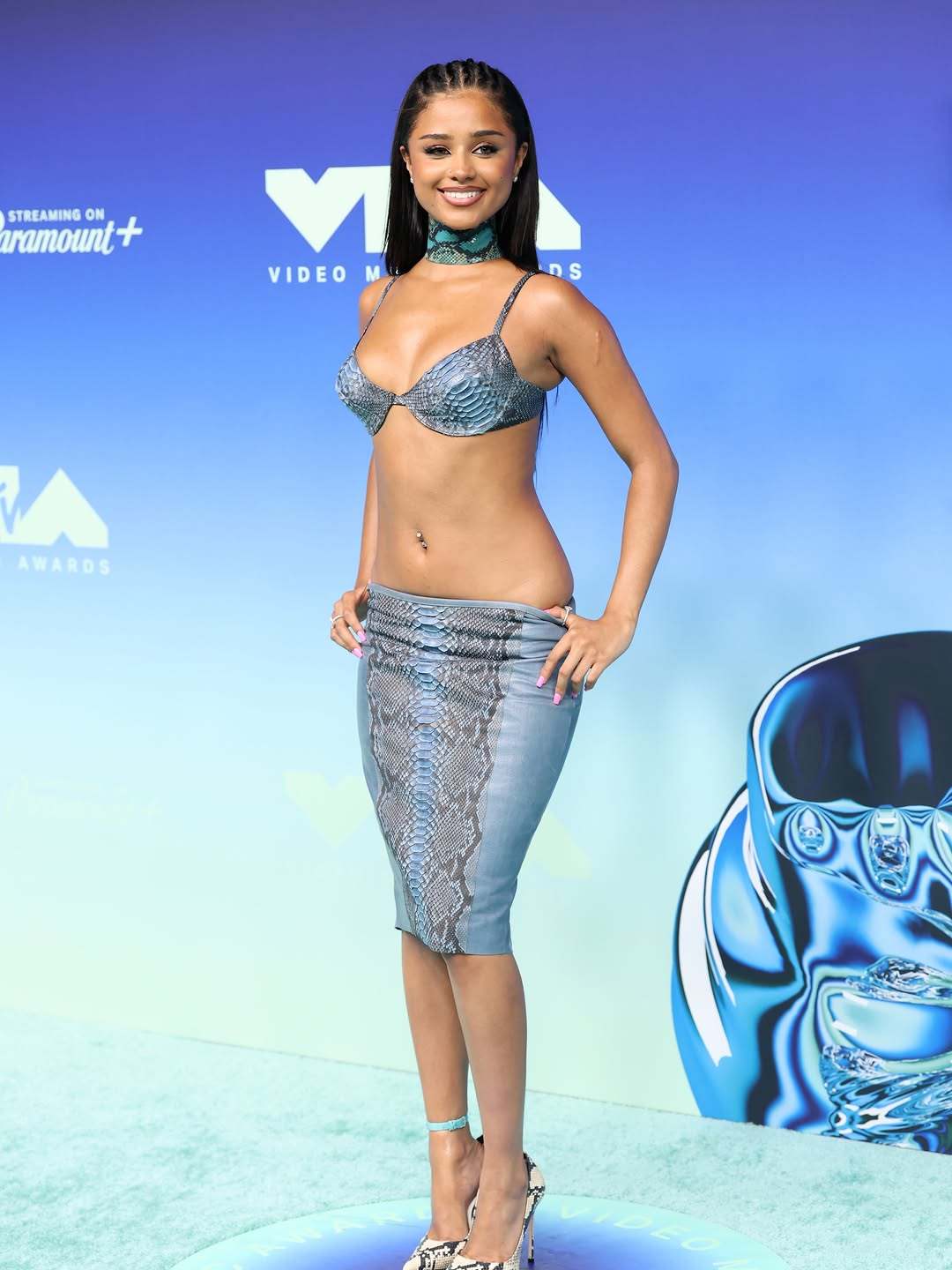
Tyla wore Mowalola Summer 2027, a snake-print bra top and matching pencil skirt in shades of blue. She added a coordinating snake-print choker and pointed pumps.
What waist? Jojo showed off her svelte figure wearing a Nue Studio bejeweled bra and an embellished skirt.
Bebe Rexha channeled gothic romance in Dreaming Elie Fall/Winter 2026 ready-to-wear. The black lace corset gown had a tulle overlay and lace-up thigh-high boots. She accessorized with Loree Rodkin jewelry, including a diamond cross pendant, and Jimmy Choo heels. Timothy Luke styled the look.
Raye sparkled in Georges Hobeika Haute Couture Fall/Winter 2026. The sheer gown was covered in champagne and silver beading, with a cowl bodice trimmed in pearl fringe and a halter neckline. Sculpted burgundy waves and a red lip gave it old Hollywood glamour.
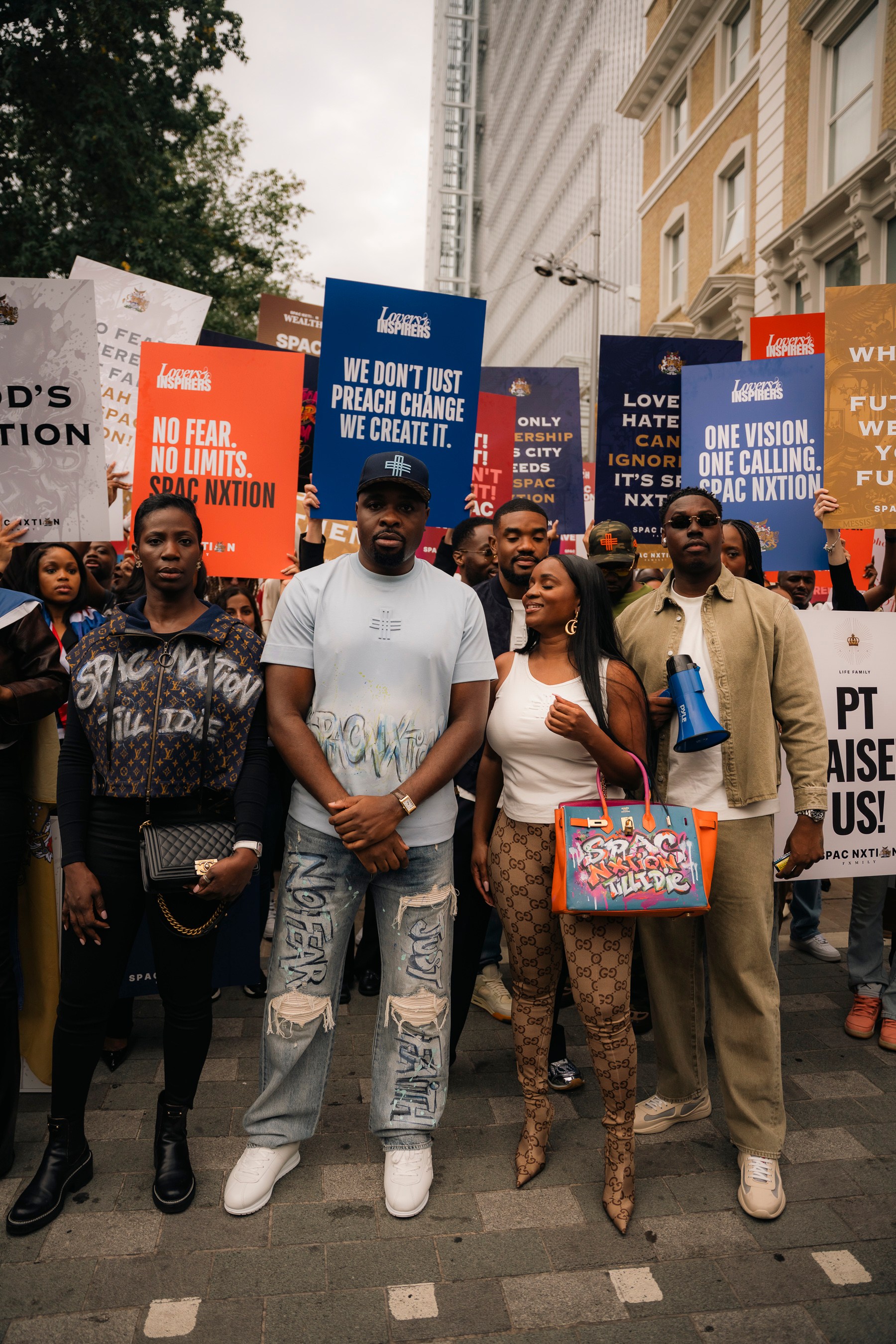
A Hermès Birkin 35 painted with “SPAC Nxtion till I die.” A Louis Vuitton jacket carrying the same declaration. Amiri jeans transformed into a walking canvas.
If that doesn’t sound like your typical Sunday, post-church service, that’s because it wasn’t.
Fresh from Sunday service, SPAC Nxtion took to the streets for its annual Peace Walk, making their way from Paddington to Marble Arch in London and suddenly, some of fashion’s most recognisable luxury codes were carrying a very different kind of message.
The phrase “SPAC Nxtion till I die” isn’t exactly subtle, and that was the point. Drivers waited, pedestrians watched, cameras captured the moment and social media began to lose their mind.
Some of luxury’s most sought-after pieces became more about pledging your allegiance. A Birkin 35 (carried by Mariam Mola, a powerful female leader and Pastor within SPAC Nxtion), traditionally synonymous with exclusivity and pristine craftsmanship, became a canvas. Meanwhile, a Louis Vuitton Sleeveless Monogram Jacquard Hooded Jacket in navy, served as a statement and a pair of blue washed Amiri jeans, were worn by Samuel Akokhia, the Senior Pastor of SPAC Nxtion, all branded with the words: “SPAC Nxtion till I die”.
Fashion has always been about signalling who you are, what you represent and which world you belong to. From luxury logos to underground streetwear labels, clothing has long operated as its own language.
“SPAC Nxtion till I die,” was a declaration of loyalty, identity and belonging.
While the fashion moments themself provided plenty for the cameras and equally, social media, the “Peace Walk” ultimately remains rooted in community. It was raw, it was unconventional and it certainly wasn’t quiet.
At the heart of the SPAC Nxtion story is Pastor Tobi Adegboyega, the movement’s founder, visionary and Global Head of Strategy. Since its beginnings in Peckham, London in 2005, his work has centred heavily on young people, leadership, and creating a different future for people that are often overlooked.
Notably, Pastor Tobi was not present at this year’s walk, due to an appearance at the Chelsea Football Club. His absence, however, did little to diminish the presence of the culture and community he had undoubtedly built for the past 21 years.
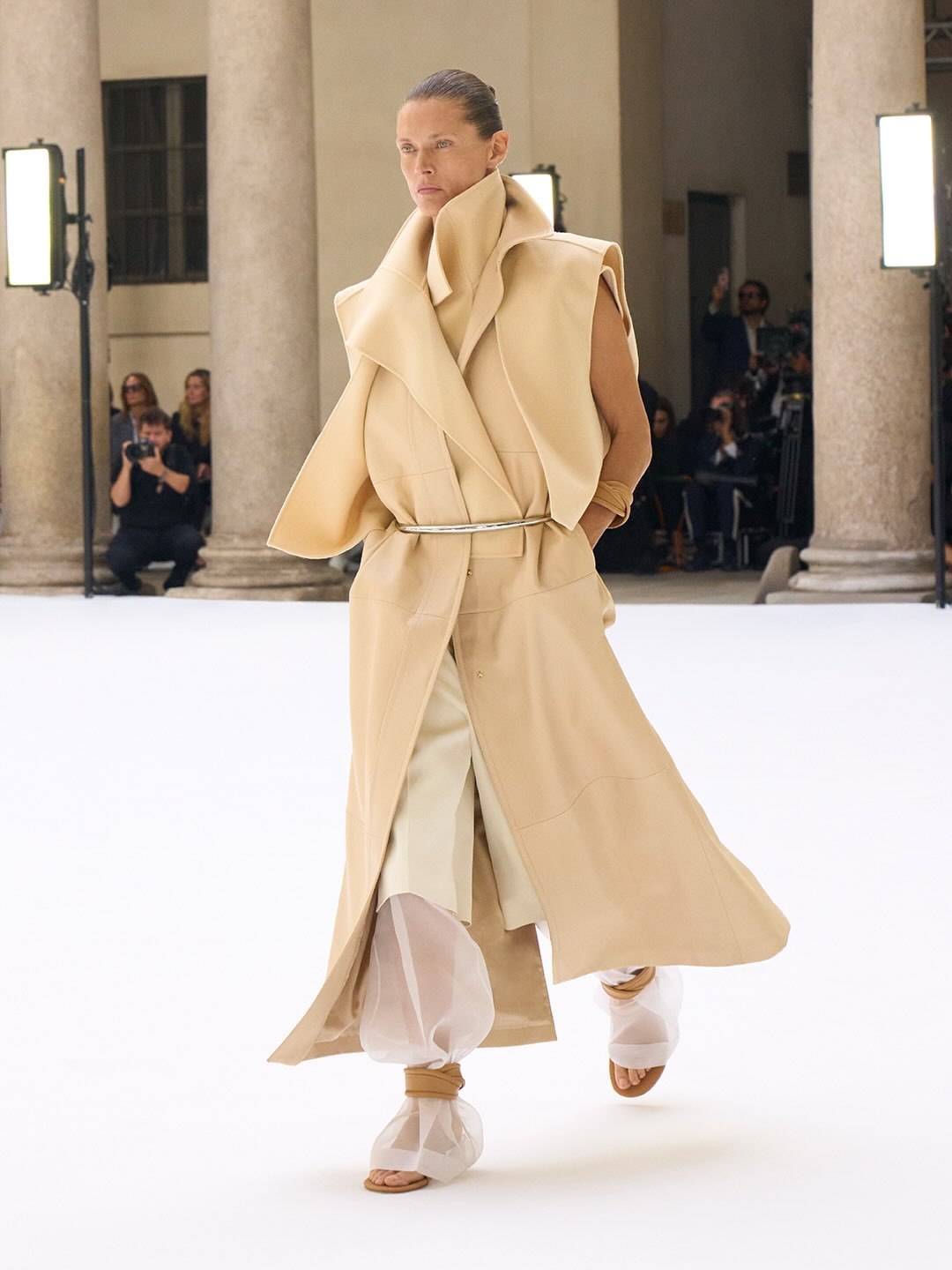
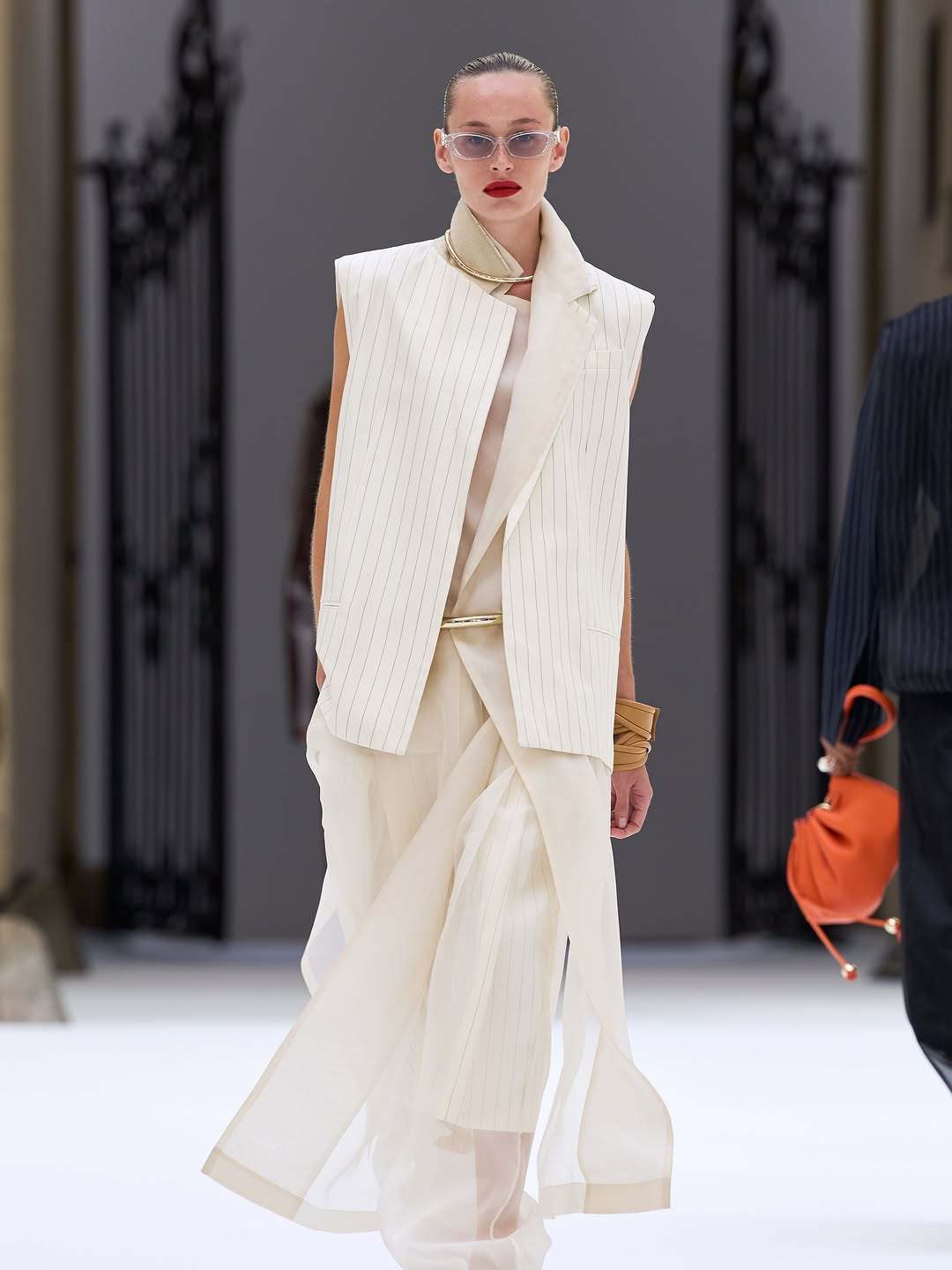
Sportmax’s Spring 2027 show unfolded in a light-drenched courtyard, with a white runway set against a palatial backdrop. The clean lines of the setting echoed the chic sensibility of the guests. Then a robotic soundtrack introduced a collection that brought a fresh perspective to familiar pieces.
The opening look established the idea: a cream jacket built up in layers, its popped collars giving a wardrobe staple unexpected dimension. Throughout the show, Sportmax returned to the clothes women reach for again and again, reworking them through proportion, texture, and sheer details. This was an evolution of the basics, though nothing about it felt basic.
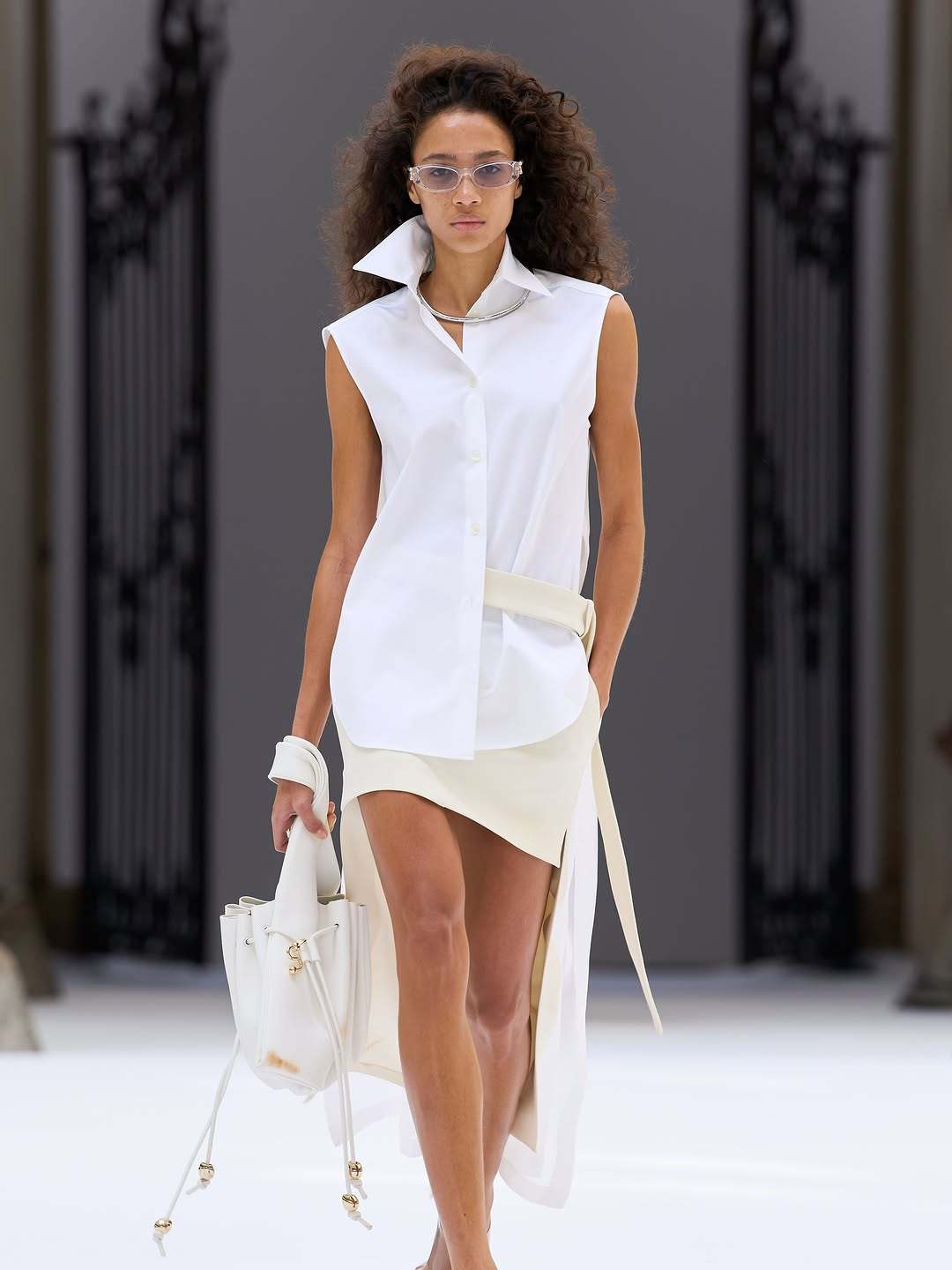
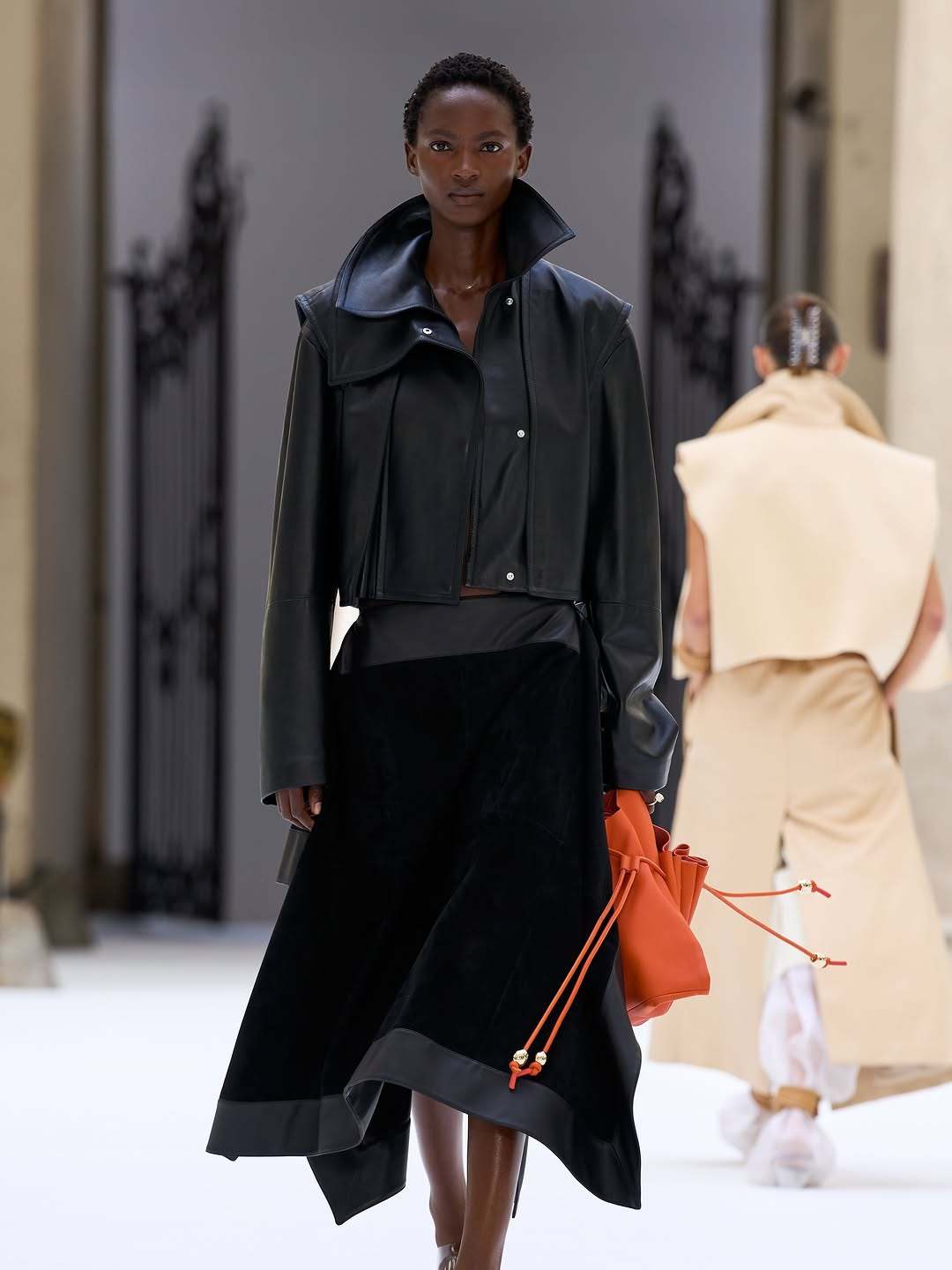
There was a working woman in these clothes, but one with flair and a point of view. Tailoring sat alongside softer pieces, including a peach-and-white knit minidress. Leather mixed with knits, while cutouts and metal rings brought an edge to dresses that could move from the workday into the weekend. Black, cream, navy, white, and brown formed the foundation; red and orange added warmth and energy.
The accessories sharpened that balance. Orange bags supplied a pop of color, while structured black bags, sheer totes, silver chokers, and low-heeled flip-flops offered different ways to wear the looks.
Some women in the audience wore similarly clean lines and considered details. It was easy to imagine pieces from the runway joining their wardrobes. Sportmax’s strongest proposition this season was also its simplest: a classic could feel entirely current in the hands of the woman wearing it.
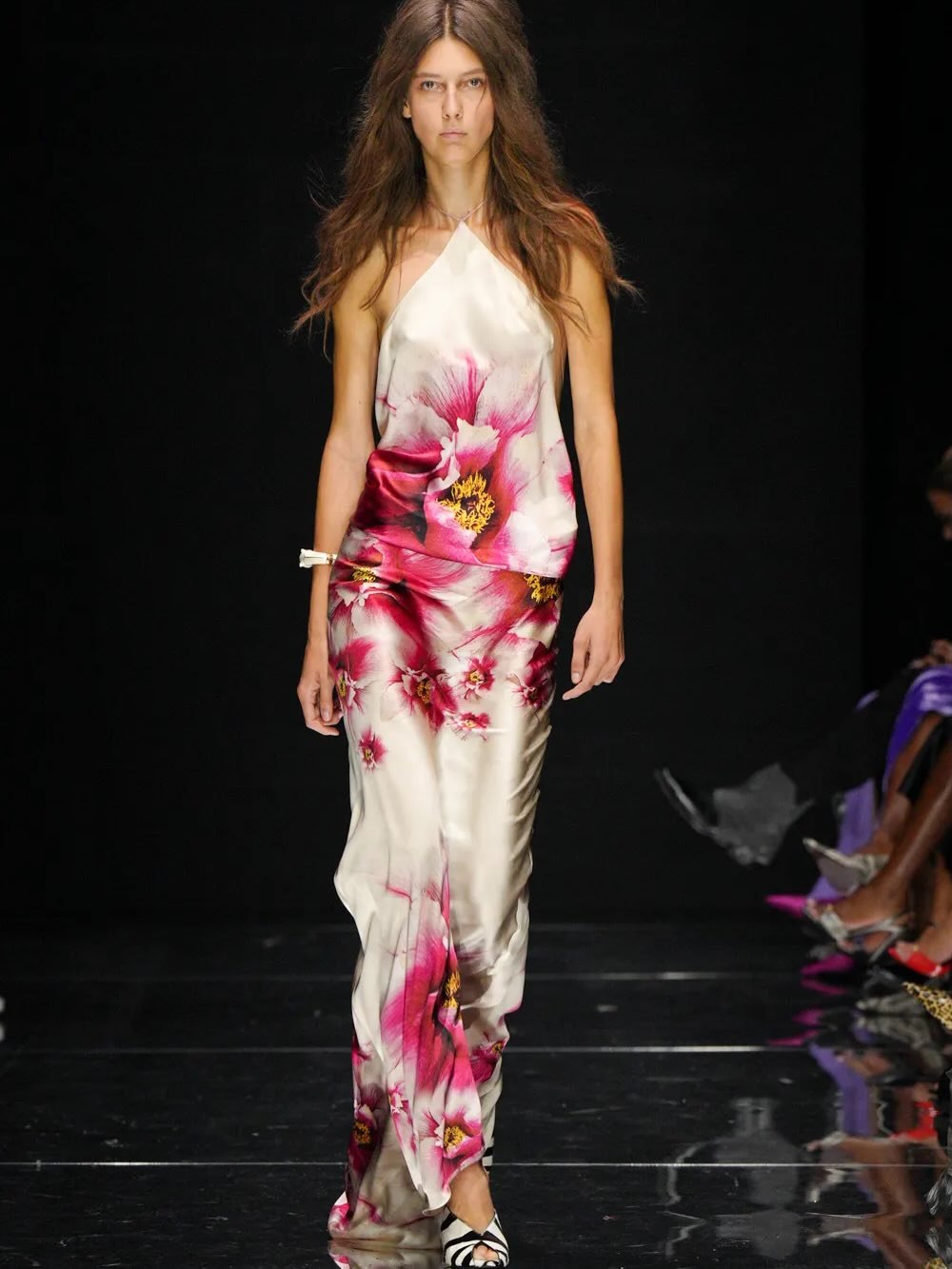
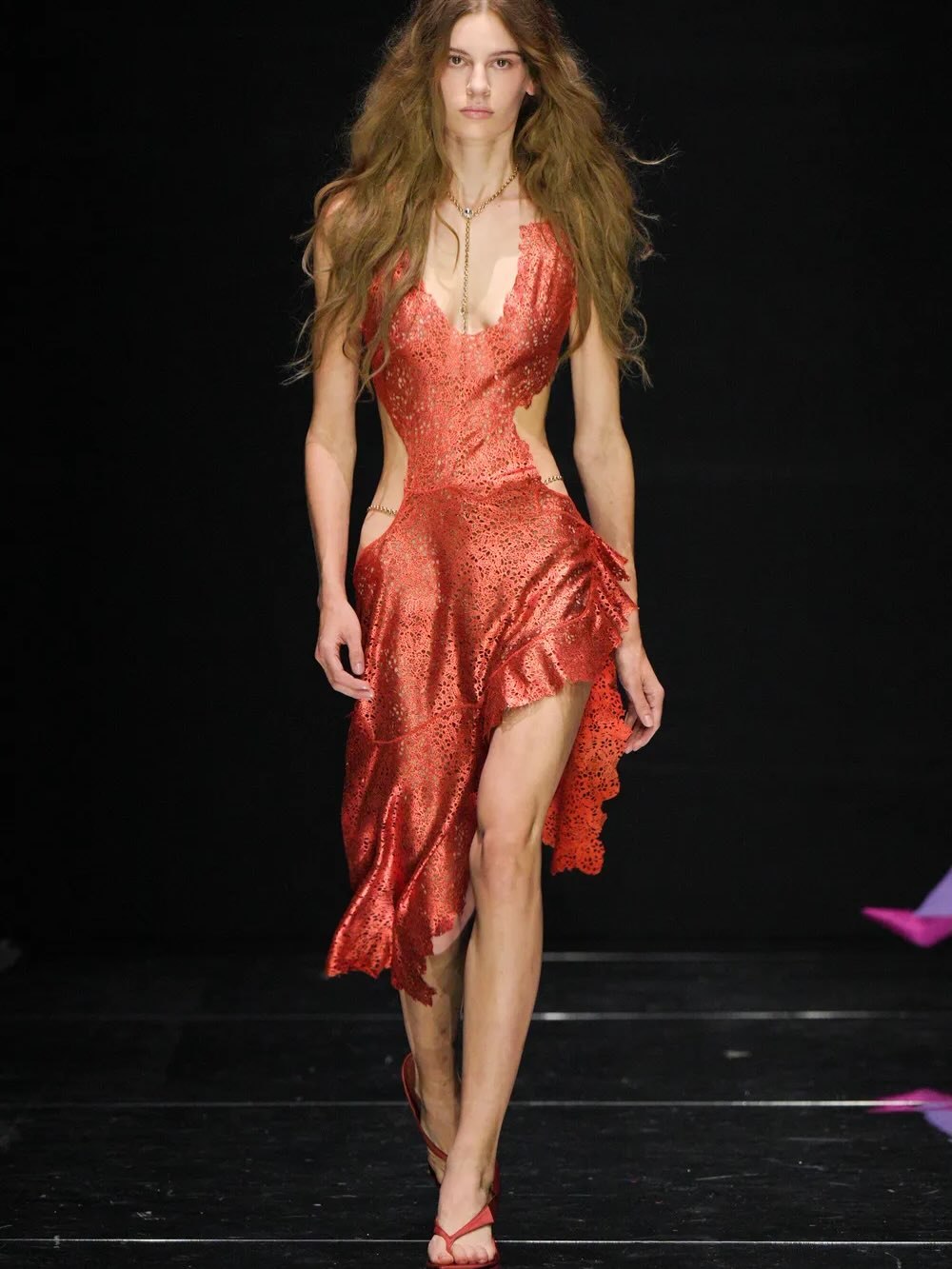
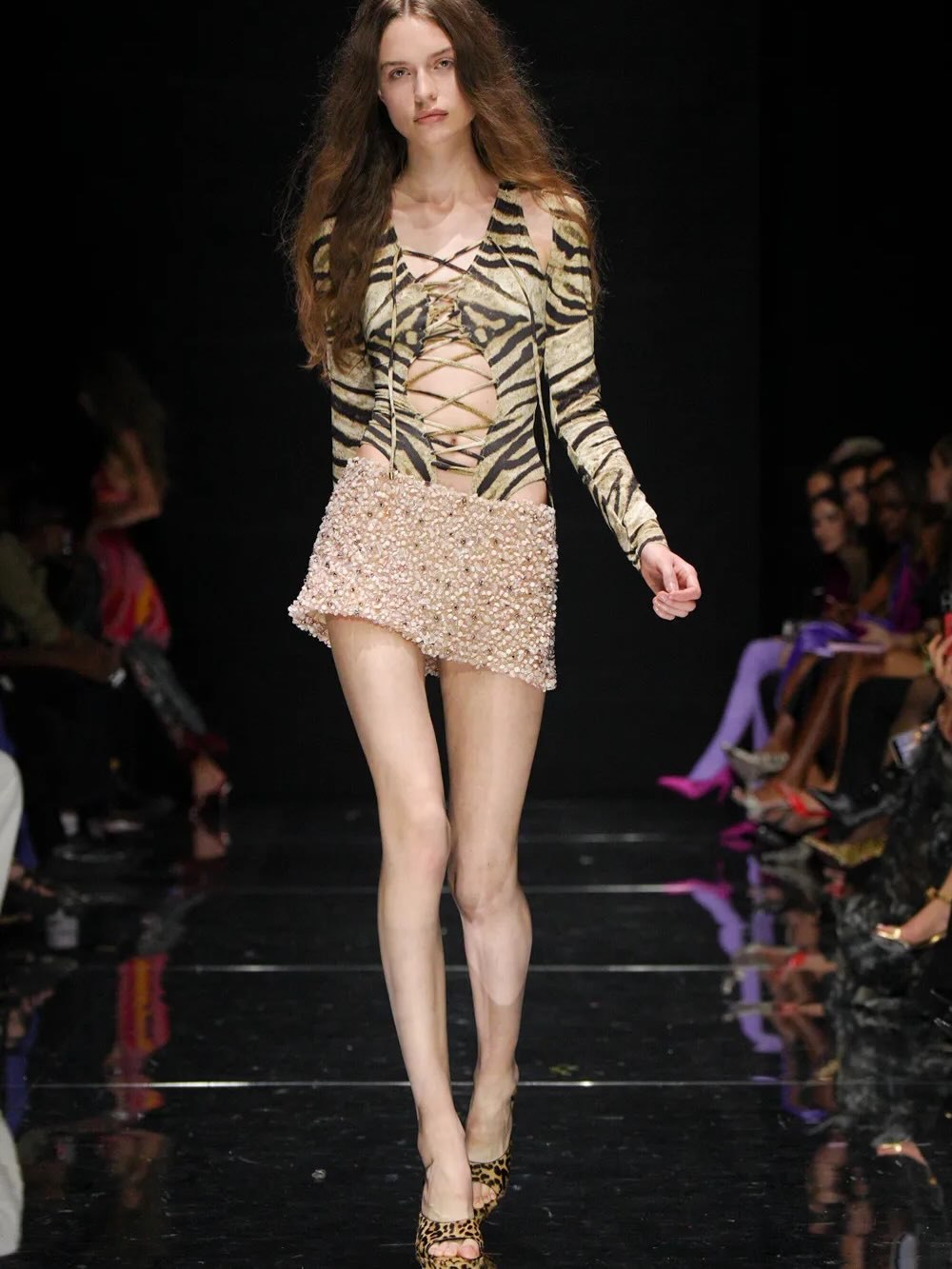
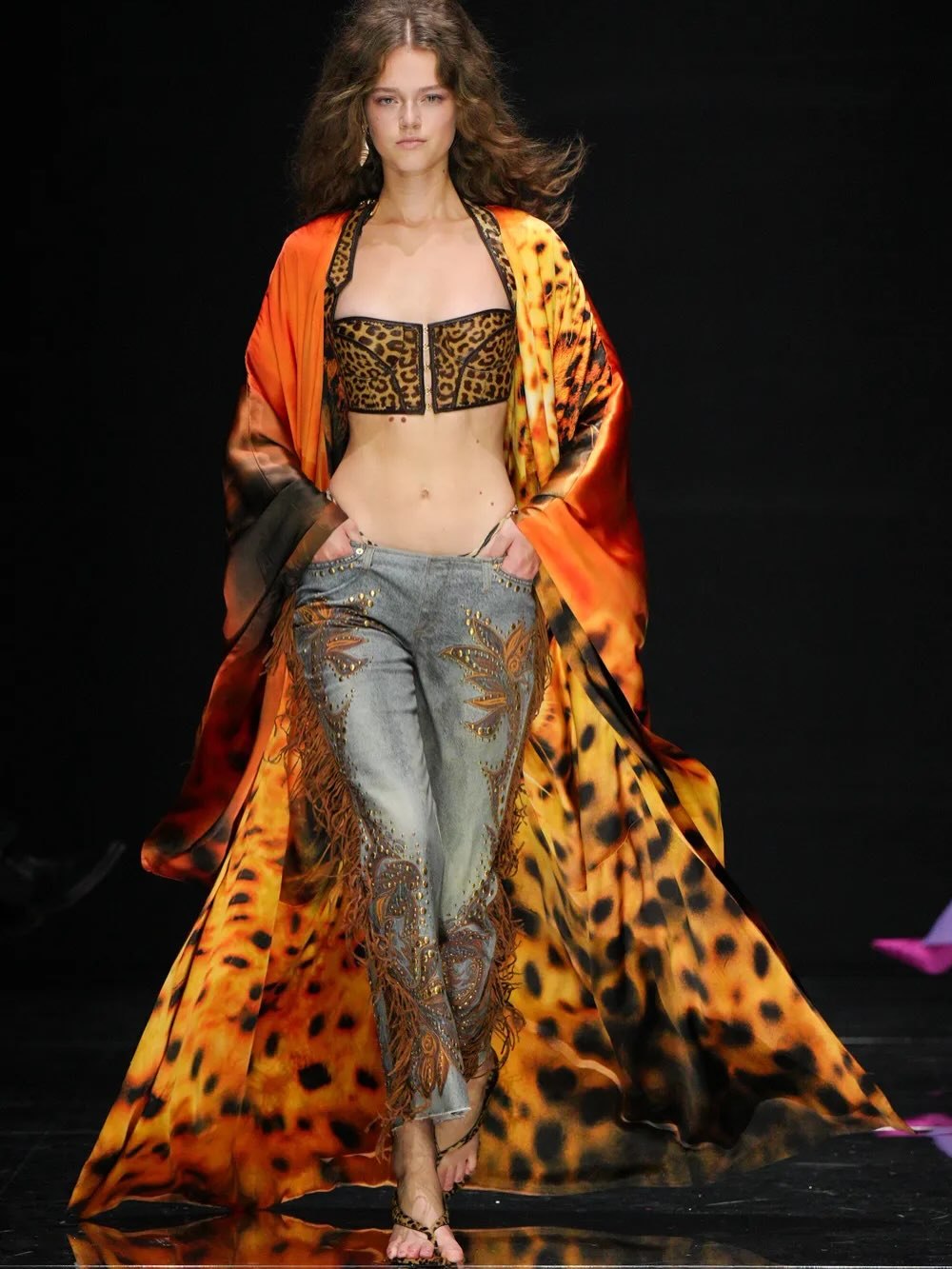
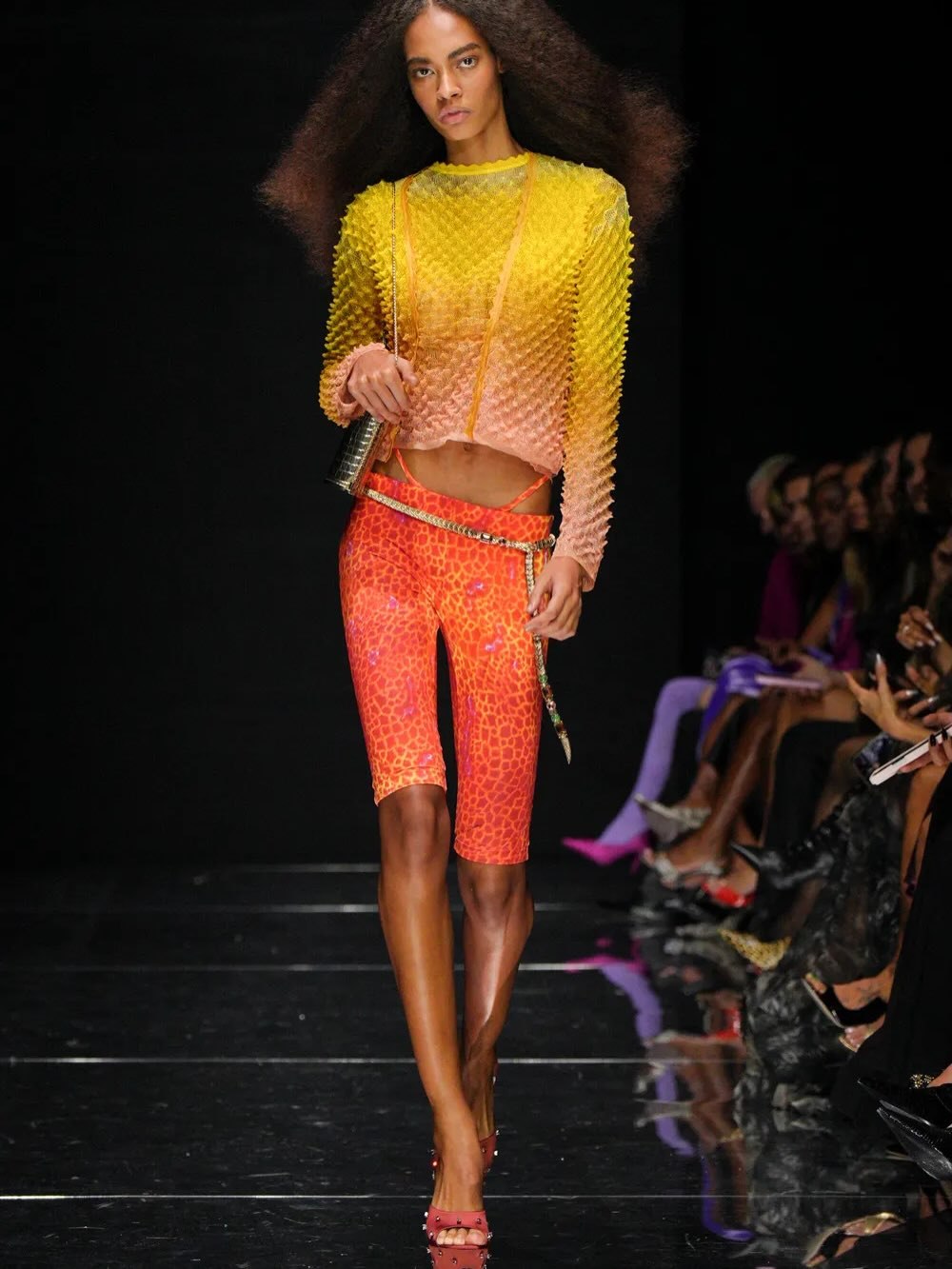
The room was lined with mirrors, the runway reflected every step, and the music came with a bass line you could feel. For Roberto Cavalli’s Spring 2027 show in Milan, Fausto Puglisi made the case for the fashion show as a full sensory experience. Before the clothes came into focus, the mood was already set: this was a night out.
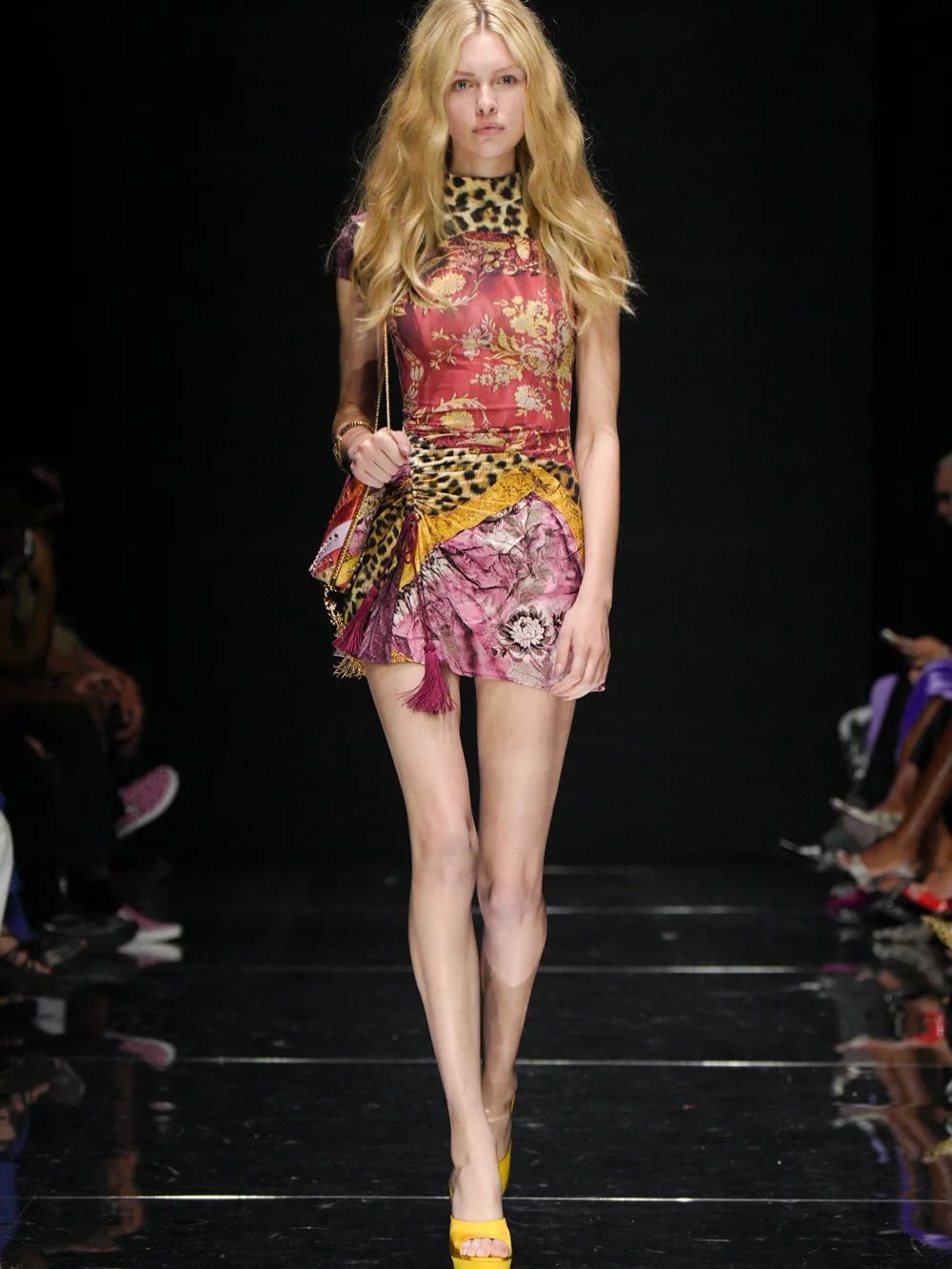
Titled House of Prints, the 45-look collection drew inspiration from Los Angeles and explored the pleasure of dressing to be seen. Its language was unmistakably Cavalli, but Puglisi kept changing the volume. Leopard appeared beside red and pink florals, then resurfaced in a slip dress whose mixed motifs spilled into fluttering, asymmetric ruffles. A red floral mini came finished with a tousled, fringed hem, while a long, golden gown offered a more languid kind of glamour.
Some of the sharpest contrasts came in the shorter looks. A lace-up animal-print bodysuit met a shimmering micro skirt; elsewhere, a red textured top was paired with a skirt printed in the fiery colors of a big cat. One flowing orange gown placed a leopard’s face across the body, turning the house’s familiar animal motif into the collection’s most arresting image. Platform heels added another jolt of color and height.
The clothes embraced a little chaos, yet the point was clear. Puglisi treated the body as something to celebrate, with pieces made for parties, escapism, and joy. The prints competed, the hemlines moved, and the silhouettes invited attention without asking for permission.
Cardi B, Naomi Osaka, and Olandria watched from the front row.
Around them, the mirrors multiplied the models and the spectacle, making every look seem to linger after it passed. At Cavalli, more was more—and for Spring 2027, that felt like the whole reason to get dressed.
When it comes to healthy hair, Bask & Lather is going straight to the source: the scalp.
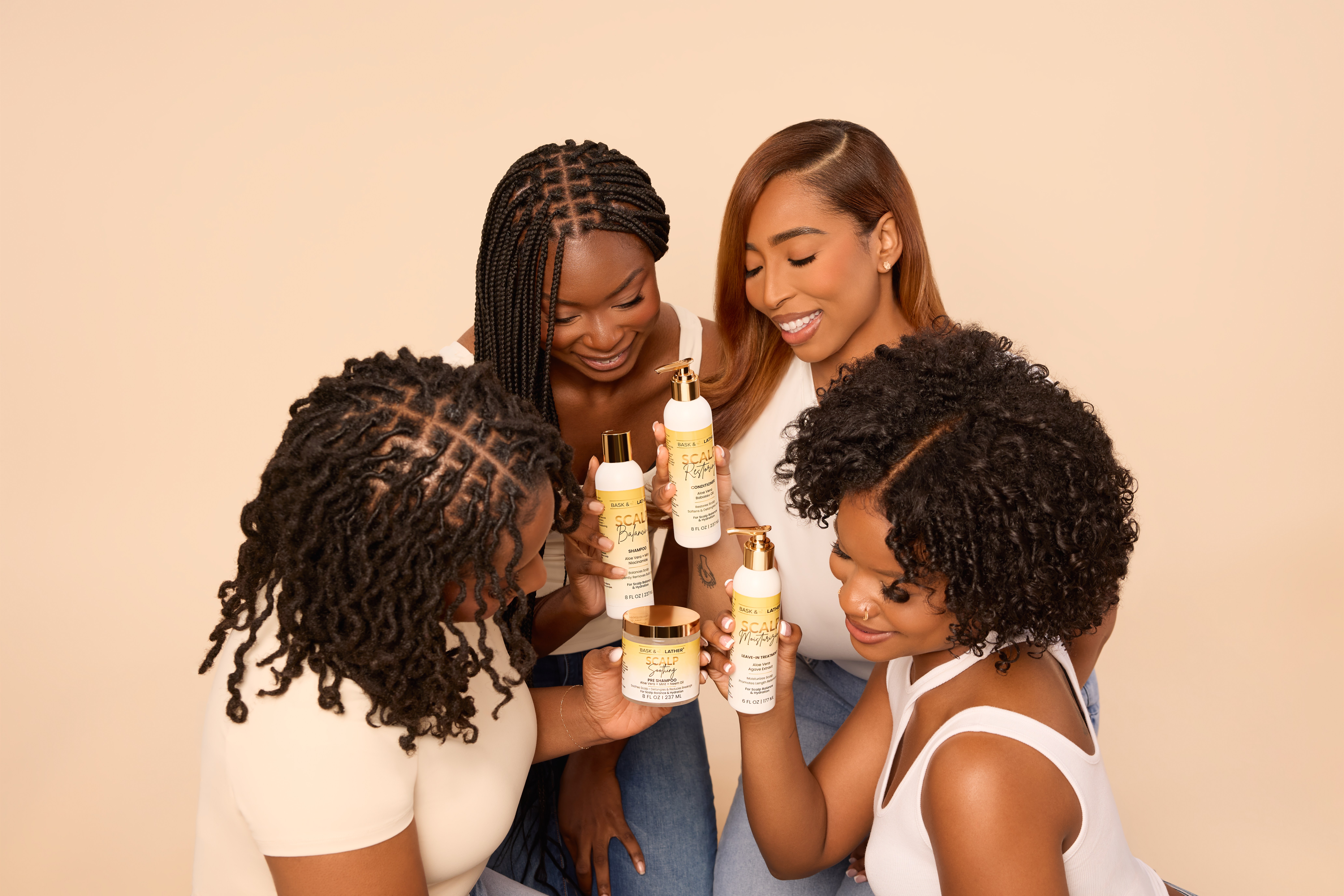
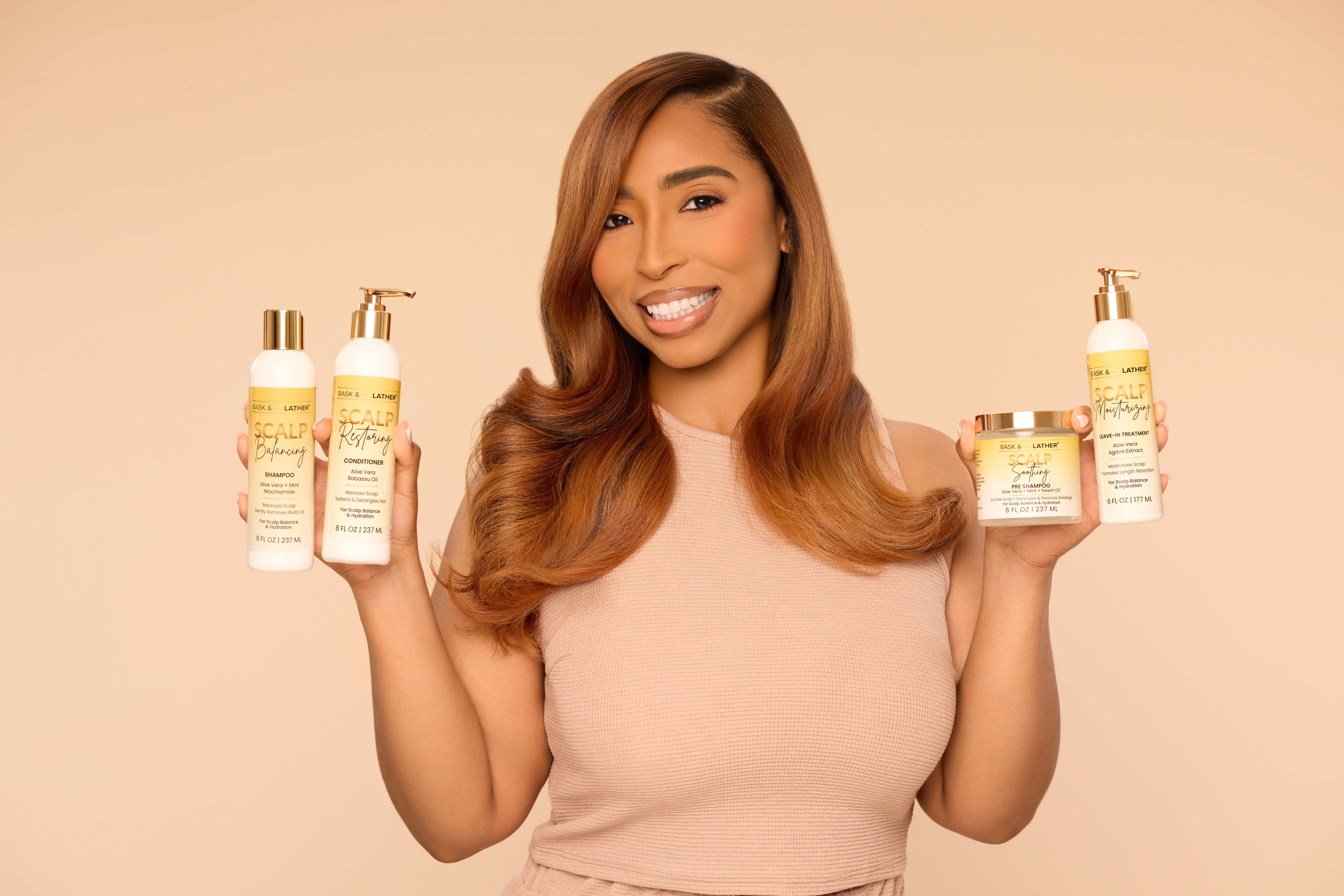
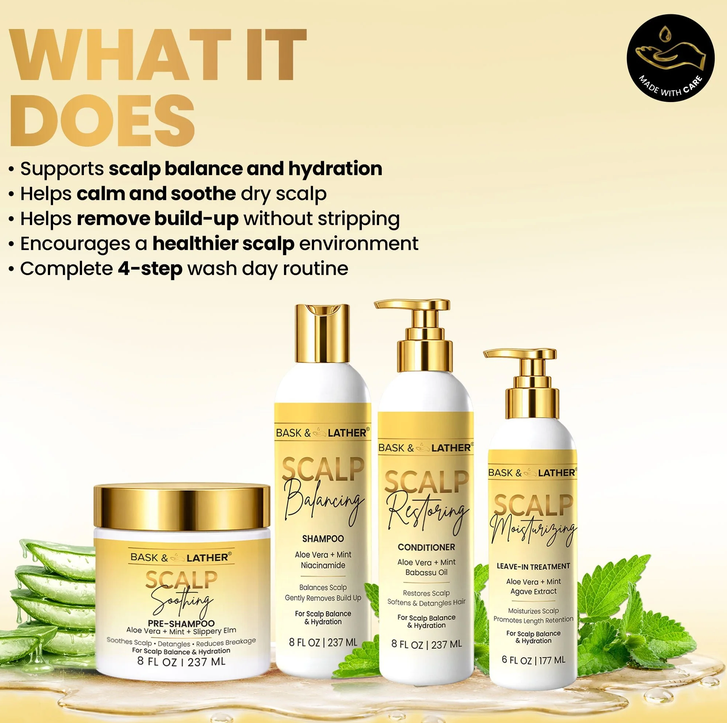
The beloved hair-care brand has expanded its scalp-first philosophy with the award-winning Bask & Lather Scalp Therapy System, a four-step regimen designed to prep, cleanse, condition and moisturize the scalp and hair as one complete routine.
And what makes the system particularly interesting is its approach. Instead of treating scalp care as an occasional add-on—a little oil when your scalp feels dry or a clarifying treatment when buildup becomes noticeable—Bask & Lather has built scalp care into every stage of wash day.
The philosophy is simple: scalp first, hair follows.
So, What Makes the Award-Winning Scalp Therapy System Special?
The scalp is skin, yet it’s often treated very differently from the skin on our faces. We cleanse, exfoliate, moisturize and carefully select ingredients for our complexions, while the scalp can easily become an afterthought.
Bask & Lather’s award-winning Scalp Therapy System takes a more comprehensive approach.
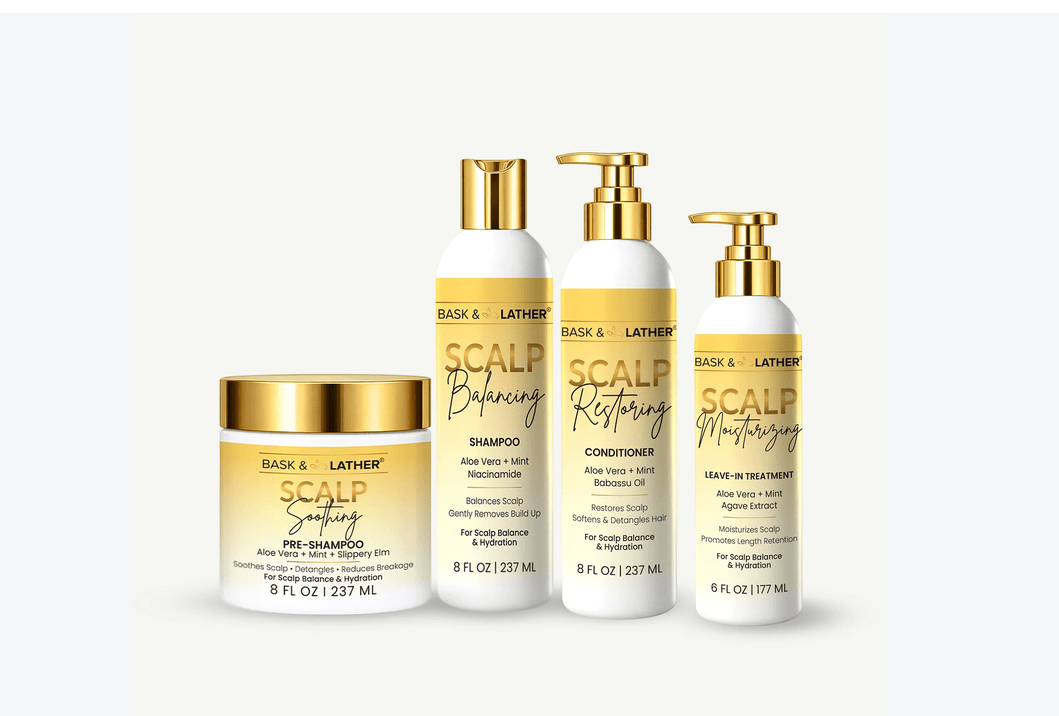
The complete regimen consists of a Scalp Soothing Pre-Shampoo, Scalp Balancing Shampoo, Scalp Restoring Conditioner and Scalp Moisturizing Leave-In Treatment. Each product has a specific role, but they’re formulated to work sequentially—loosening buildup before cleansing, cleansing without unnecessarily stripping moisture, restoring hydration and then helping maintain that moisture after wash day.
That distinction matters particularly for women who regularly wear braids, wigs, slick-backs and other protective or product-heavy styles. Gels, edge controls, oils and styling creams can accumulate on the scalp, while repeated manipulation and detangling can contribute to breakage.
Instead of waiting for dryness, itching or buildup to become noticeable, the Scalp Therapy System makes scalp maintenance part of the routine.
Step One: Prep Before You Shampoo
One of the most distinctive products in the collection is the Scalp Soothing Pre-Shampoo, a moisturizing jelly applied before cleansing.
Formulated with aloe vera, mint and slippery elm, the treatment is designed to soften and loosen buildup while providing enough slip to make detangling easier before shampoo ever touches the hair. Bask & Lather recommends leaving it on for 10 to 30 minutes for additional hydration and easier detangling.
It’s a thoughtful first step because wash-day breakage doesn’t only happen after shampooing. Manipulating dry, tangled hair before cleansing can also create unnecessary stress.
Slippery elm helps provide the “slip” that makes strands easier to separate, while aloe adds hydration and mint creates the refreshing sensation often associated with scalp-care products.
Step Two: Cleanse Without Stripping
Next comes the Scalp Balancing Shampoo, which goes beyond simply removing dirt and product.
Its ingredient list includes willow bark extract, aloe vera, niacinamide, mint, eucalyptus, rosemary, biotin, hydrolyzed rice protein, castor oil and coffee seed extract, among other ingredients.
The cleansing base is designed to remove buildup and impurities while maintaining moisture rather than leaving the scalp and hair feeling stripped.
Niacinamide is particularly noteworthy. An ingredient many consumers already recognize from their skincare routines, it reinforces the collection’s idea that scalp care deserves the same level of attention we give facial skincare.
Step Three: Put Moisture Back In
After cleansing, the Scalp Restoring Conditioner focuses on hydration, softness and manageability.
Here, the ingredient story gets richer. The formula combines niacinamide, aloe vera and mint with babassu oil, castor oil, avocado oil, murumuru butter, rosemary oil, biotin, hydrolyzed wheat protein and silk amino acids.
Babassu oil helps give the formula its nourishing quality, while the combination of conditioning agents, oils and proteins is designed to soften hair and make detangling easier.
For textured hair in particular, manageability isn’t simply cosmetic. The easier hair is to detangle, the less pulling and manipulation it may require. Bask & Lather specifically positions the conditioner as helping reduce breakage during detangling while restoring moisture to both the scalp and hair.
Step Four: Don’t Let the Moisture Stop at Wash Day
The routine finishes with the Scalp Moisturizing Leave-In Treatment.
Its formula includes agave extract, babassu oil, aloe vera, avocado oil, sunflower seed oil, murumuru butter, rosemary, eucalyptus, mint, slippery elm, panthenol and hydrolyzed rice protein.
The leave-in is designed to maintain hydration after the rinse-out portion of wash day is complete. It can be incorporated into natural and curly styling routines as well as used before blow-drying for silk presses.
It’s that continuity that helps distinguish the award-winning collection: scalp care isn’t confined to one bottle.
The “Skinification” of Hair Care
Perhaps the most compelling part of Bask & Lather’s approach is that the brand is tapping into the growing intersection between skincare and hair care.
Think about a sophisticated skincare regimen: you prep, cleanse, treat and moisturize. The Scalp Therapy System applies a similar logic above the neck.
Rather than positioning one miracle product as the answer to every hair concern, Bask & Lather has created a routine in which each step prepares for the next.
The result is an award-winning collection that approaches scalp health as a complete regimen rather than an afterthought.
A Scalp-First Philosophy That Goes Back to the Brand’s Roots
The focus on scalp health isn’t new territory for Bask & Lather.
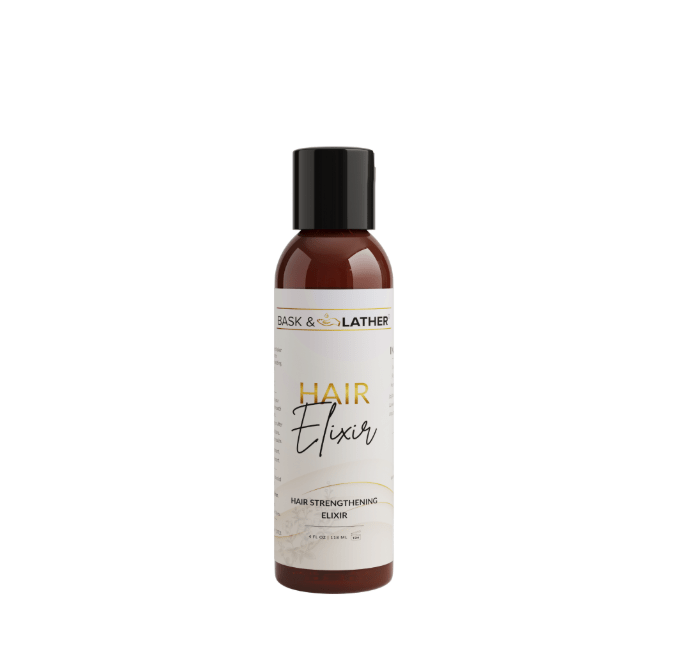
The company itself grew out of a deeply personal experience. According to the brand, founder and CEO Shaina Rainford’s younger sister lost her hair after a scalp condition was initially misdiagnosed as dandruff. Their mother subsequently developed natural formulas for her scalp and hair, which became the foundation for Bask & Lather’s Scalp Stimulator and Hair Elixir.
That history makes the award-winning Scalp Therapy System feel less like an excursion into a trending category and more like an expansion of the philosophy that has been embedded in Bask & Lather from the beginning.
The original question was how to create an environment where compromised hair could thrive. Today, that idea has evolved into an entire regimen.
The Bottom Line
The beauty of Bask & Lather’s award-winning Scalp Therapy System is that it makes the scalp the main character.
From aloe vera and slippery elm in the pre-shampoo to niacinamide in the cleansing and conditioning steps and babassu, agave and nourishing oils throughout the regimen, every stage is designed around creating a cleaner, hydrated and more balanced foundation for healthier-looking hair.
For anyone accustomed to spending considerable time—and money—on what happens from the roots down, Bask & Lather offers a reminder that perhaps the most important part of the hair-care routine is the part we can’t style.
Because great hair doesn’t simply start with the strands.
Jennifer Lopez has landed in Milan, and she wasted no time embracing Italian fashion and glamour with longtime favorite Dolce & Gabbana.
The superstar touched down in Italy for Milan Fashion Week and kicked off her fashionable stay with a major moment at Vogue World: Milano, held inside the iconic Galleria Vittorio Emanuele II. Lopez arrived alongside designers Domenico Dolce and Stefano Gabbana before later taking to the Vogue World runway herself.
For the occasion, J.Lo embodied classic Italian glamour in a dramatic black Dolce & Gabbana tea-length gown featuring a voluminous tulle skirt and intricate lace and beaded embellishments. She accessorized the look with sheer black opera gloves, patent slingback pumps, and spectacular Dolce & Gabbana Alta Gioielleria jewels, including a statement necklace centered around an extraordinary Paraíba tourmaline.
With her voluminous waves and signature glow, Lopez channeled the unapologetic femininity and sensuality that have long defined both her personal style and the Dolce & Gabbana woman.
But one Dolce moment was hardly enough.
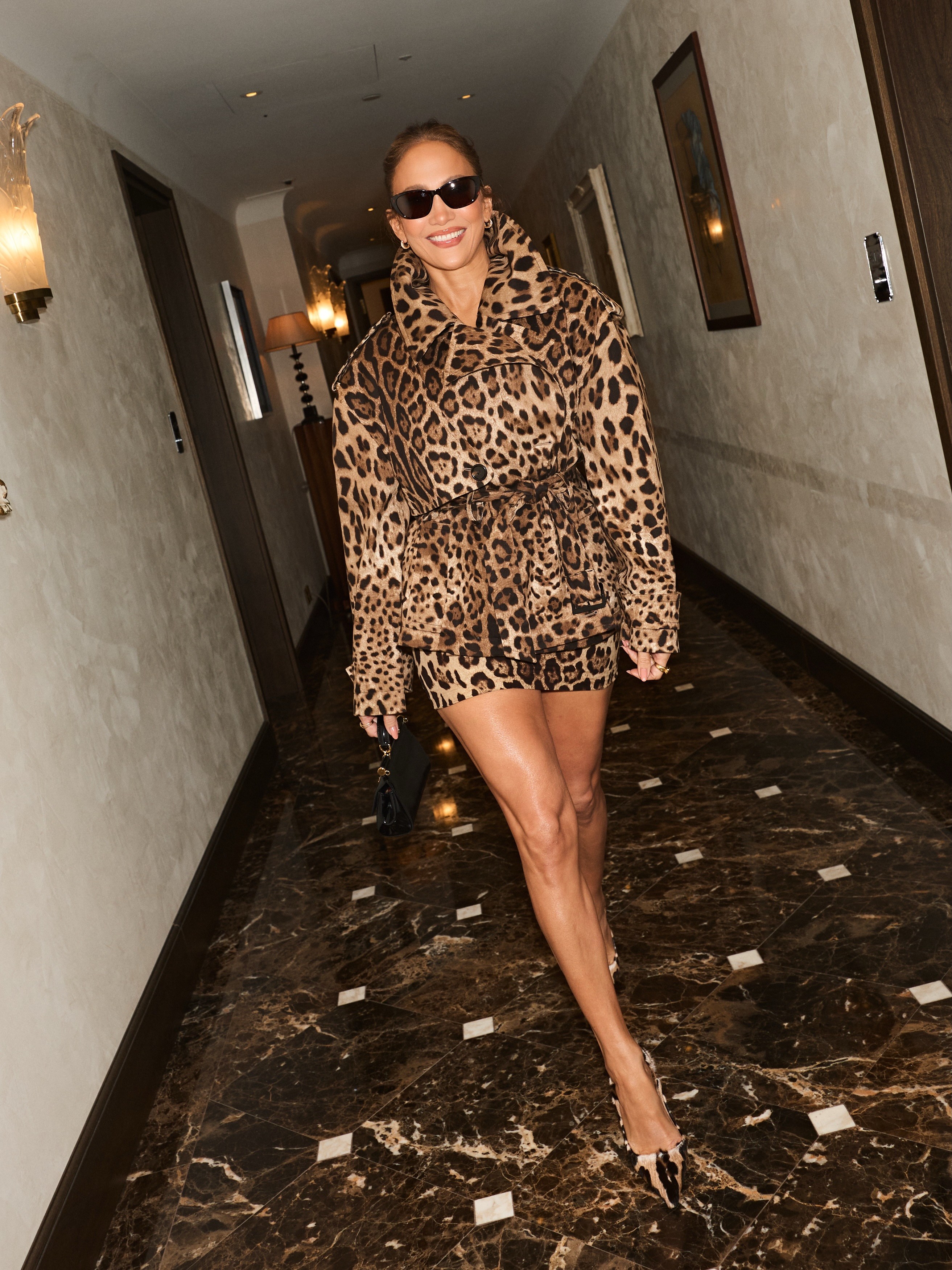
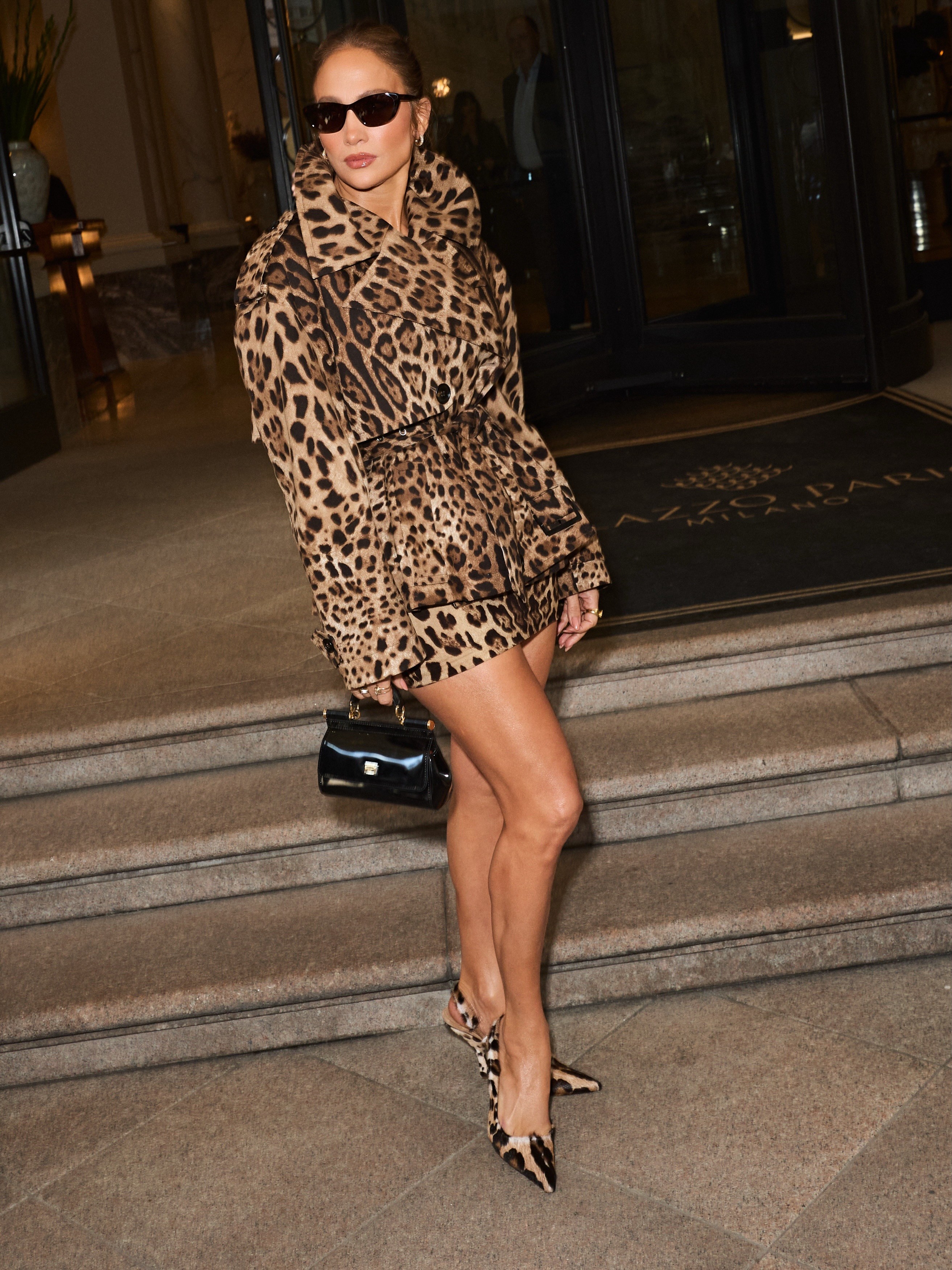
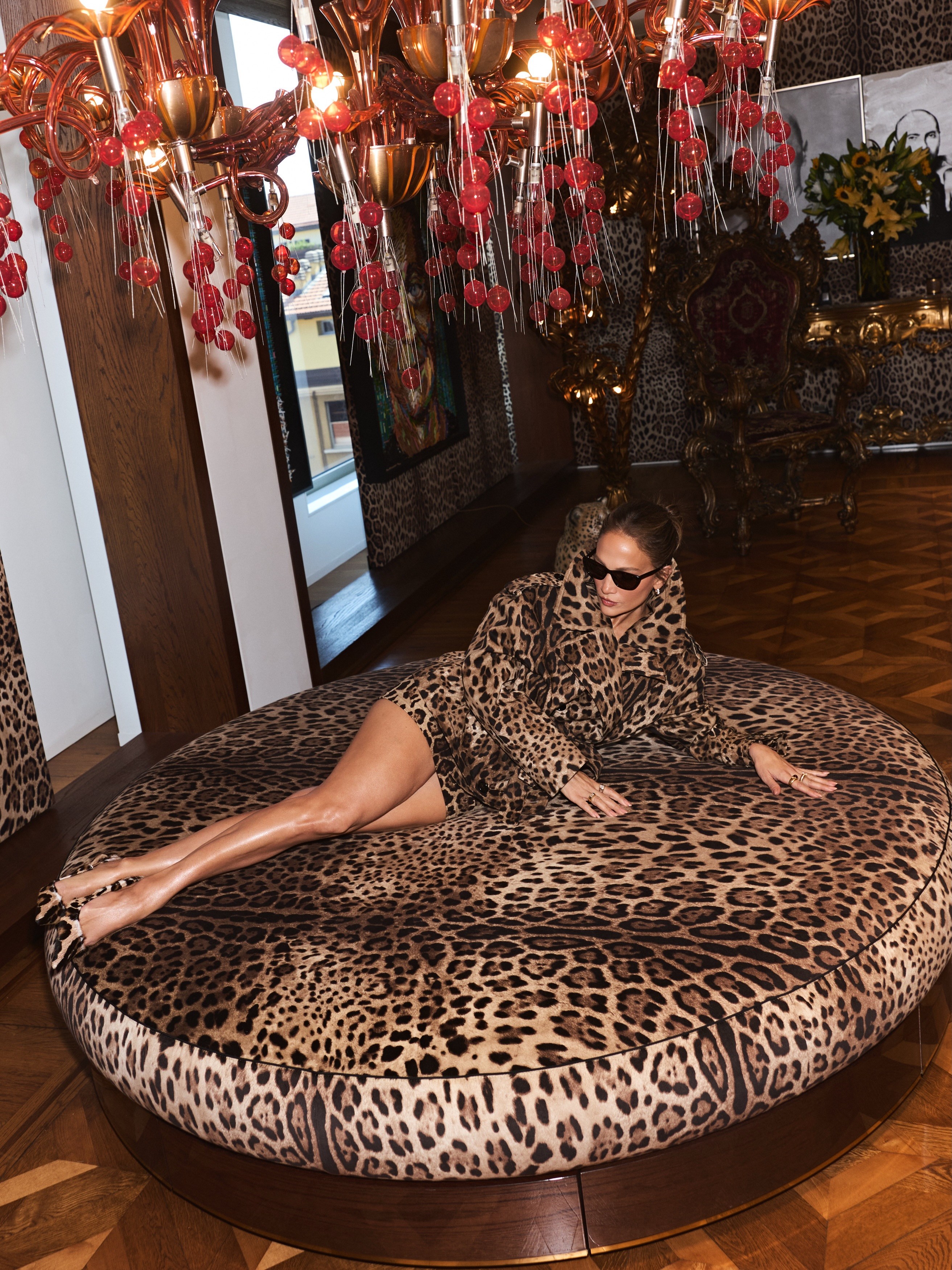
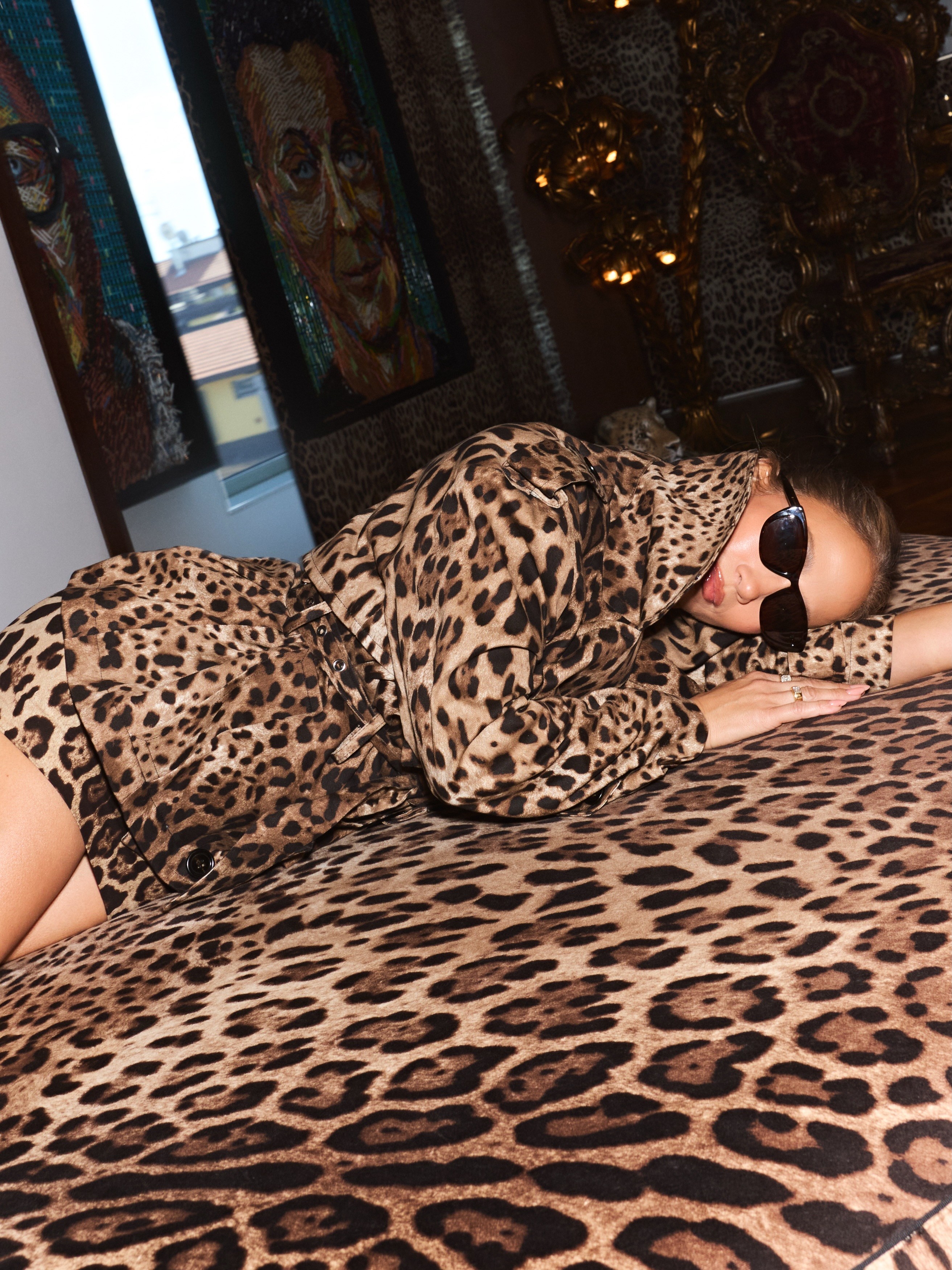
The following day, Jenny from the Block traded black-tie glamour for a walk on the wild side, hitting the streets of Milan in head-to-toe Dolce & Gabbana leopard.
Styled by her longtime collaborators Rob Zangardi and Mariel Haenn, Lopez stepped out in a cropped leopard-print trench paired with coordinating bottoms and matching leopard footwear. Oversized sunglasses and gold accessories amplified the look, proving once again that when it comes to J.Lo, more is often more.
Animal print has long been part of the Dolce & Gabbana vocabulary, making the ensemble a natural marriage between the Italian house’s maximalist aesthetic and Lopez’s own fearless approach to fashion. Leopard may be a statement for some, but on J.Lo, it might as well be a neutral.
Her Milan wardrobe also continues a longstanding relationship between the superstar and Dolce & Gabbana. From glamorous red carpets and front-row appearances to the house’s Alta Moda celebrations, Lopez has repeatedly turned to Domenico Dolce and Stefano Gabbana when the occasion calls for unabashed glamour, sex appeal, and a little Italian drama.
And Milan Fashion Week is only getting started.
From twirling through Vogue World in black tulle to prowling the Milan streets in full leopard, J.Lo has already made one thing clear: she didn’t come to Italy to play it safe.
What do you think of her latest Dolce & Gabbana looks?
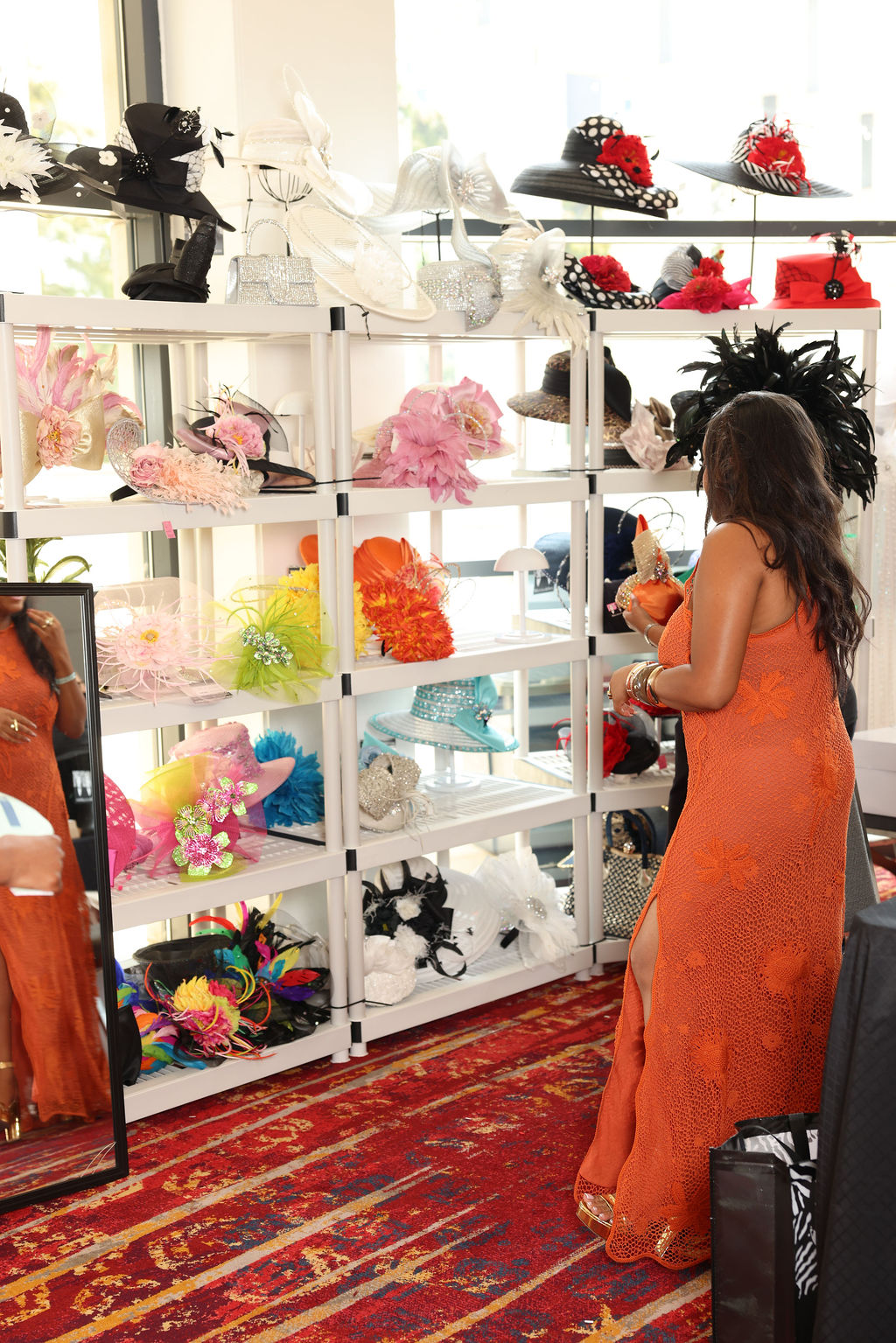
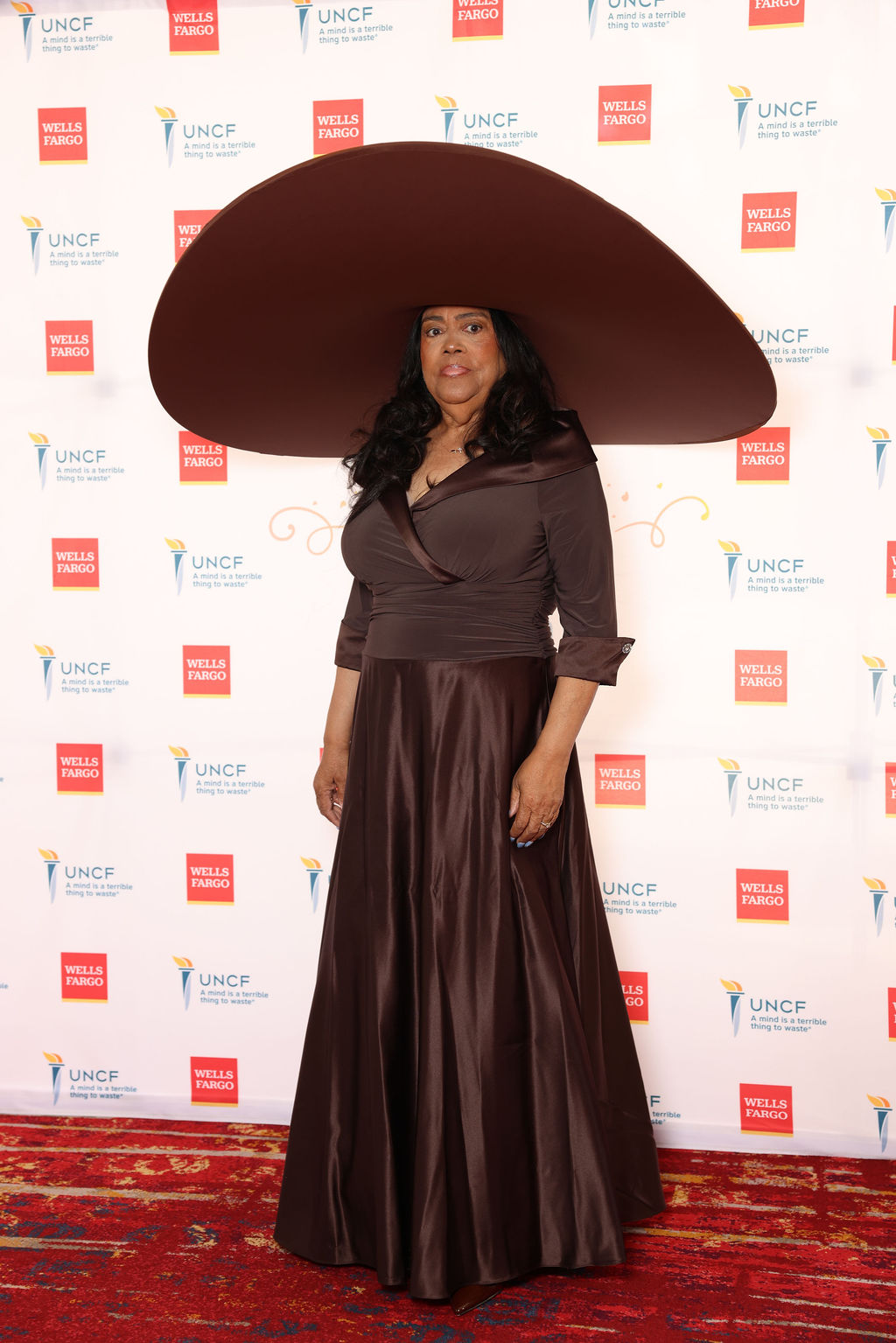
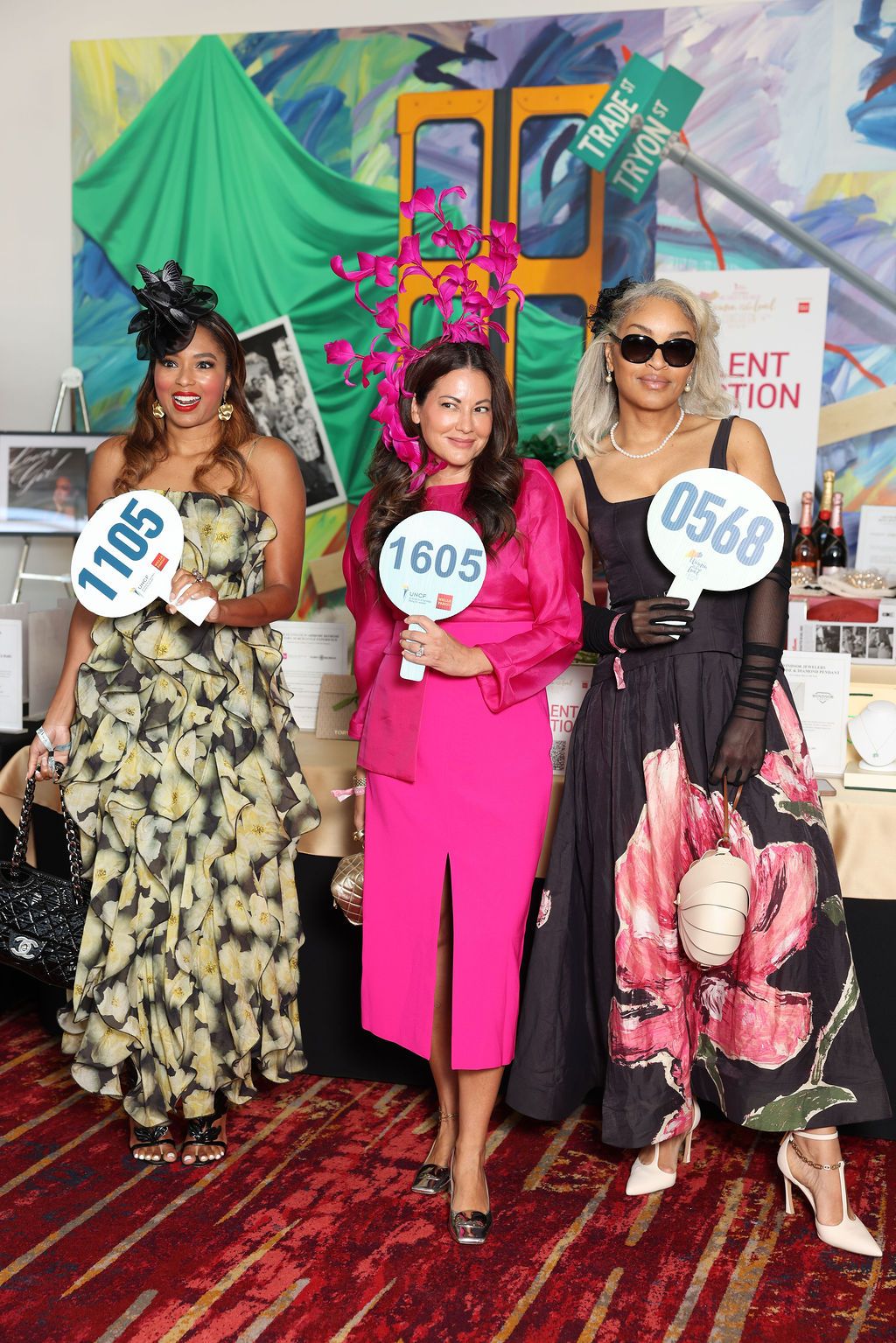
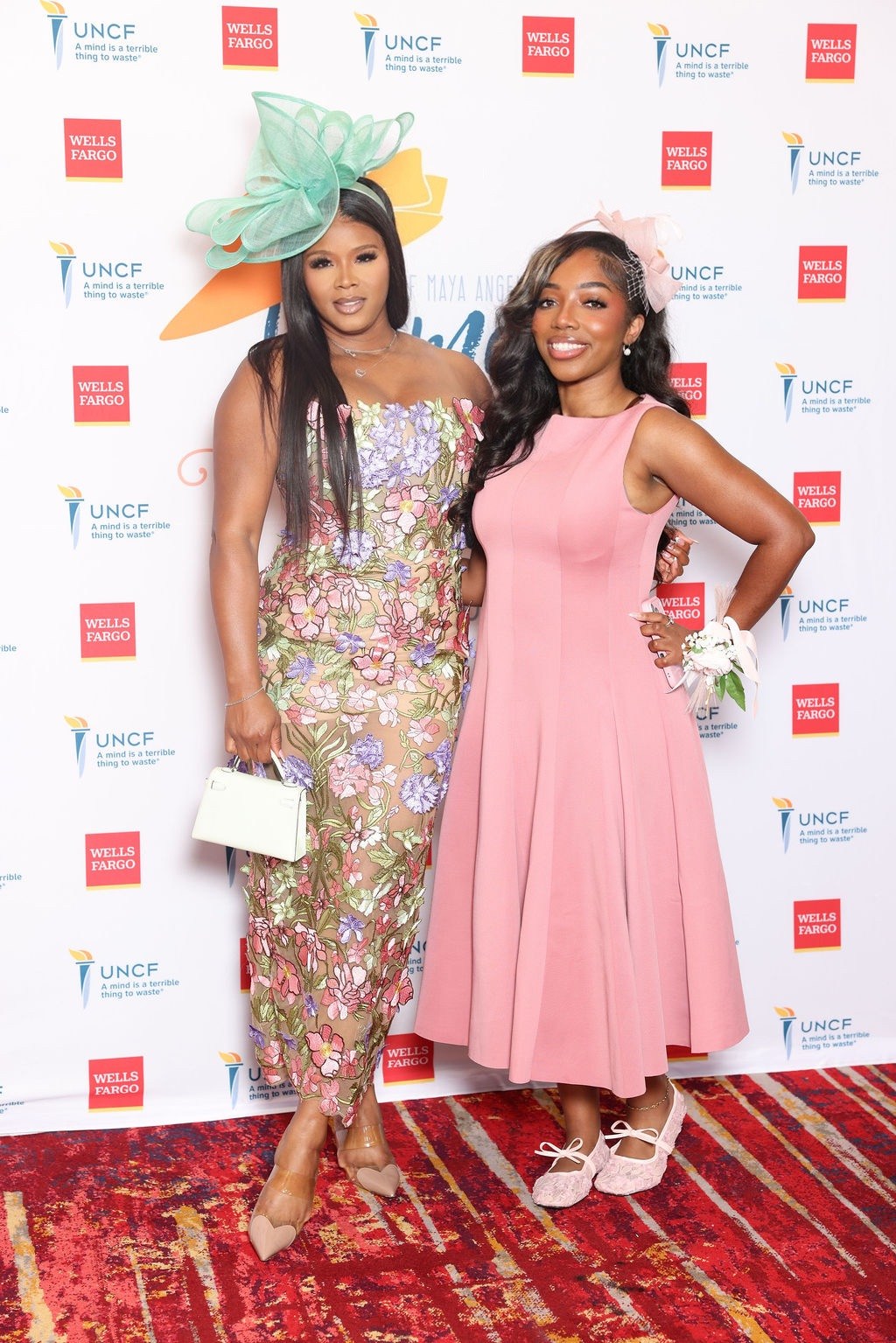
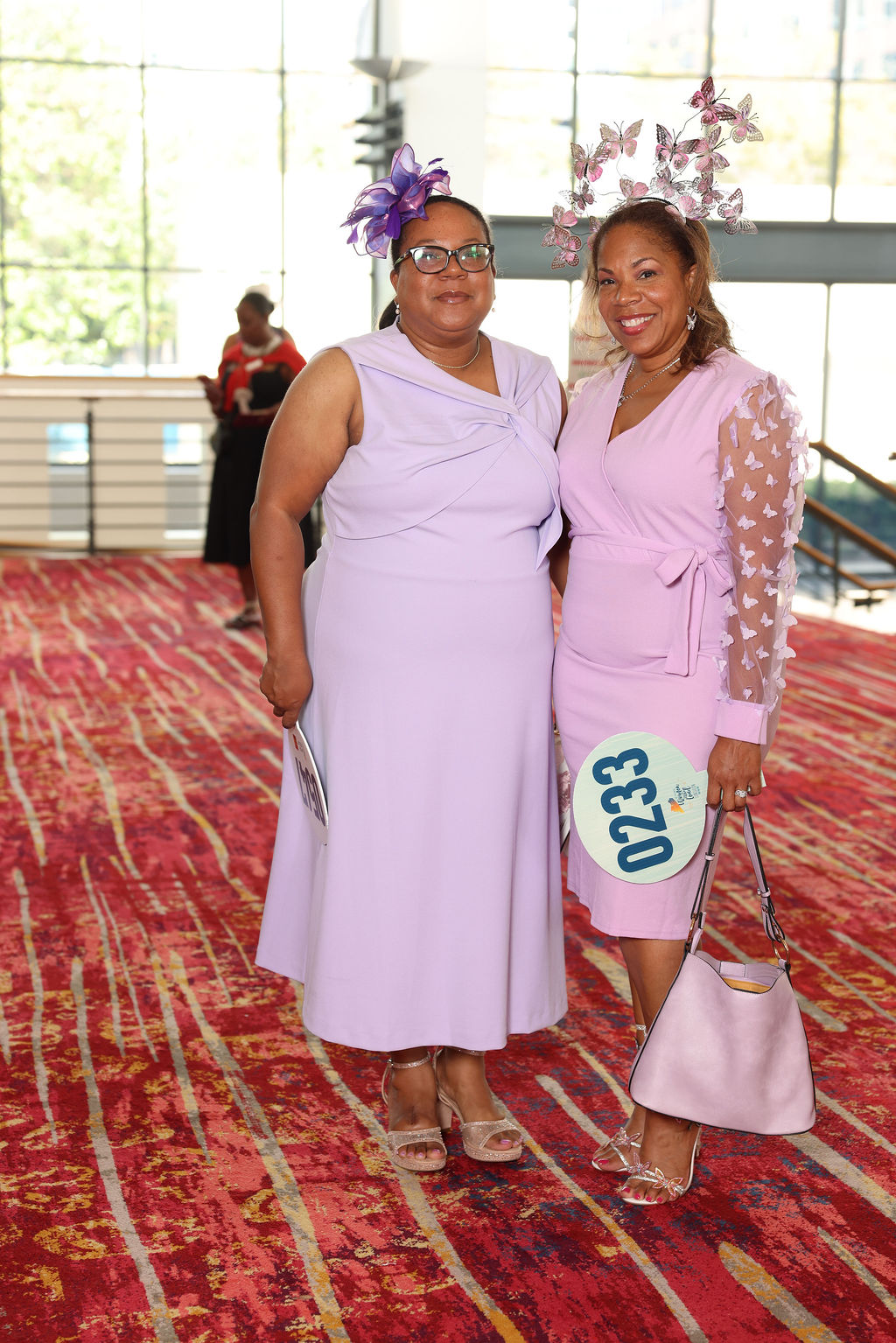
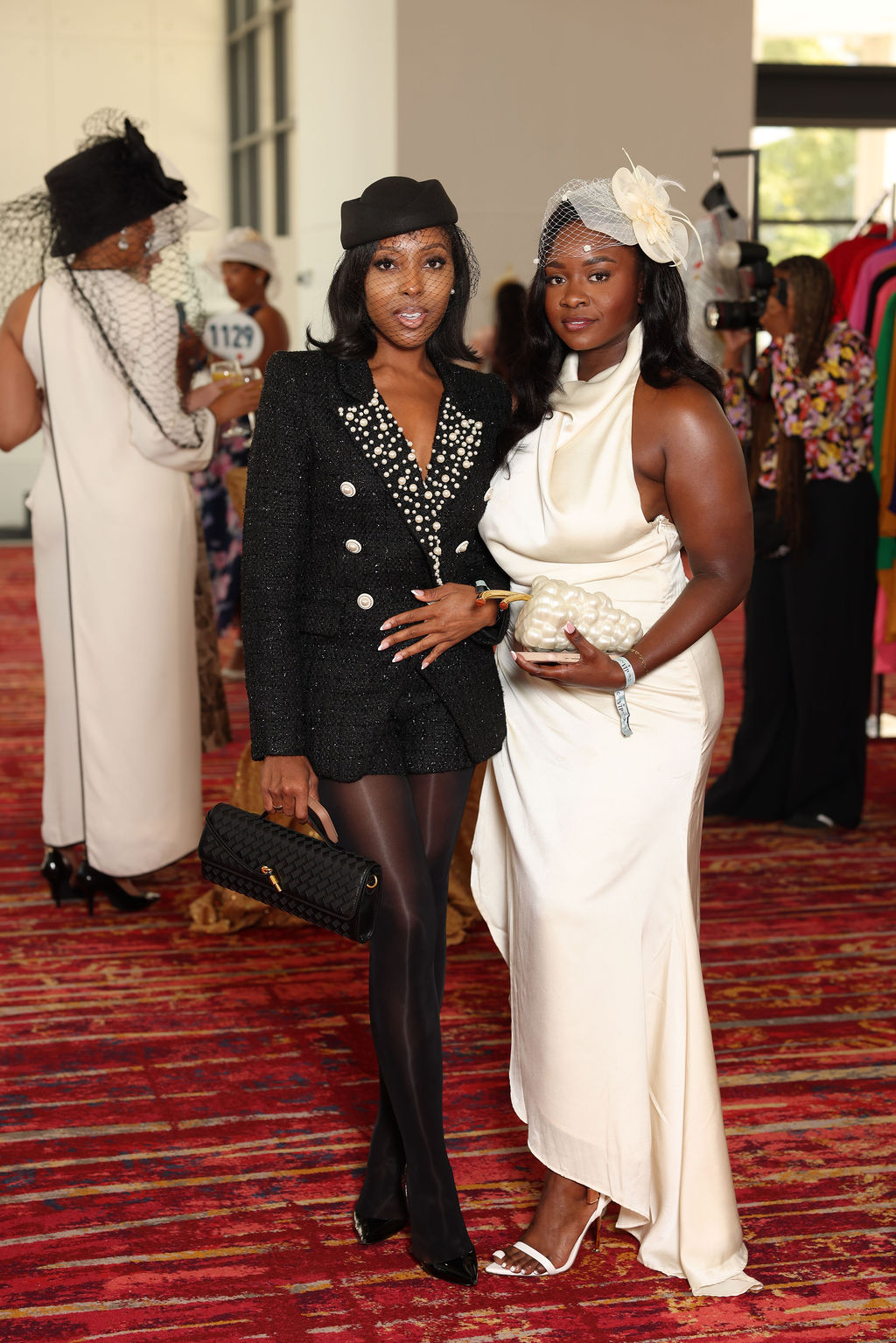
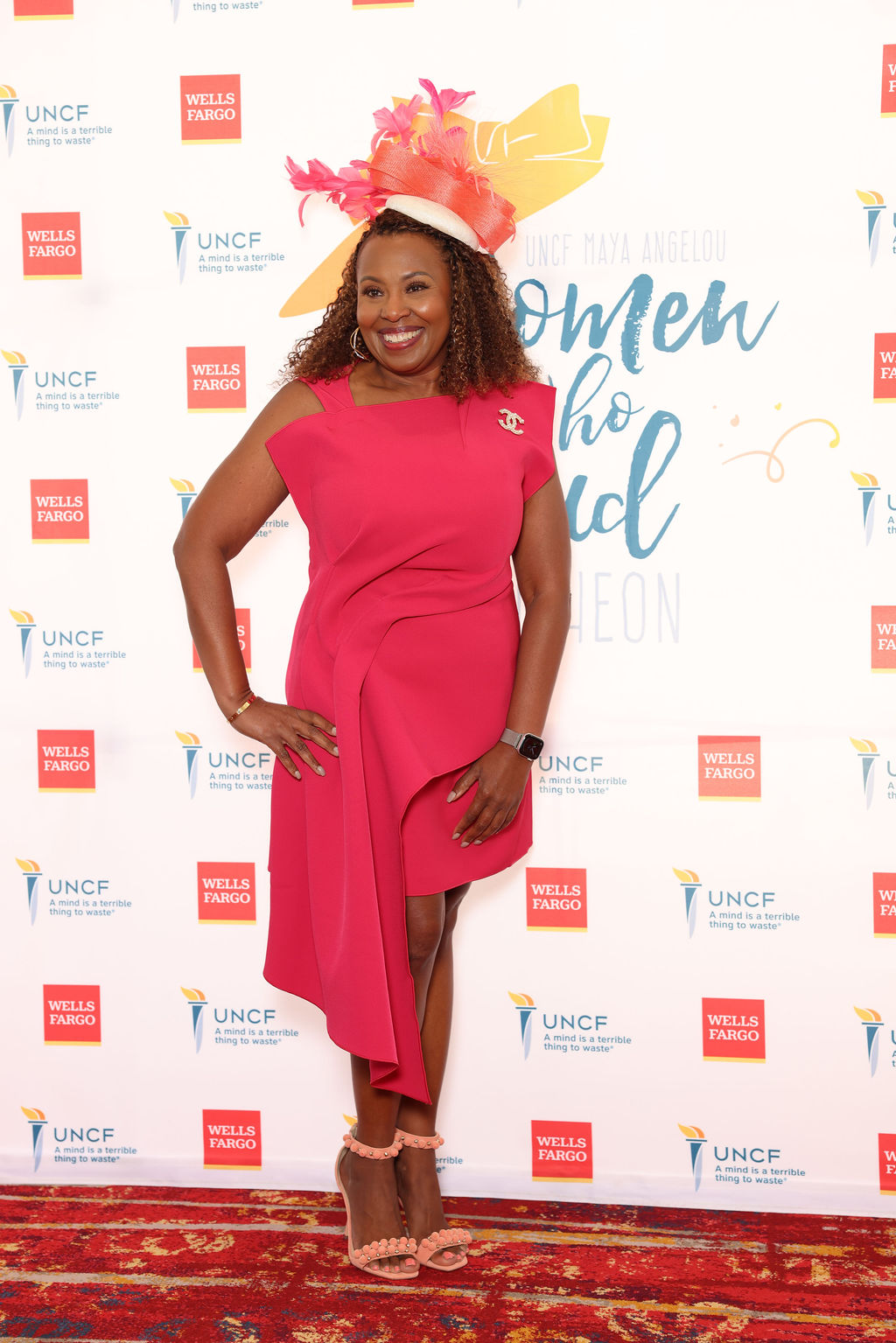
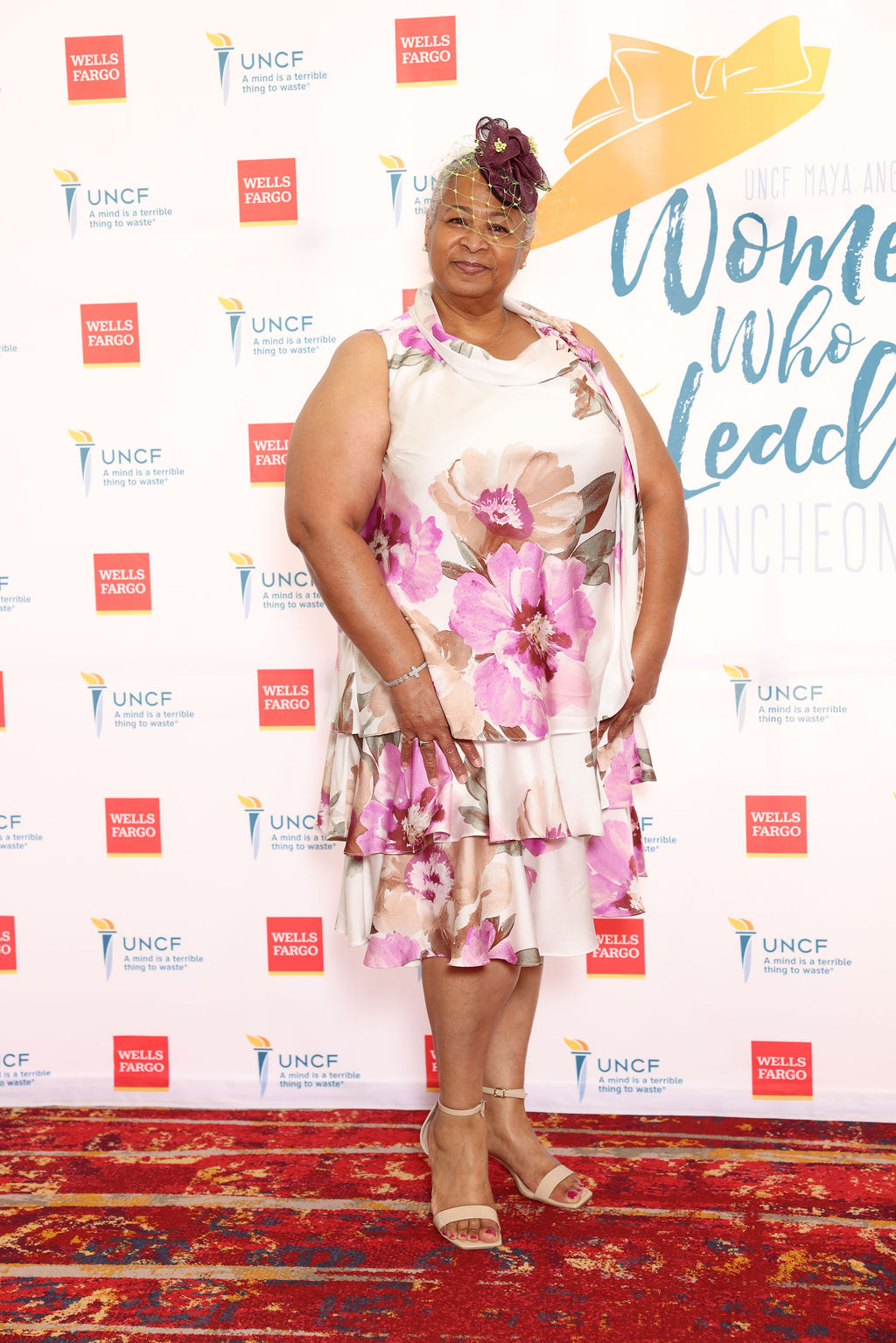
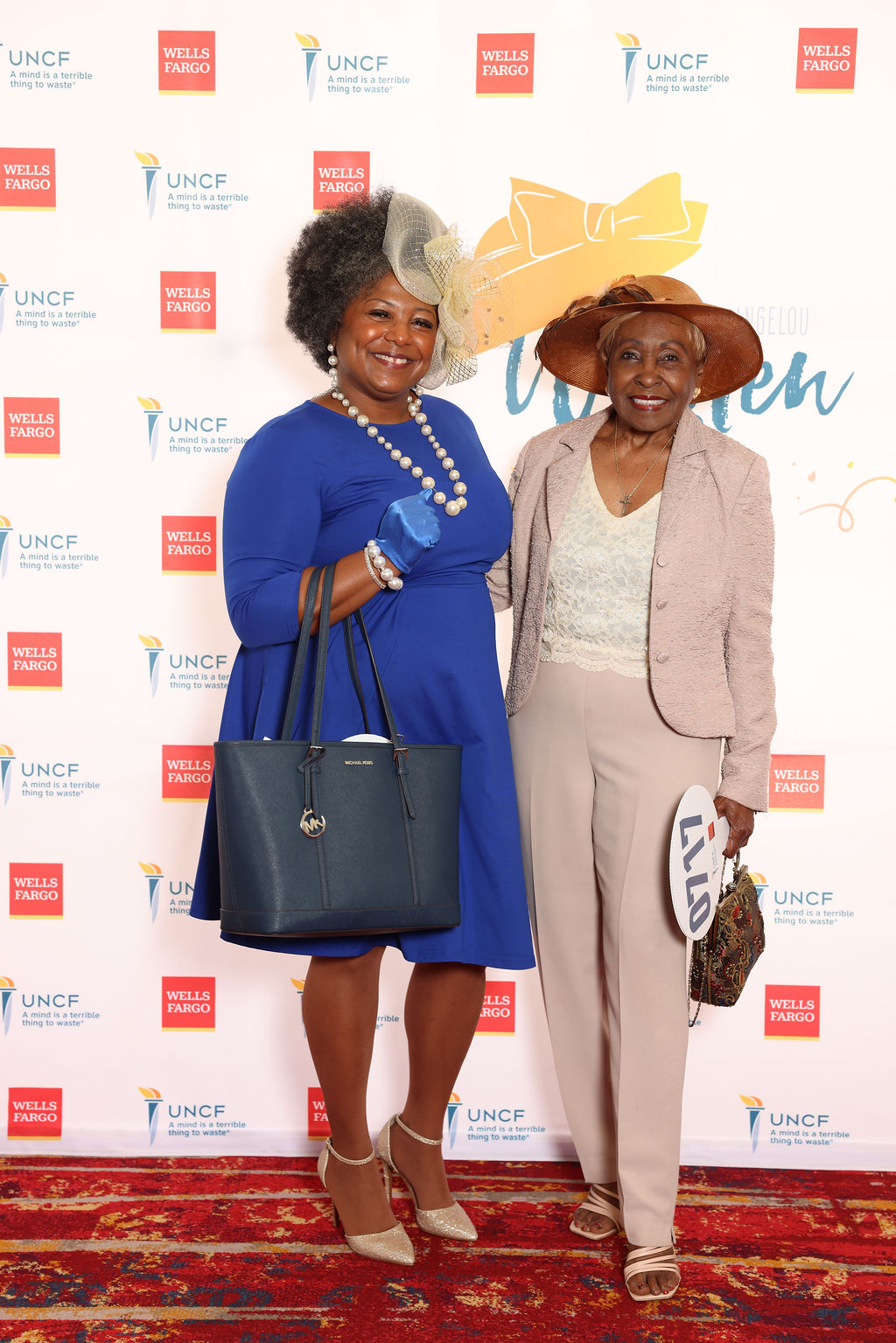
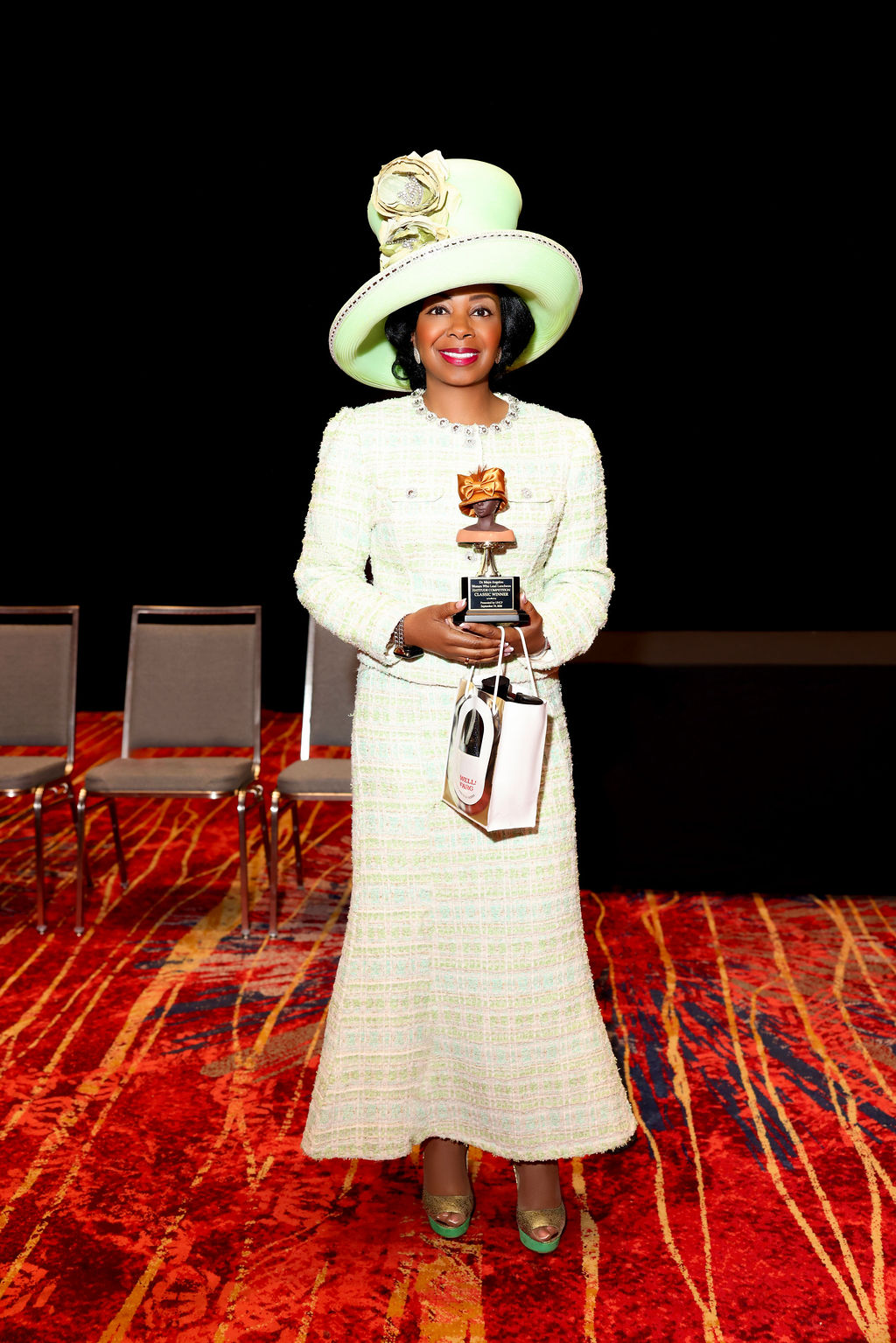
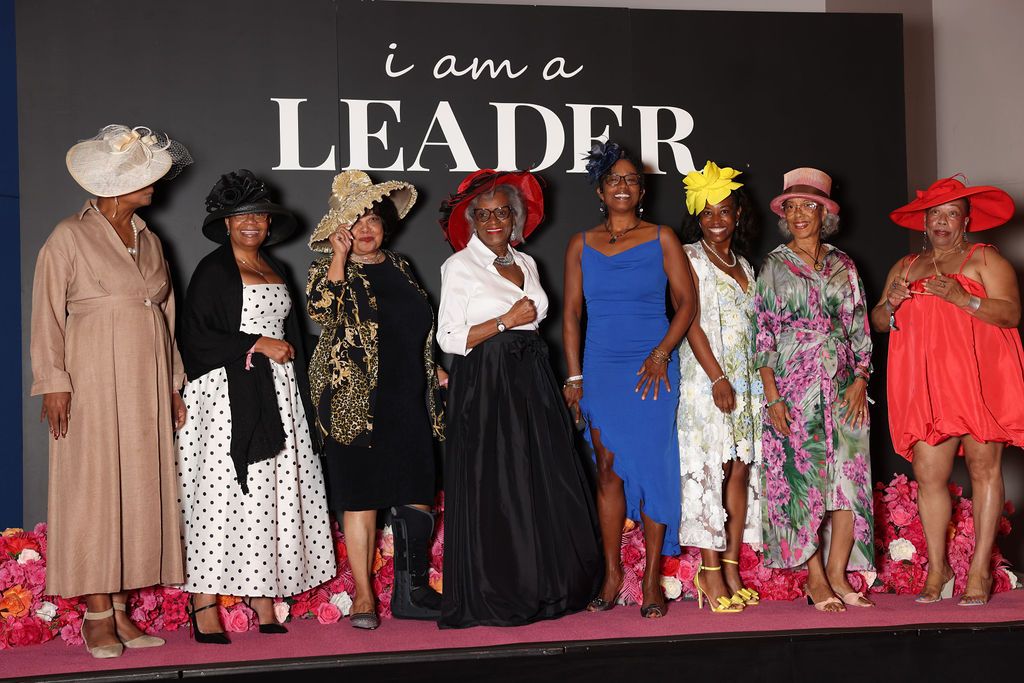
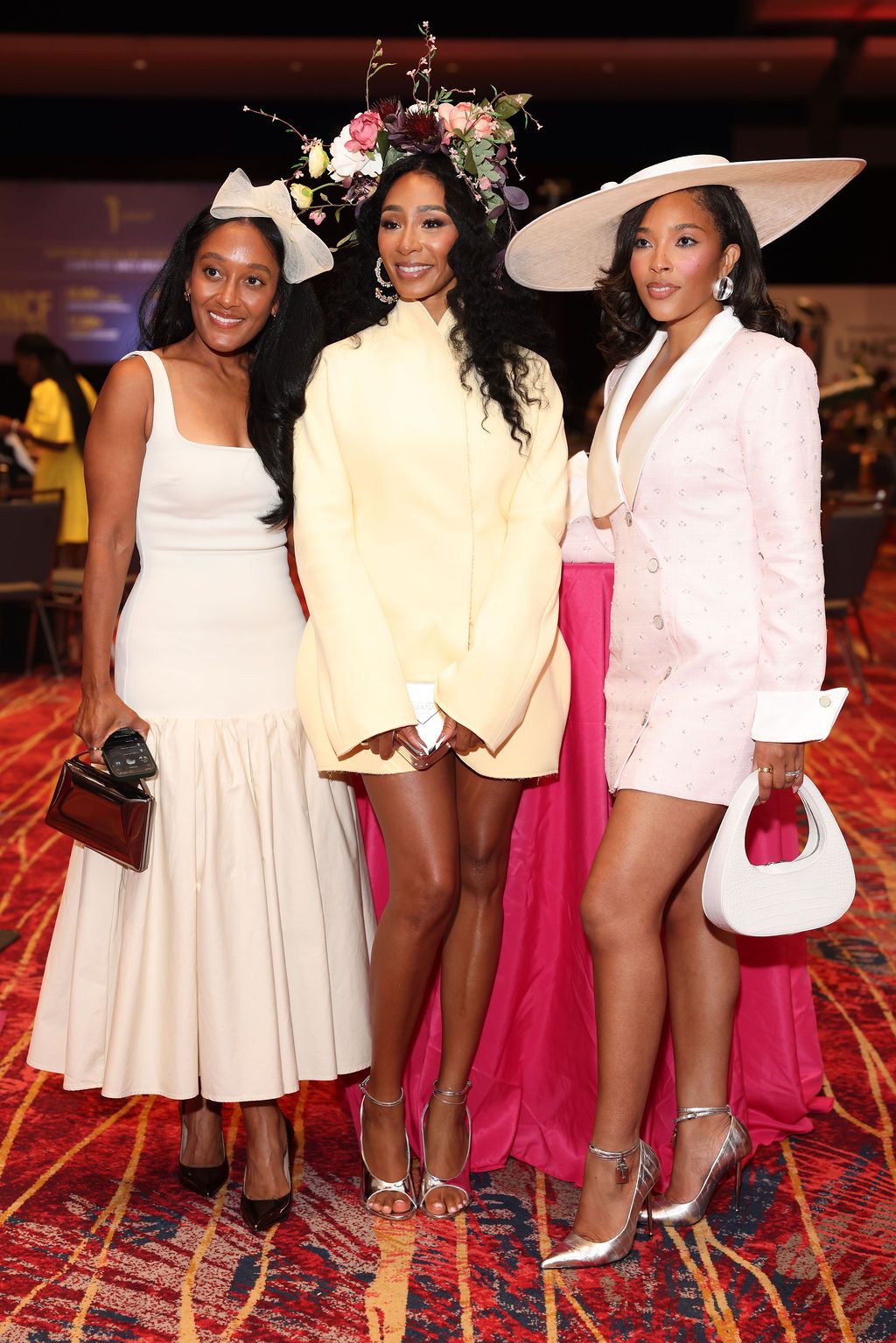
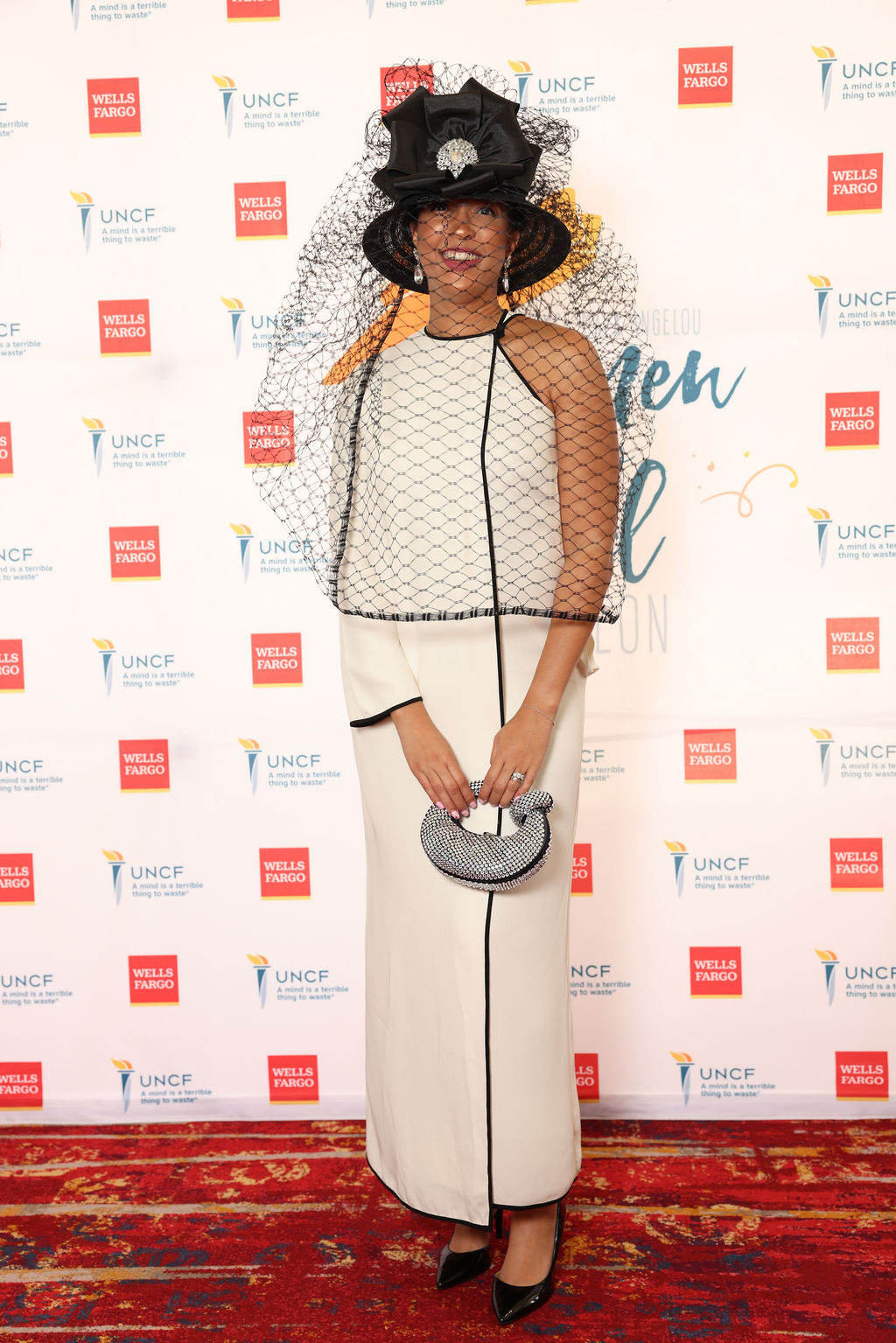
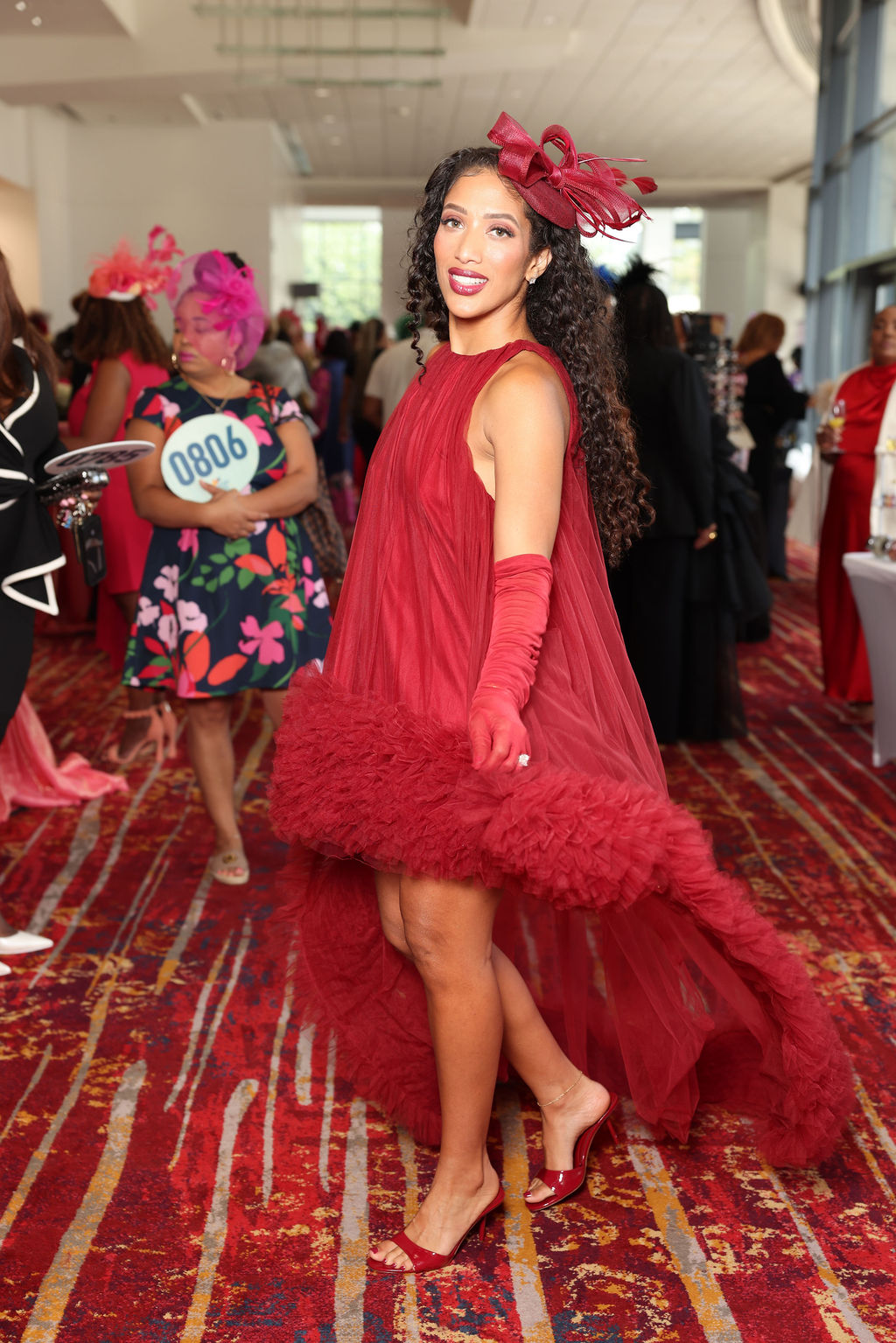
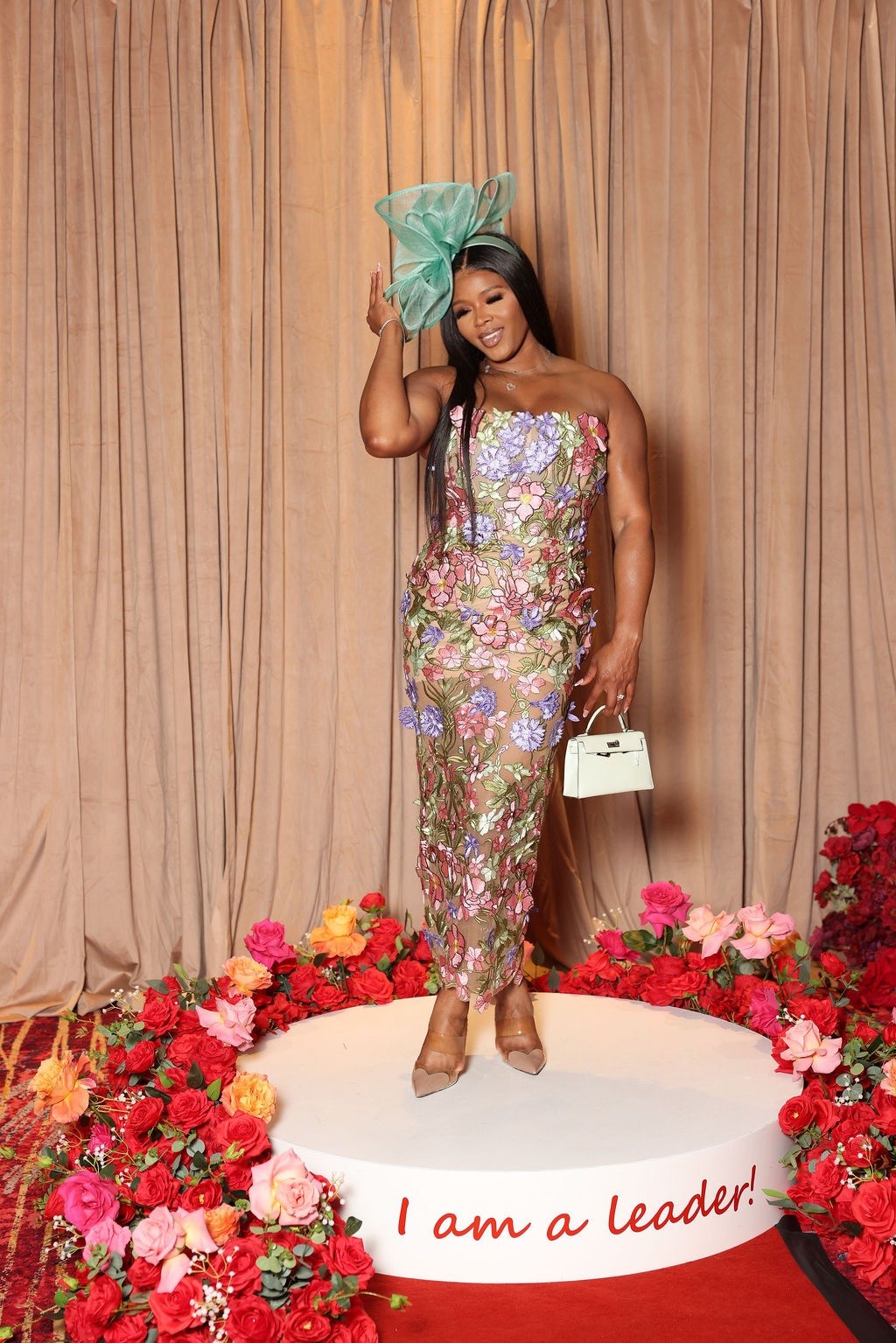
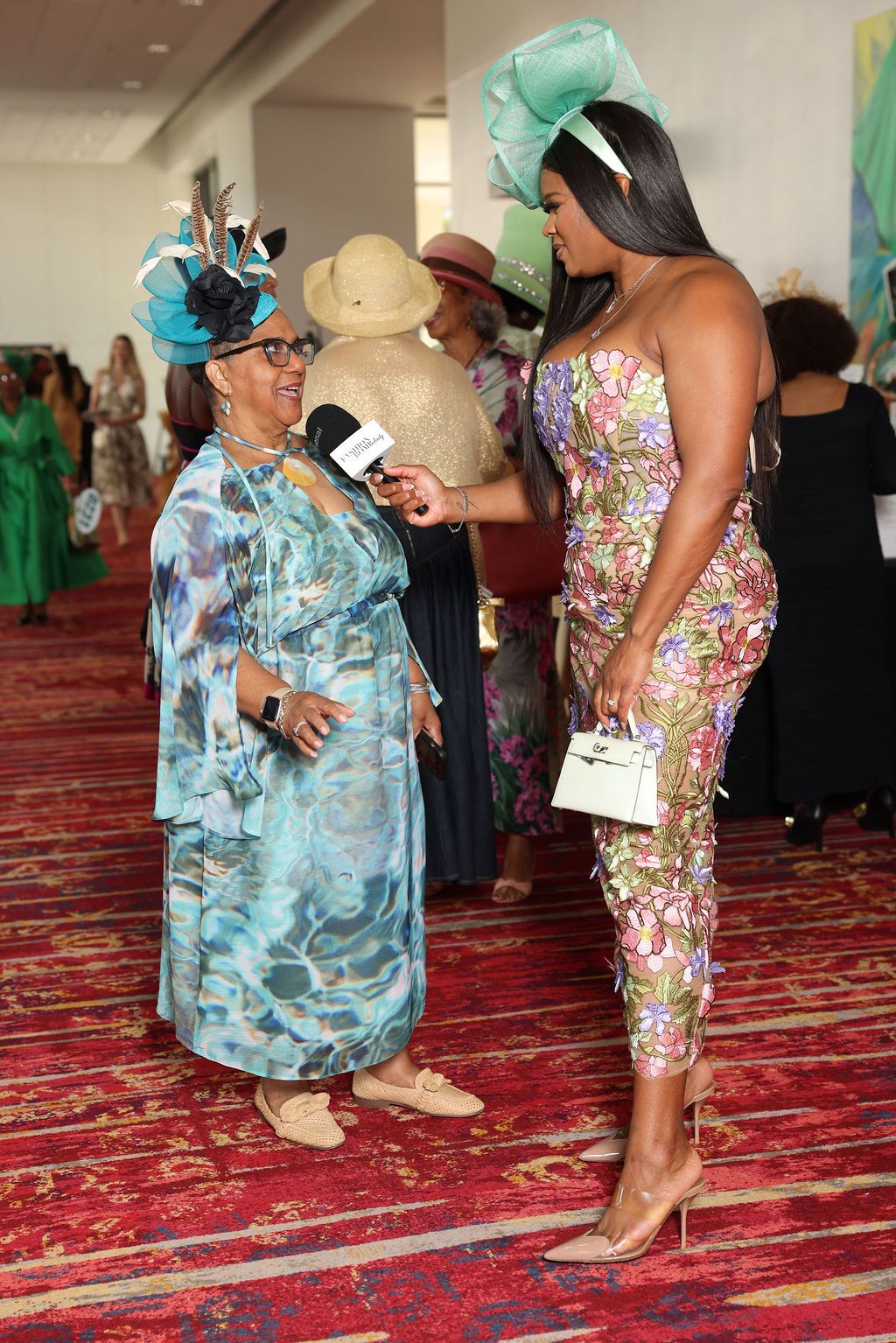
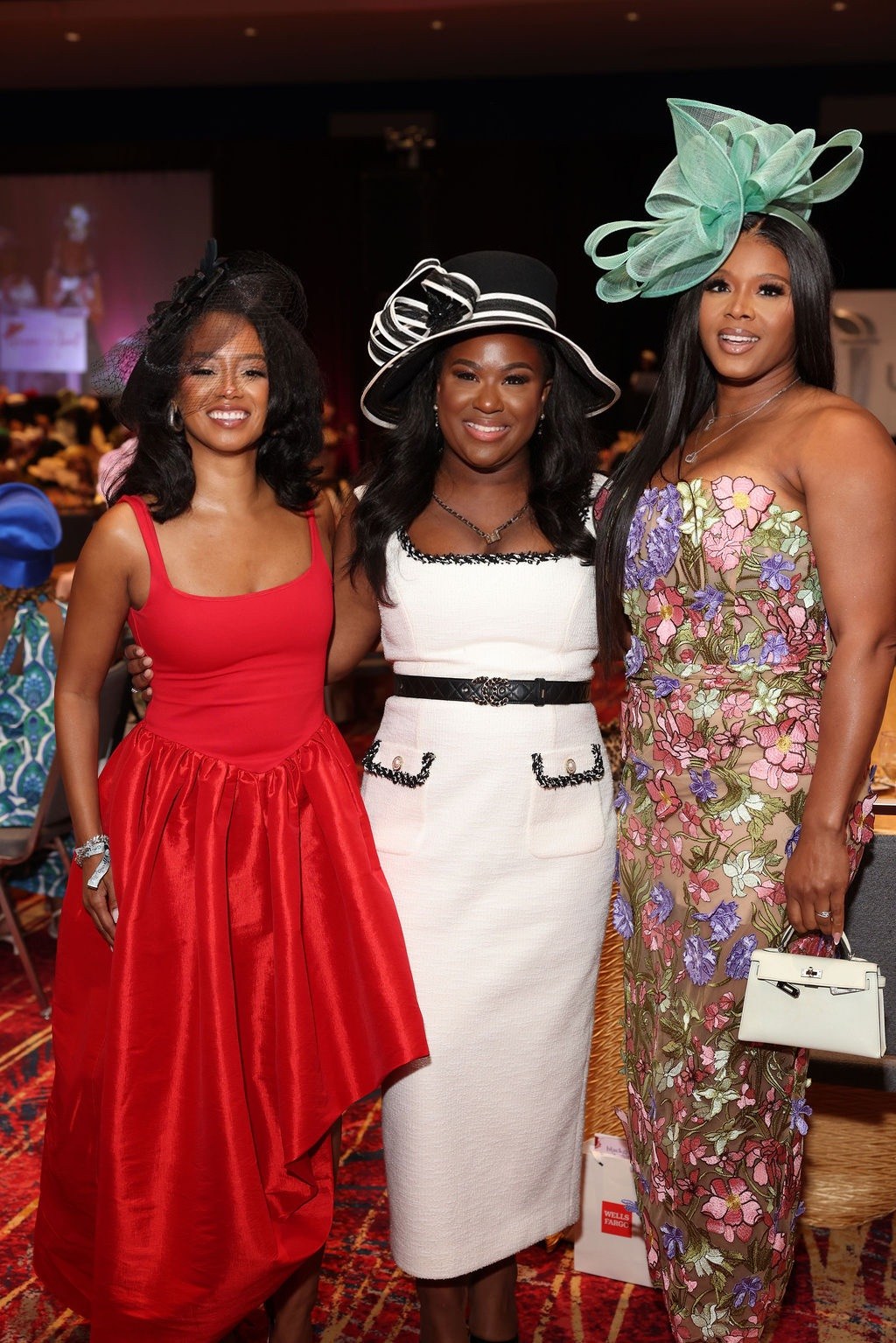
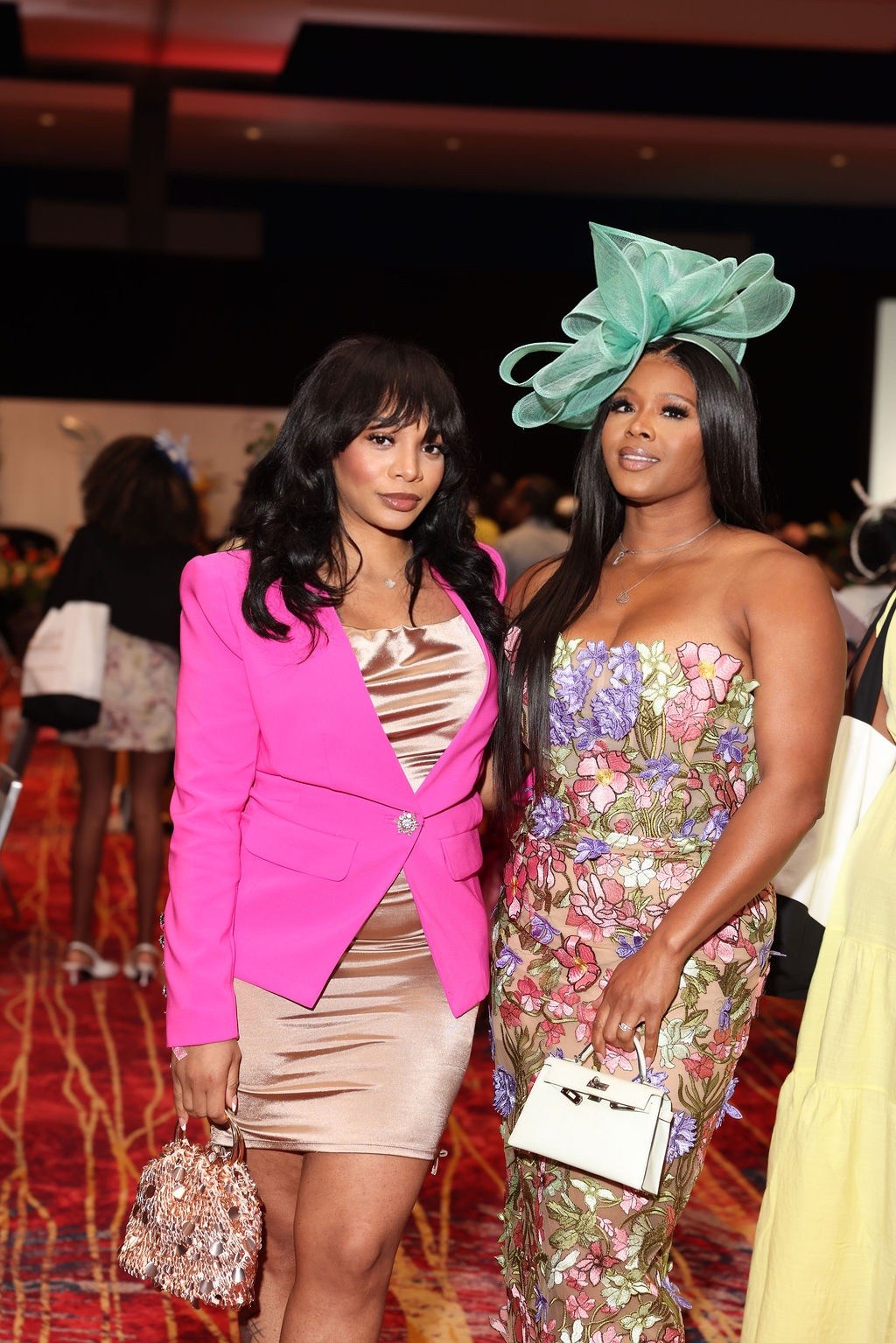
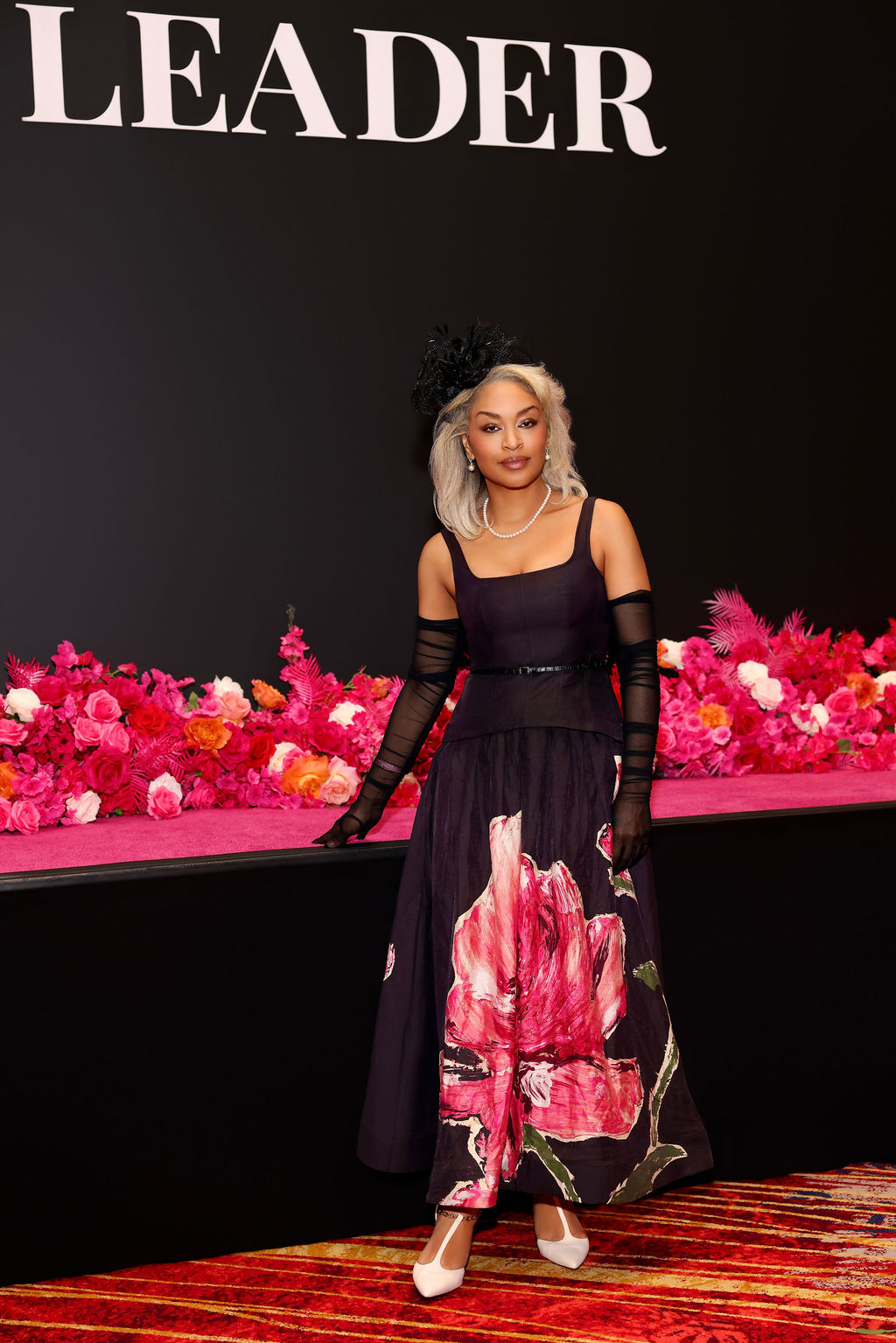
Fashion Bomb Daily was on the scene for the 24th Annual UNCF Maya Angelou Women Who Lead Luncheon, presented by Wells Fargo, held Saturday, September 19th at the Charlotte Convention Center’s Richardson Ballroom.
Now one of Charlotte’s largest annual women’s luncheon fundraisers, the event is named in honor of Dr. Maya Angelou, a longtime UNCF supporter whose belief in education inspired the luncheon’s creation. This year’s gathering aimed to raise over $550,000 to support students across North Carolina, continuing UNCF’s mission to help students get to, and through, college.
The day kicked off at 10am with shopping from local vendors, mimosas, and red carpet photos, building anticipation for the noon program.
This year’s theme centered on Beauty, Health & Wellness, brought to life through a panel discussion moderated by Ohavia Phillips-Reed, giving honorees a platform to share their journeys shaping the future of the industry.
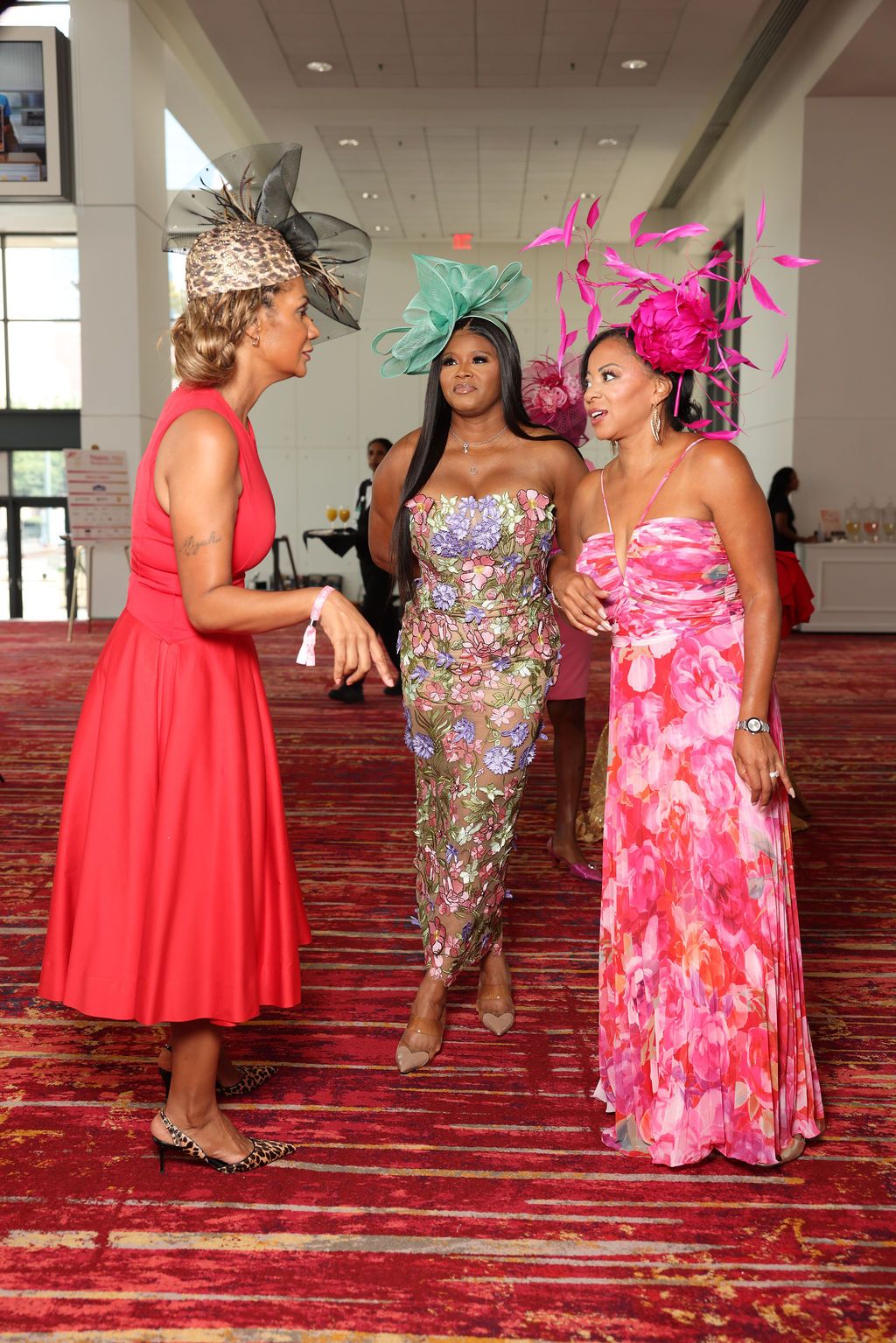
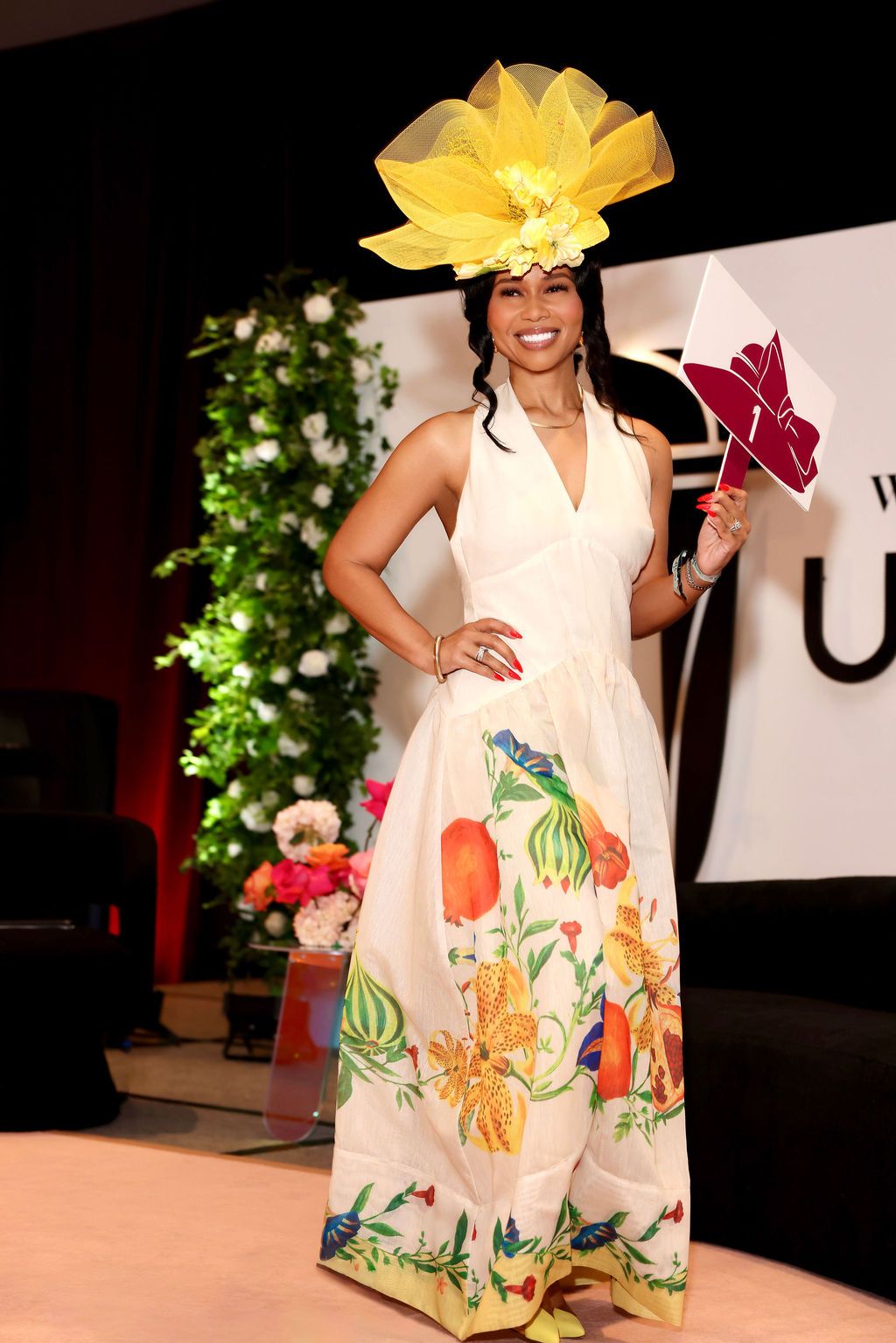
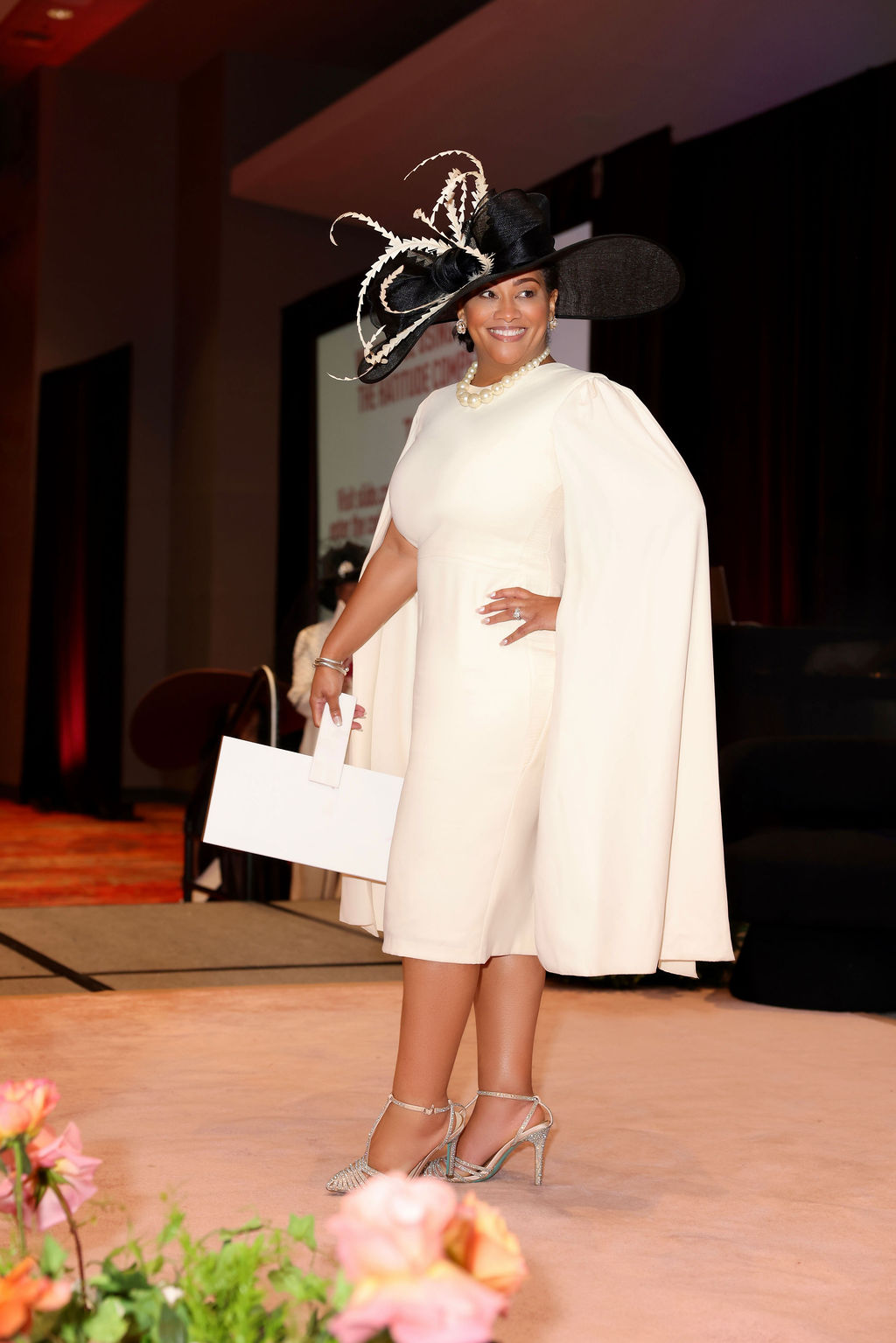
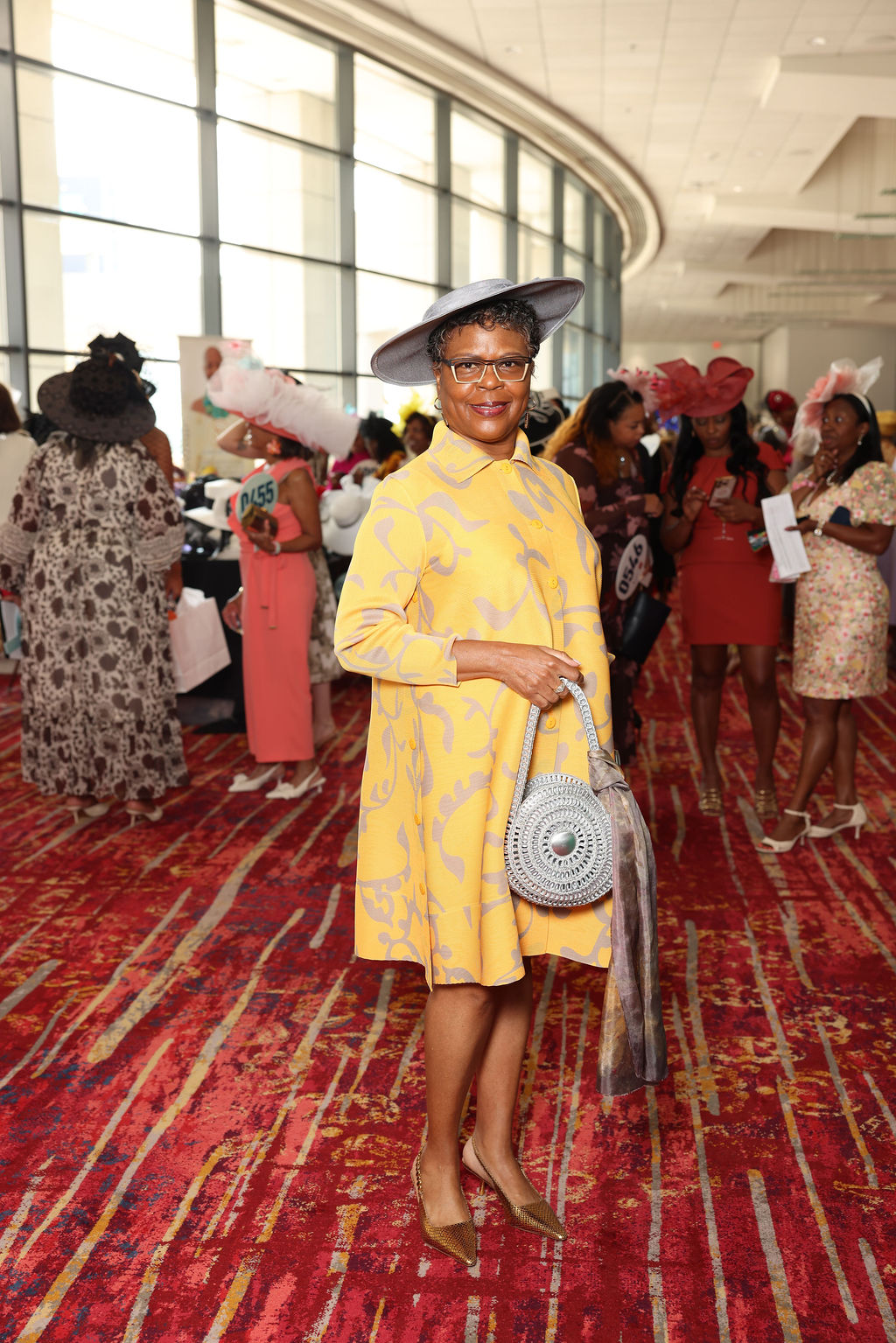
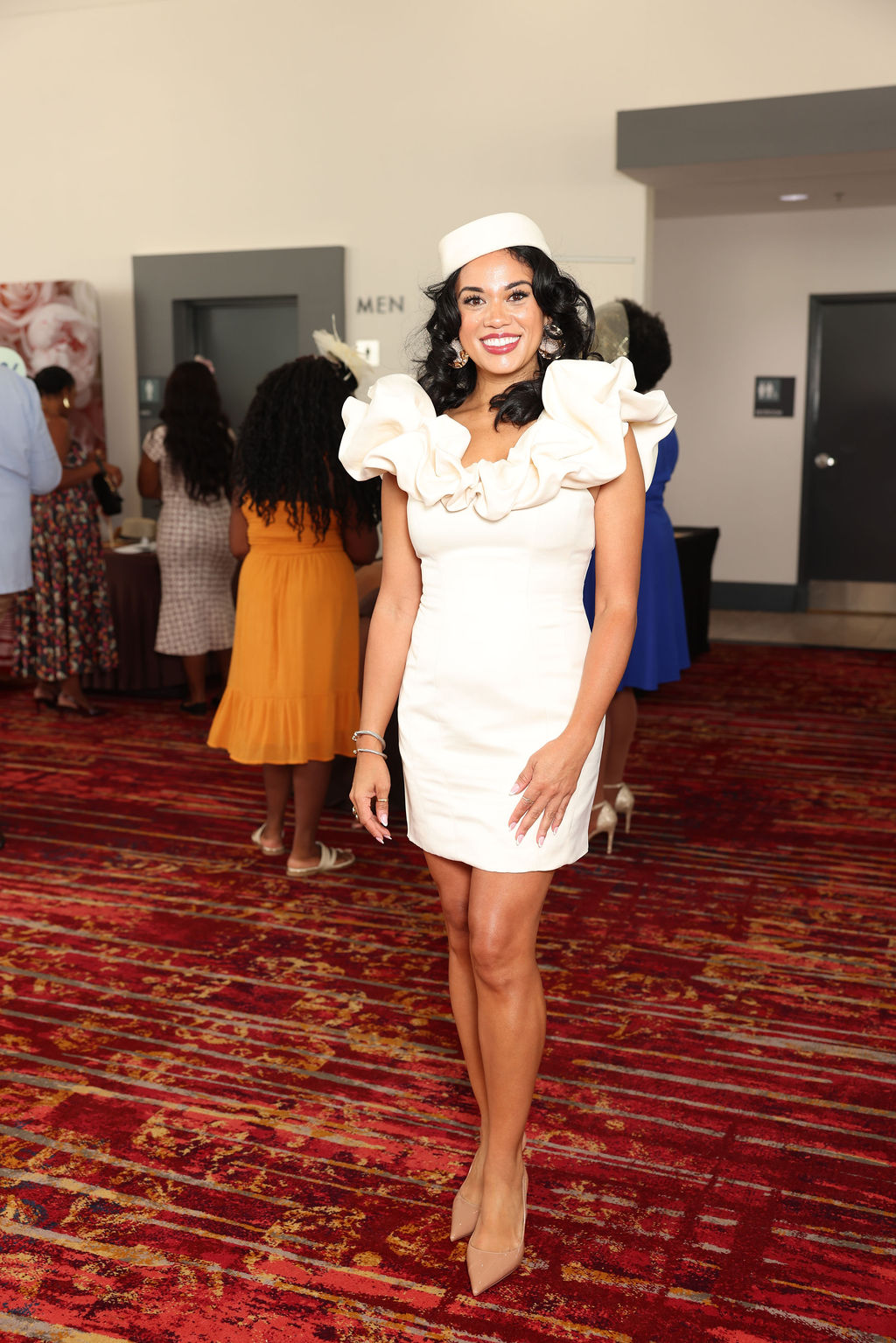
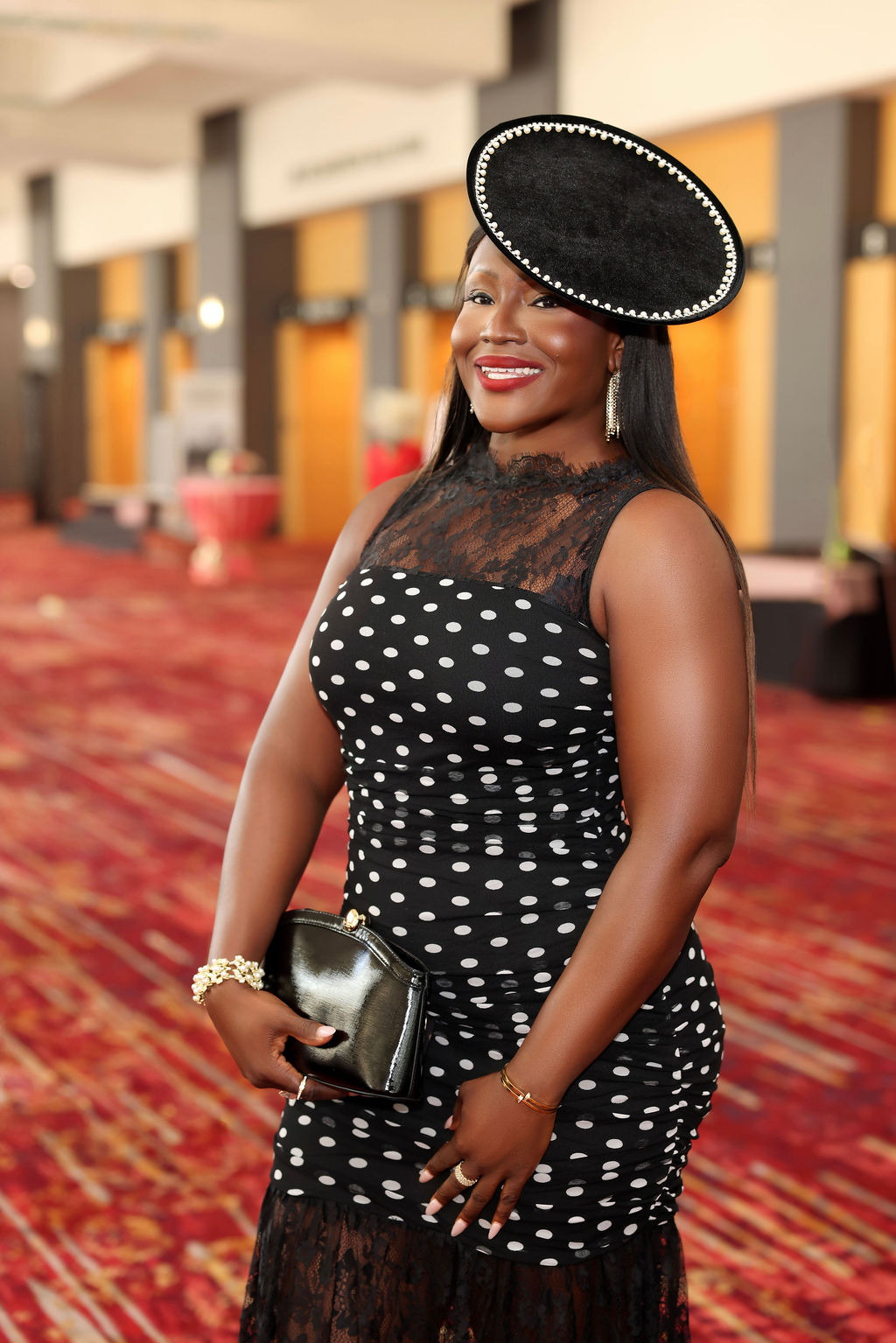
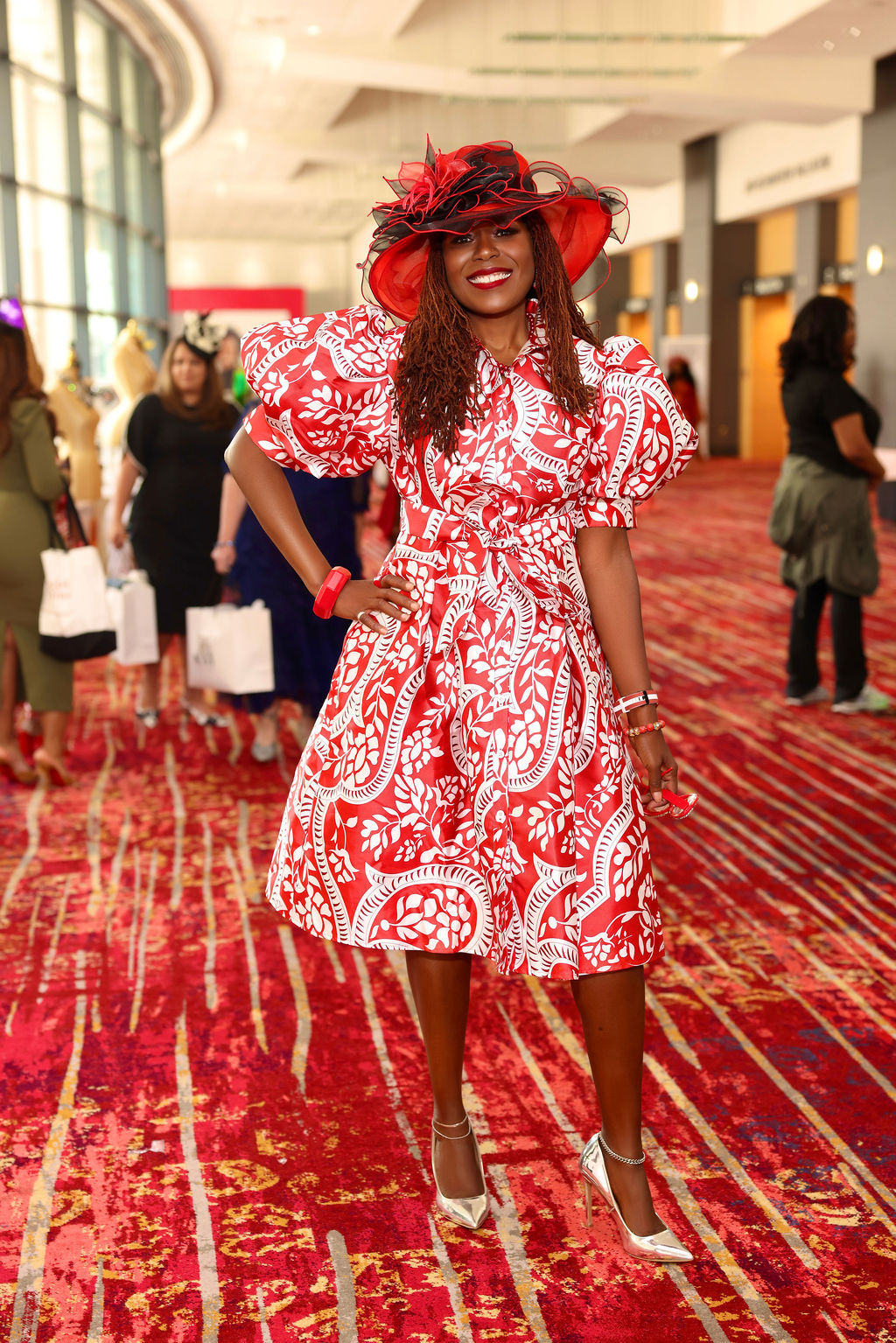
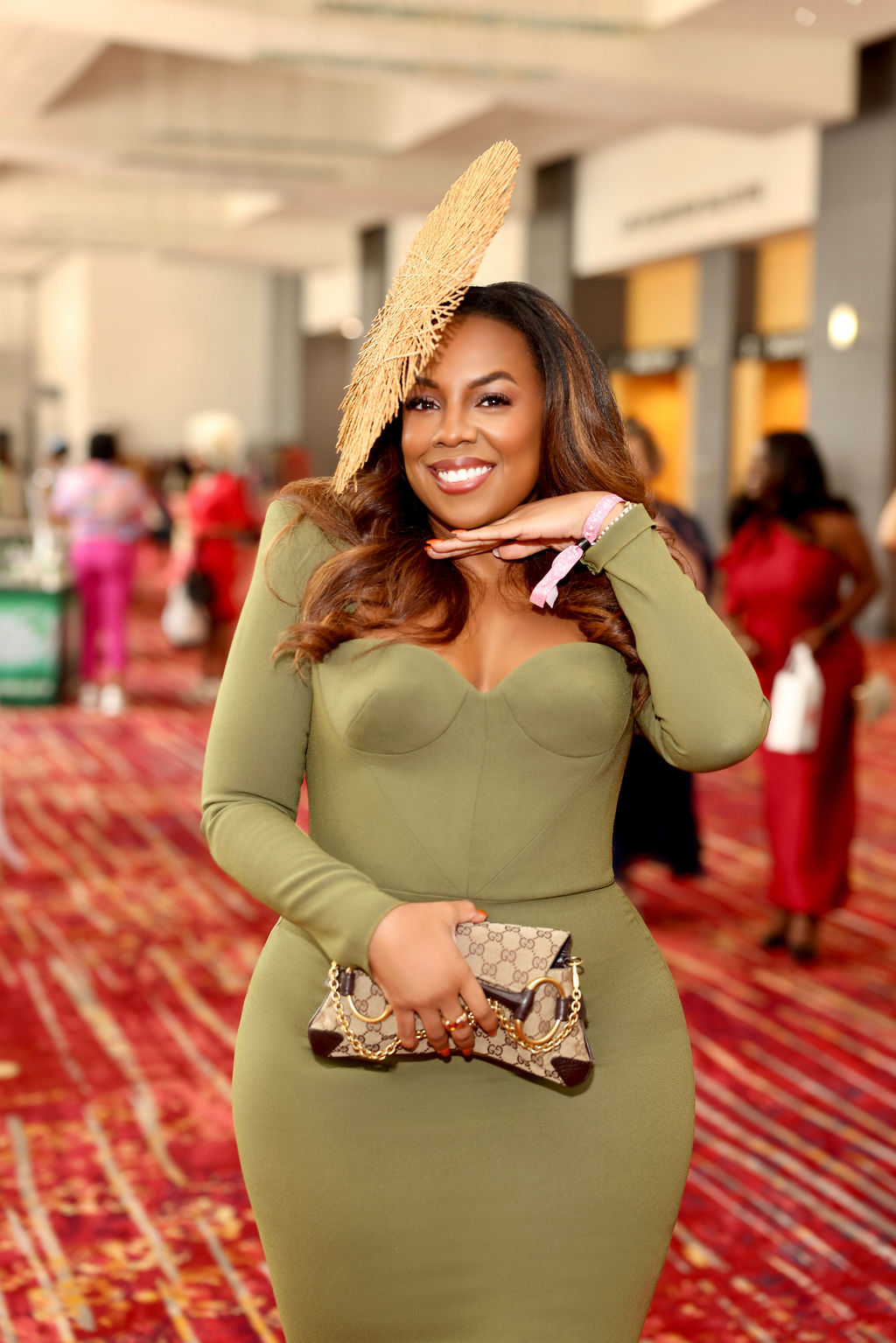
No UNCF North Carolina luncheon is complete without Hatitude, the signature competition where guests compete for the most stylish, creative, and dramatic hats across several categories.
Now a beloved tradition spanning over two decades, Hatitude has become synonymous with the luncheon itself, turning the room into a runway of Southern glamour and personal expression.
Among the standout looks was contestant Krystal Batts, who wore an Atoir dress, Coperni bag, and Tom Ford heels, topped off with a hat she found on Etsy that she described as both classic and bold.
Check out more of our interviews below:
Thank you to Tiffany, Kennedy, and the whole UNCF Team for having us! Until Next Year!
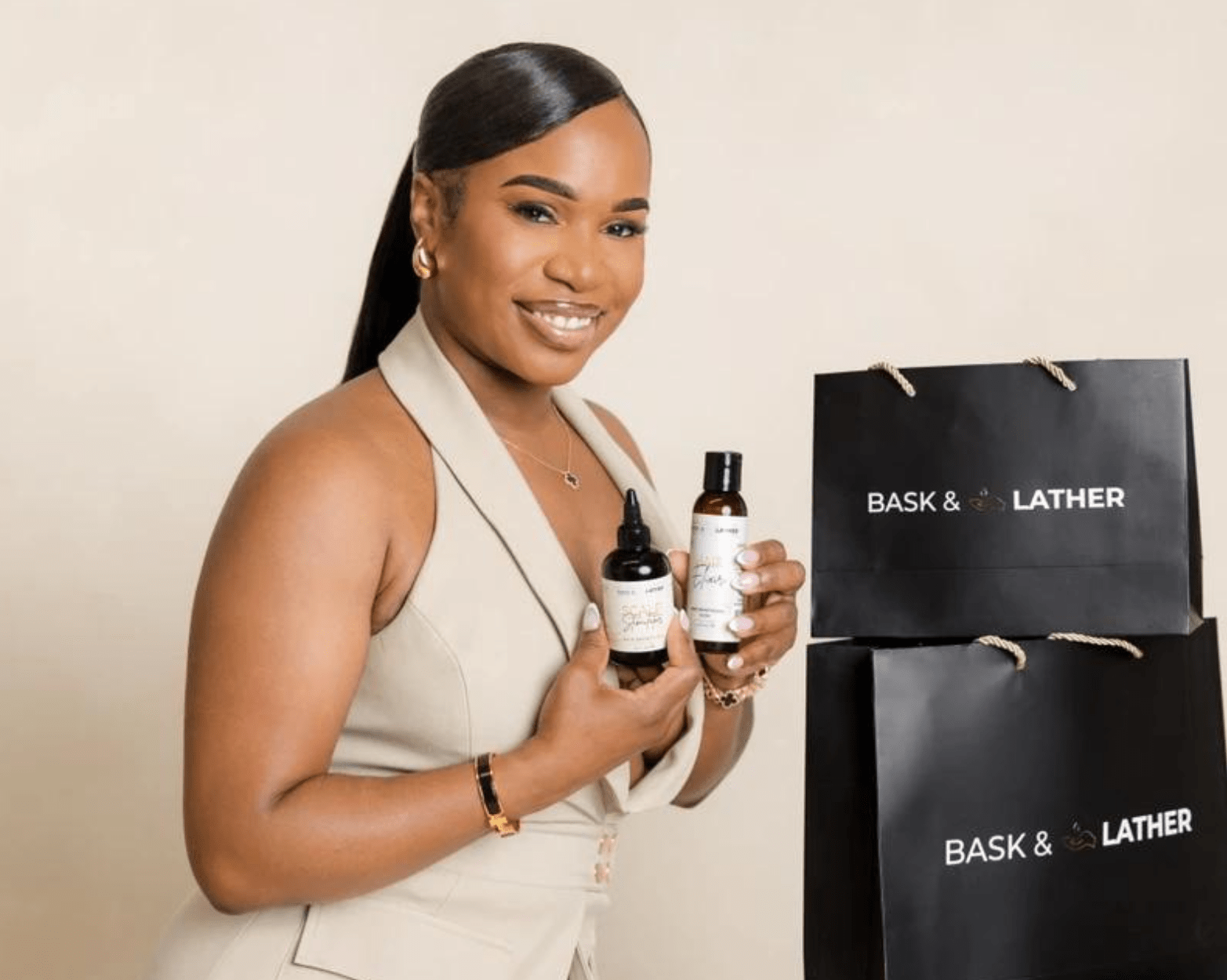
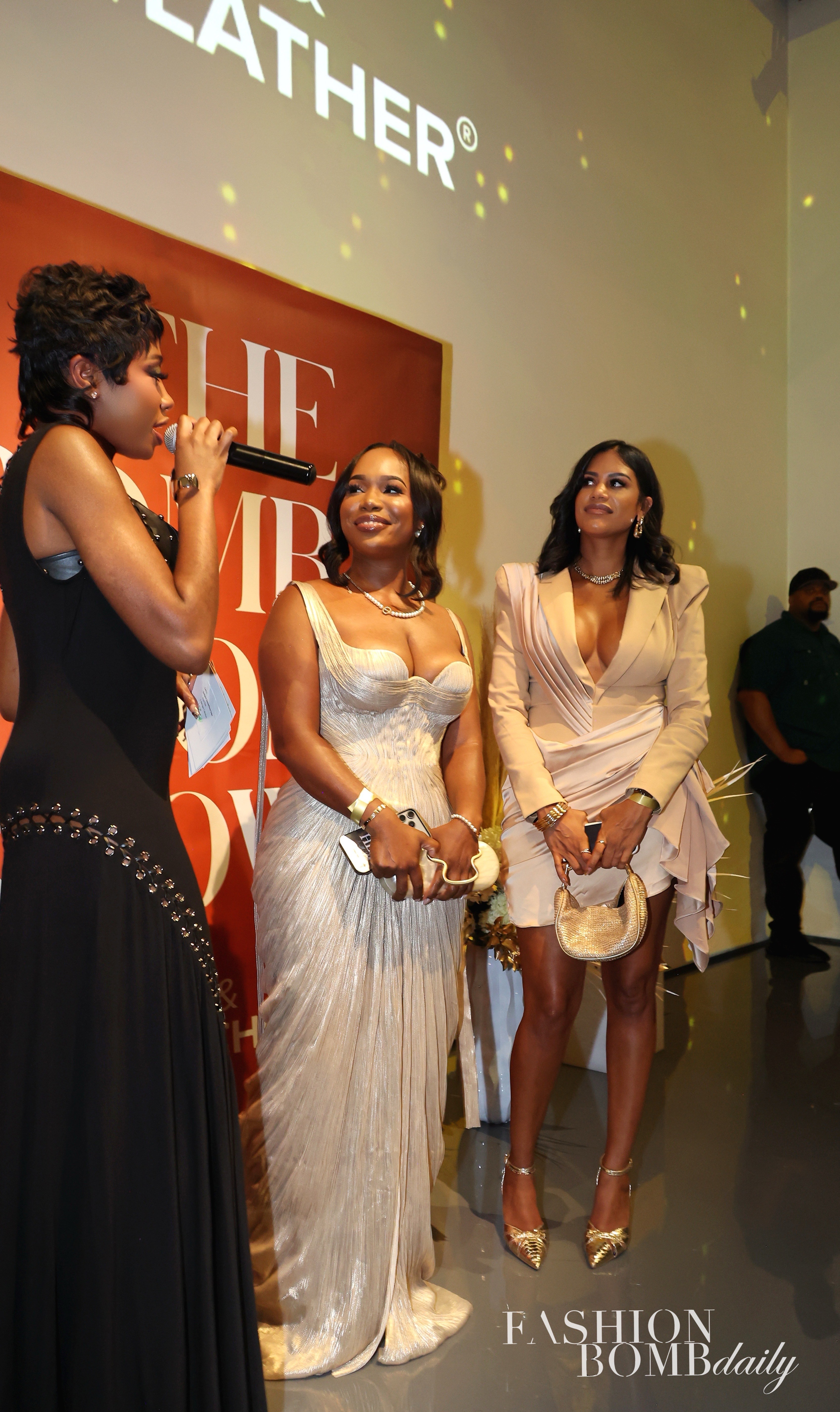
For Shaina Rainford, Bask & Lather Co. began with something deeply personal: family, hair loss, and a desire to find a solution that actually worked.
Today, that personal journey has evolved into a rapidly growing haircare company with a devoted community, a major social commerce presence, and a philosophy rooted in a refreshingly simple promise: “Grow It And Keep It Too.”
At the helm is Rainford, Founder and CEO of Bask & Lather Co., who launched the brand in 2020 after experiencing significant hair loss alongside her younger sister. Drawing inspiration from natural remedies and the Scalp Stimulator Hair Growth Oil originally created by her mother, Rainford transformed a family solution into a business centered on helping consumers nurture healthy hair and retain the length they work hard to achieve.
From a Family Remedy to a Growing Beauty Brand
Bask & Lather’s approach is centered on consistency, healthy routines and real results. Rather than treating scalp care as an afterthought, the brand encourages customers to think about the scalp as the foundation of their overall haircare regimen.
That message has resonated with consumers. Through social commerce, creator partnerships and an engaged online community, Bask & Lather has built significant demand and was recognized as a top haircare brand on TikTok Shop U.S. during both the first and second quarters of 2026.
Rainford’s entrepreneurial journey has also garnered recognition beyond beauty. According to her company biography, Bask & Lather achieved 1,400% growth between 2024 and 2025 and scaled without outside investors. Rainford was named to Inc. Magazine’s Female Founders 500 list in 2026, while Bask & Lather was recognized on the 2025 Inc. 5000 list of America’s fastest-growing private companies and selected for BeautyMatter’s 2026 FUTURE50 list.
The Bask & Lather Products to Know
At the heart of the brand is its Scalp Stimulator, one of Bask & Lather’s signature products. Made with cold-pressed oils and ingredients including rosemary and mint, hemp seed oil and grapeseed oil, the formula was created to nourish the scalp and support healthy scalp stimulation with regular use.
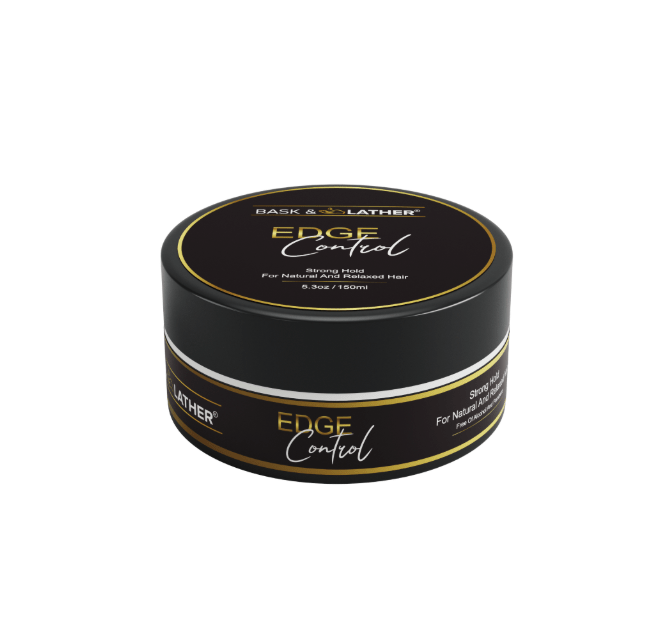
The Strong Hold Edge Controlhas also emerged as a bestseller. Formulated with ingredients including argan and castor oils, it was designed to lay and soften edges while delivering a strong hold without leaving behind white streaks. The formula works across hair textures, including natural, relaxed and 4C hair.
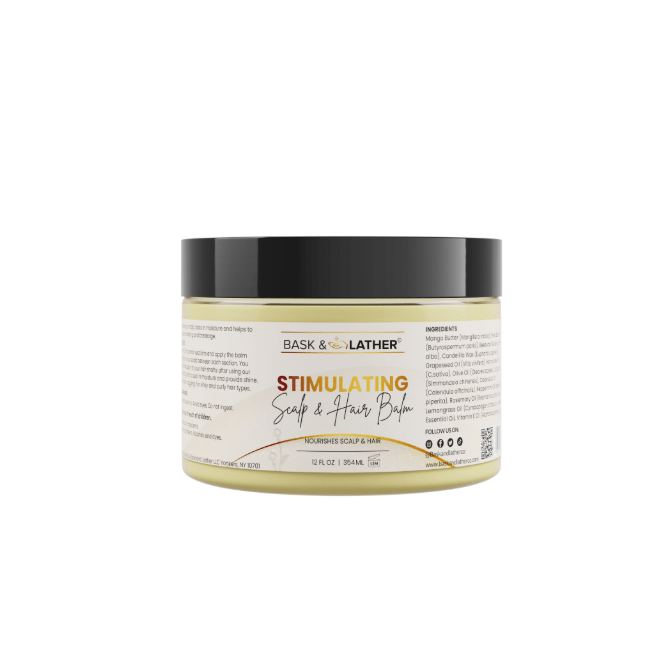
For additional moisture, the Stimulating Scalp & Hair Balm combines mango butter, shea butter, beeswax, grapeseed oil, jojoba oil, peppermint, rosemary, lemongrass, vitamin E and dried lavender in a targeted scalp and hair treatment.
Meanwhile, the lightweight Hair Elixir Oilfocuses on sealing in moisture, helping prevent breakage and supporting length retention with Jamaican black castor oil, apricot kernel oil, jojoba oil, lavender essential oil and vitamins B, C and E.
Introducing the Scalp Therapy System
Bask & Lather is taking its scalp-first philosophy even further with its new Scalp Therapy System, bringing dedicated scalp care into every stage of wash day.
The four-step collection includes a Scalp Soothing Pre-Shampoo to soothe and detangle; a Scalp Balancing Shampoo to gently remove buildup; a Scalp Restoring Conditioner to soften and detangle; and a Scalp Moisturizing Leave-In Treatment created to provide moisture while supporting length retention.
Across the collection, formulas incorporate ingredients such as aloe vera, mint, niacinamide, babassu oil, agave extract, rosemary, biotin and silk peptides.
It’s an expansion that feels particularly aligned with what Rainford has built from the beginning. Bask & Lather isn’t simply selling the idea of longer hair; the brand is encouraging consumers to develop the routines and scalp-care practices that can help them maintain healthy hair over time.
Shaina Rainford Is Building With Purpose
What makes Rainford’s story particularly compelling is the evolution from solving a problem within her own family to creating products now used by a much larger community.
As Bask & Lather continues to expand, Rainford remains closely connected to the brand’s original mission: real people, real routines and real results.
From a mother’s homemade hair oil to a nationally recognized beauty business, Bask & Lather’s trajectory demonstrates what can happen when personal experience, community and entrepreneurship intersect.
And with its newest collection placing even greater emphasis on scalp health, the brand’s message remains consistent: growing your hair is only part of the journey. Keeping it healthy is just as important.
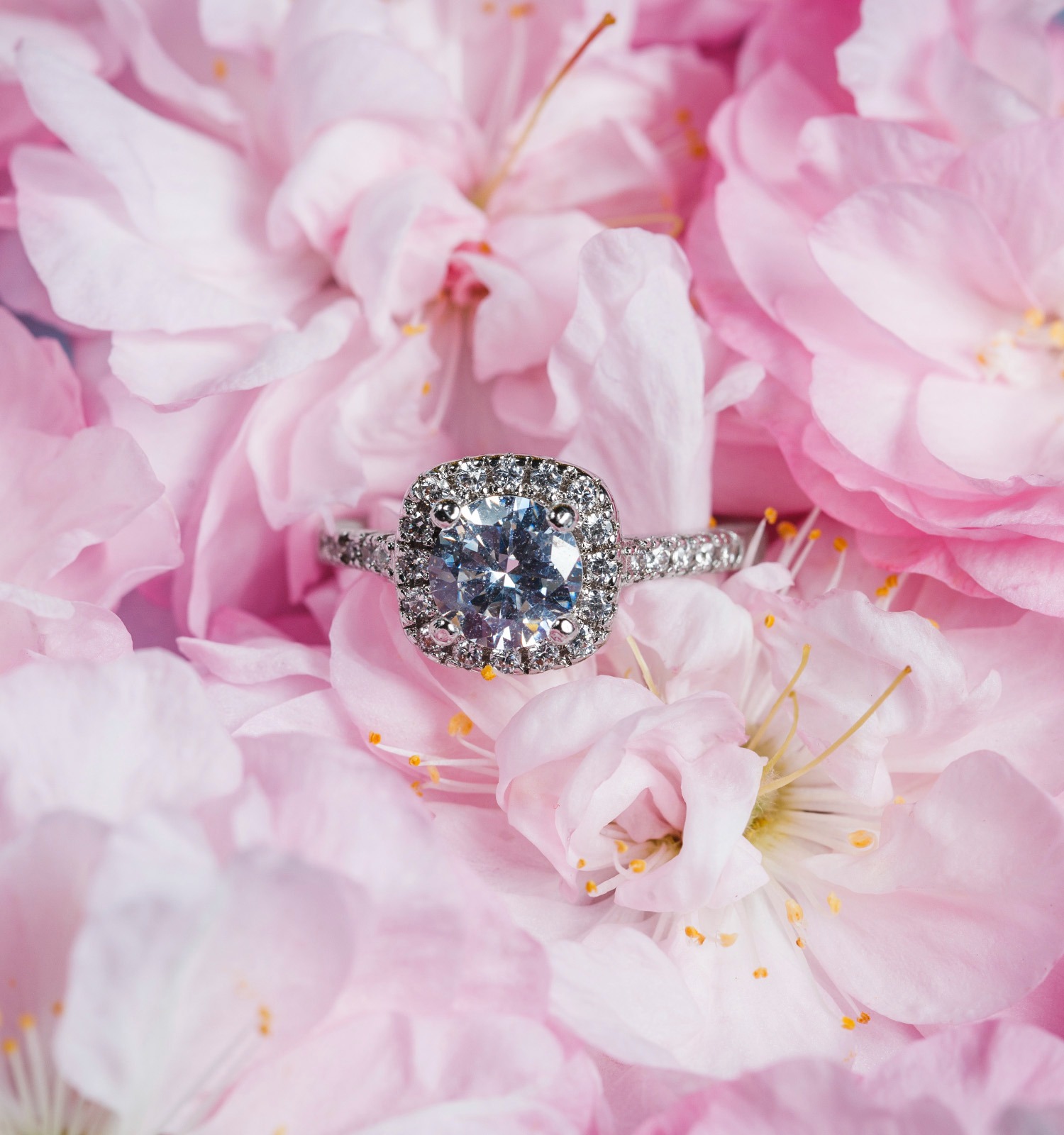
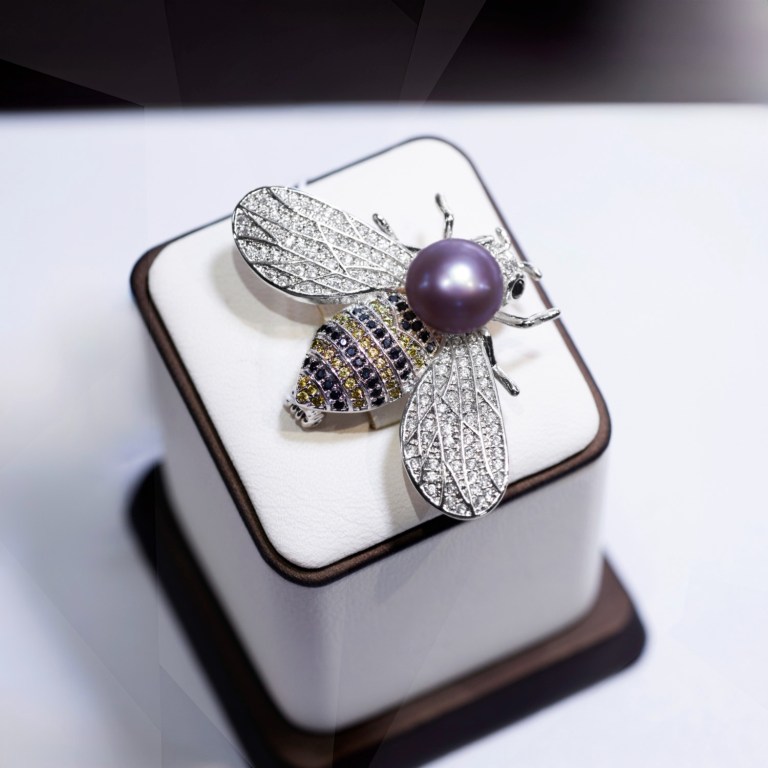
Jewelers have long associated platinum with American weddings – whether it’s an engagement ring, a wedding band, or an heirloom passed down through generations. This perception is evolving. Today, platinum is appearing more often in statement rings, sculptural necklaces, brooches, men’s jewelry, and custom jewelry designed to reflect an individual’s unique tastes instead of their wedding day. In fact, this change in how we view fine jewelry represents a larger trend: jewelry is becoming more about expressing who you are and your own sense of style.
From Bridal Classic to Jewelry That Says Something About Its Owner
The numbers suggest that platinum’s appeal is extending well beyond traditional wedding jewelry, making platinum jewelry trends in 2026 worth watching. According to PGI USA’s Retail Barometer (a study of 300 U.S. Jewelry retailers), sales of platinum jewelry outside of bridal rose by more than 24 percent in 2025. That figure applies specifically to non-bridal platinum jewelry, not to platinum sales overall. Olertis has recently reported seeing a similar shift among its own customers.
Clearly there are many reasons for this phenomenon. Consumers are increasingly looking for jewelry that feels personal rather than interchangeable. A statement ring does not have to be tied to a particular occasion. A necklace can be purely sculptural, while a brooch can feel like a work of art. For men, platinum offers a distinctive sense of weight and presence that other metals may not provide. Lastly, custom jewelry offers the opportunity to combine all of these elements together in one-of-a-kind pieces made for just one person.
In these custom pieces, platinum is no longer merely the base metal upon which a diamond sits. Instead platinum’s weight, scale, form, and naturally white color are incorporated into the bold design.
This matters because today’s luxury buyer is often looking for pieces with personal meaning. Once a piece of jewelry becomes part of someone’s signature style, then the material used in that piece becomes part of the statement.
What Makes Platinum Special for Design
Using the exact same design and making each version using platinum, 14K gold, and 18K gold will yield three products that are visually very different. The primary difference lies in density. Platinum is heavier than gold-based alloys. As stated by Jewelers of America, a ring or pendant containing 90% platinum can be approximately 60% heavier than a comparable 14K gold piece.
Because of platinum’s higher density, its mass can be felt in both statement and sculptural jewelry where size and scale matter. Without additional ornamentation, a substantial ring or necklace can feel more solid and weighty without needing more decoration.
Platinum is also inherently white in color and presents an ideal background for diamonds and colored gemstones. White gold can look similar when new, but it is commonly rhodium-plated to achieve its bright white finish. Unlike white gold, platinum does not require this process.
When rhodium plating begins to wear off, white gold may need to be replated to maintain its brightness and original appearance. However, unlike white gold, platinum develops a beautiful patina after prolonged wear. The finish of platinum can be polished to reveal a fresh surface. Many owners appreciate the softer appearance and unique character that develop naturally over time.
There is also a connection to the idea of individuality. Like its wearer, platinum jewelry can develop character over time rather than remaining permanently “brand-new.”
Compared to some 14K and 18K gold alloys, platinum is relatively soft, which means that it scratches differently and displaces metal at the surface as opposed to removing it entirely. As a result of this property, platinum retains much of its metal over many years of wear — an essential trait for fine jewelry that is expected to be passed down as an heirloom.
Why Platinum Can Cost More Even When It Costs Less per Gram
Platinum has historically traded at a premium to gold. Today, however, that relationship has reversed. Platinum currently trades well below pure gold – around $58 per gram versus roughly $142 for gold, based on September 2026 market quotes. However, this does not mean that finished platinum jewelry will be cheaper.
Platinum’s higher density means that the same physical design generally requires more metal by weight. A platinum ring would generally contain more grams than an equivalent gold ring.
While purity is relevant, it is not the reason platinum jewelry tends to cost more than similar 14k gold jewelry. Most platinum jewelry consists of 95% platinum whereas 14k gold consists of 58.3% gold. Doing simple math regarding a single gram shows clearly that the pure gold within a gram of 14k gold is worth more than the platinum contained in a gram of platinum jewelry.
Ultimately, the difference in the price of a finished piece comes from the work required to turn the metal into jewelry. Working with platinum involves specialized tooling and techniques and finishing processes are often more time-consuming. Custom jewelry presents an example where each aspect including contours, settings, and surfaces must be individually crafted and completed for the specific design.
The final price of a platinum piece reflects far more than its weight: design, gemstones, construction, craftsmanship and finishing all play a role. That is why a piece of platinum jewelry may have equal or greater value than an equivalent piece created in 14k gold regardless of whether platinum costs less per gram.
Choosing platinum can be about more than the material itself – it can be about exclusivity, durability, presence and the experience of owning something created specifically for the wearer.
Thus, the story behind platinum’s current pricing trends becomes compelling. Customers are still selecting it even when commodity pricing no longer presents it as the obvious option.
Why Platinum Could Become More Than a 2026 Fine Jewelry Trend
Customization creates a separate landscape within the fine jewelry market.
Although broadening consumer awareness and growth in customization remain positive developments within fine jewelry markets globally, the overall outlook is gloomier. According to data released by the World Platinum Investment Council in their May Platinum Quarterly publication, global demand for platinum jewelry is forecast to decline by 12% in 2026 while demand is expected to decline by 7% in North America alone. The decline is largely tied to the sharp rise in platinum prices, which had roughly doubled from a year earlier; even strong customers tend to reduce consumption of platinum once costs increase enough. These figures describe the broader platinum jewelry market rather than the custom segment.
This is not an industry-wide statistic; it reflects what one company is seeing. It is significant nonetheless because it contrasts with the broader North American forecast rather than simply tracking alongside the category.
The company’s experts expect demand for customized platinum fine jewelry to continue increasing in 2027, even if demand decreases across other segments of the fine platinum jewelry market in North America.
The practical differences are most evident in what customers request for their custom pieces.
They typically request statement rings with unexpected proportions, necklaces built around distinctive shapes, large men’s pieces with platinum’s substantial heft, or designs featuring the properties inherent to the metal itself as part of its aesthetic appeal. Additionally, customers are drawn to platinum’s naturally white color, its heft, durability, or the patina it develops on its surface over time.
These requests differ from customer inquiries related to viewing options available at retail stores. They represent requests to design something that is personal.
And that may be platinum’s next chapter: moving from America’s iconic bridal metal to a more versatile luxury material for personal jewelry — chosen for its design, character, and presence rather than simply because tradition says so.