

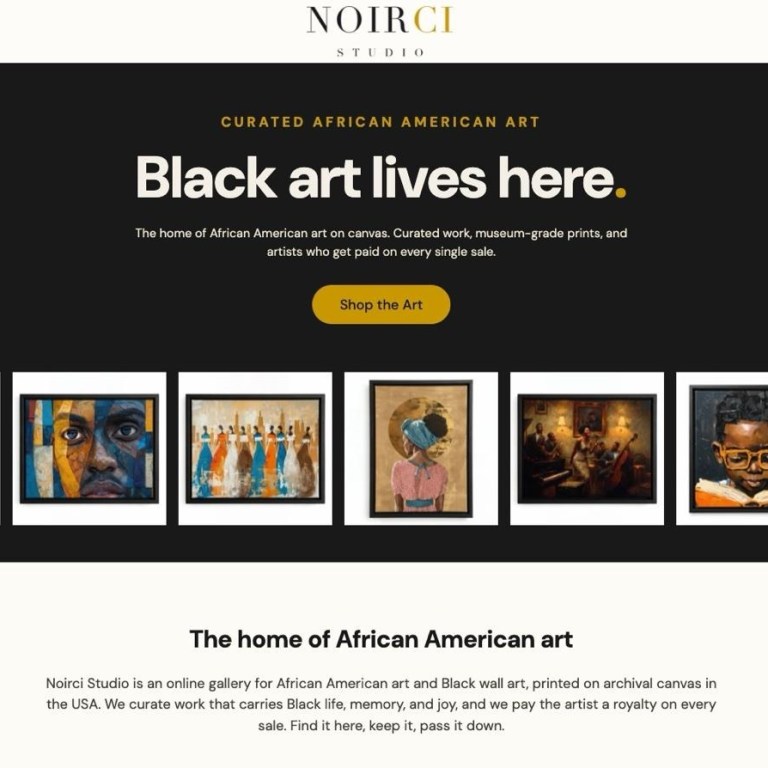
Noirci Studio is a Black-owned online shop and art marketplace where you can buy African American wall art prints, archival canvas pieces made from original paintings by Black artists. Maybe you’ve been searching for where to buy Black art online, from Black woman art and Black love art to Harlem Renaissance jazz portraits and Afrocentric abstracts. This marketplace answers with artwork sourced from original works and free US shipping.
The story starts with a painter, not a warehouse. Robert Lawrence, an Atlanta-raised artist who has been painting since 2006, founded Noirci Studio in 2024 and runs it from Plano, Texas. Every piece on the site begins as an original work. The originals stay with the artists who made them. What you buy is a museum-grade giclée canvas checked against the source work, and much of the catalog is released in limited editions backed by a certificate of authenticity.
“I kept watching Black art get sold everywhere except by us,” Lawrence says. “Somebody else’s warehouse, somebody else’s margins, no artist’s name anywhere on the page. I built the store I couldn’t find.”
That model matters more than it sounds. Usually, “Black art print” on the big marketplaces means an open-ended digital file run off on demand, with no edition, no provenance, and no guarantee a Black artist saw a dime. Here the terms are inverted. Artists earn a royalty on every sale, each canvas is verified before it leaves the printer, and editions are capped across much of the catalog.
Where to buy Black art online, without the guesswork
Type “buy Black art online” into any search bar and you’ll drown in options. Etsy alone returns thousands of listings of uneven quality, and the mass-market decor sites sell African American canvas wall art with no artist name attached at all.
Curation is the fix. Noirci Studio carries a curated, browsable catalog organized the way people actually shop, by subject, style, and feeling. Collections cover a wide range of themes including Black woman art, Black love art, Black family pieces, Afrocentric and Afro-boho decor, jazz, and faith-centered work. You can move from a themed collection to a single product page in two clicks, and every page reads like a dossier. With the artwork’s backstory, materials, sizing, and framing laid out in plain language.
Spend a minute inside the collections and the personalities emerge. In the Harlem Renaissance line there’s Lady Day, a vocalist caught at the exact second the club goes quiet, eyes closed, one hand cradling the mic, gold sequins glittering under amber lanterns while her band works in the smoky dark. Golden Crown gives you a woman with her back to the viewer, a disc of burnished gold rising behind her head like a halo she earned, teal headwrap knotted over natural curls. And Held Close, from the Black love collection, is two people forehead to forehead against a plain cream field, her marigold dress and his burnt-orange shirt the only color the moment needs.
These aren’t stock figures. They’re scenes with weather in them.
Art that teaches while it decorates
Educational value is baked into the browsing. Each piece names its themes, so a canvas like Black Boy Joy, a young reader in orange glasses lost in a book, arrives with context about curiosity and possibility rather than a bare product shot. The Noirci Studio Journal, the marketplace’s art education center digs deeper, with plain-spoken guides on what home decor, how certificates of authenticity work, the history behind Black art, and new artist on the rise.
For a first-time collector, that turns a purchase into a small education. For parents, it means the art on a child’s wall can start a conversation.
Priced for real walls
Accessibility here is a price tag, not a slogan. Rolled canvas starts around $60, ready-to-hang stretched pieces occupy the middle of the range, and floating-framed formats in walnut, gold, silver, or black cost a fraction of what a gallery original would. Sizes start at 12×12 inches and climb from there.
“The price of the 12×12 was a decision, not an accident,” Lawrence says. “A teacher furnishing her first apartment should be able to own a real piece with the artist’s name behind it. That’s who I picture when we set prices.”
Free US shipping applies to every order, returns are accepted for 30 days, and each canvas is printed in the USA on archival poly-cotton with pigment inks rated to last generations. Nothing about the experience assumes you already know how to buy art.
Built for everyone who’s been left out of the art world
Inclusivity shows up in the subject matter first. Black women crowned and at rest, Black fathers with daughters, boys reading, couples dancing, elders and church pews and city stoops. It’s a catalog where Black collectors see themselves without translation, and where anyone furnishing a home can find work that carries meaning.
It also shows up in the business model. The marketplace framing is deliberate. Lawrence built the platform to carry other Black artists’ work alongside his own, with a royalty attached to every sale. In an industry where Black artists have historically been collected but rarely paid fairly, a standing royalty is structural support, not charity.
Styling it, gifting it
Most of this catalog was made with specific rooms in mind, and the product pages say so. A Black love canvas over the headboard changes a bedroom. The reading boys and tribal girls belong in nurseries, kids’ rooms, and classroom corners. Jazz portraits settle into offices and dens, while the Afrocentric abstracts hold their own above a sofa in a busy living room.
That specificity makes gifting simple. Collectors reach for these canvases as housewarming gifts, wedding presents, graduation markers, and upgrades for an office that needs one. Ready-to-hang formats arrive with hardware installed, so the recipient does nothing but choose a nail.
The bottom line
Noirci Studio sits in a gap the art market left open, more accountable than a print-on-demand feed, more affordable than a gallery, and built to pay Black artists on every sale. The shop makes African American art prints collectible in the literal sense, verified originals, documented provenance, numbered editions on much of the catalog, while keeping the door open to anyone with sixty dollars and a bare wall.
“Collectible was never about scarcity games,” Lawrence says. “It’s about respect. A numbered edition says this picture mattered enough to count.”